

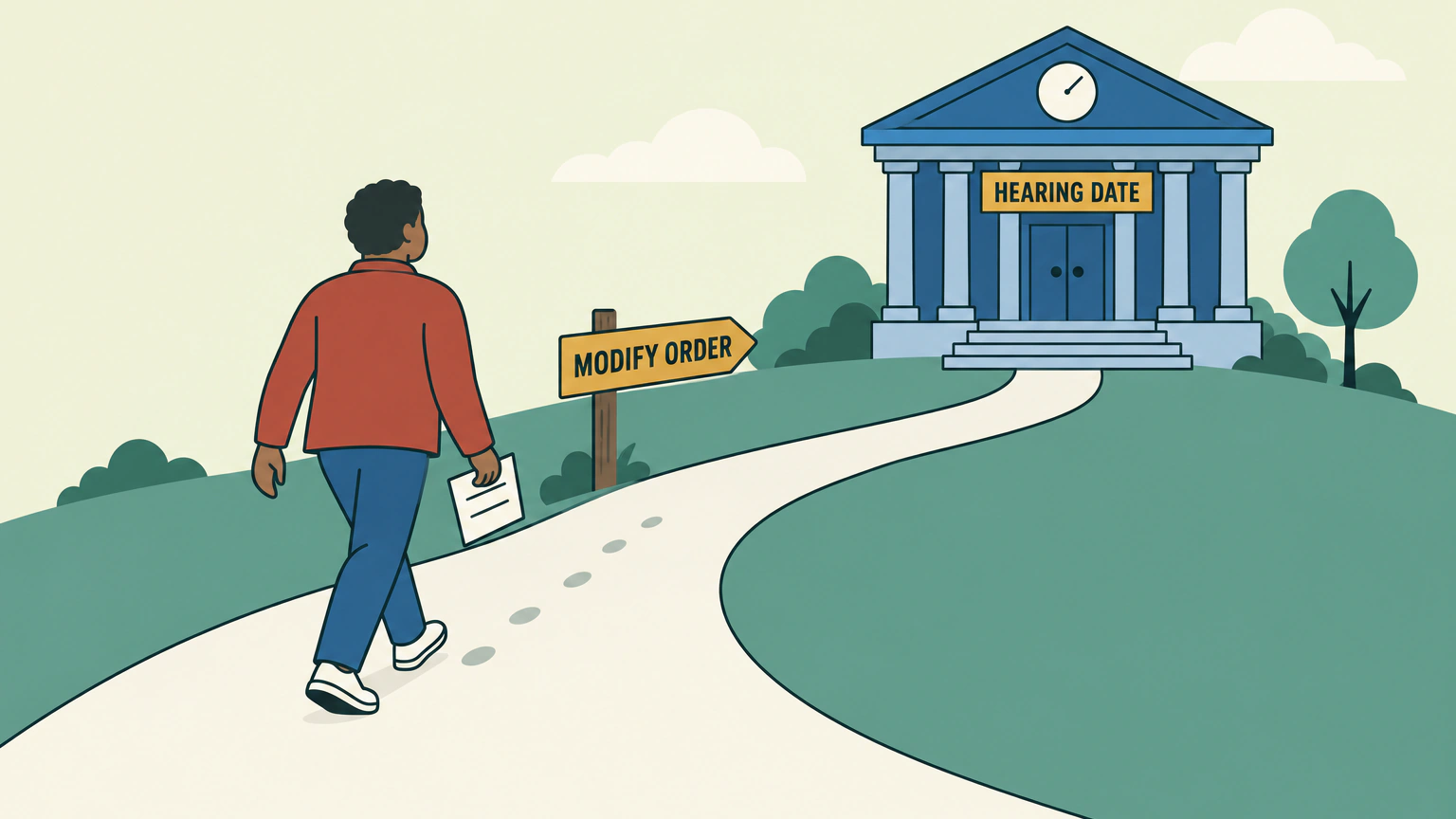
There's no set number of missed payments that gets a warrant issued. Jail for contempt comes after a hearing. In Texas, a judge can order your arrest if a contempt motion was personally served and you skip the hearing. At the hearing itself, the judge's central question is whether you could actually pay. The fixed numbers belong to other tools. Your passport can be blocked once your state certifies that you owe more than $2,500. Federal law makes nonpayment a crime at more than $5,000 or more than a year unpaid when your child lives in another state.
So the warrant turns on something you control. Everything else runs on a number, and you deserve to know each one.
On this page
There's no set number of missed payments
Nobody can honestly give you a payment count, and here's why. Federal law makes every state treat each child support payment as a court judgment on the day it's due. So the first payment you miss is already a debt the other parent or the state can enforce. There's no grace period and no minimum.
What turns that debt into a warrant is one of two roads. One is a contempt case, where a family court decides whether you disobeyed its order. The other is a criminal charge, brought by a prosecutor. Each road has its own trigger, and neither one is a simple dollar figure.
The other consequences work differently. They do run on numbers, and most of them can start without anyone putting you in front of a judge.
Table A: Every consequence, and when it can start
| What can happen | When it can start | The law |
|---|---|---|
| Arrest in a contempt case | No dollar amount. In Texas, when you were personally served with a contempt motion and don't appear | Tex. Fam. Code § 157.114 |
| Federal tax refund taken | $150 or more, if the support is owed to the state; $500 or more in other child support agency cases | 45 C.F.R. § 303.72(a) |
| Passport refused or revoked | More than $2,500 past due, once your state certifies it | 42 U.S.C. § 652(k) |
| Driver's or professional license suspended | Each state sets it. Texas: 3 months of support overdue plus a missed repayment plan | 42 U.S.C. § 666(a)(16); Tex. Fam. Code § 232.003 |
| Reported to credit bureaus | Any past-due support, after notice and a chance to dispute the amount | 42 U.S.C. § 666(a)(7) |
| Lien on your property | Automatically, once support is overdue | 42 U.S.C. § 666(a)(4) |
| Federal crime (child lives in another state) | More than $5,000 or more than 1 year unpaid; up to 2 years in prison past $10,000 or more than 2 years | 18 U.S.C. § 228 |
| State crime | Depends on your state; see Table B | State statutes |
Of everything on that list, arrest is the one that keeps people awake. Start with the contempt road, because it turns on the one thing you control: showing up.
How a contempt case turns into a warrant
It usually starts with paperwork. The other parent, or the state child support agency, files a motion asking the court to enforce your support order and hold you in contempt. Contempt of court means disobeying a court order. It's the heavy tool, the one with jail on the table, and it tends to come out when a parent is far behind rather than a month late. You're served with the motion, and the court sets a hearing.
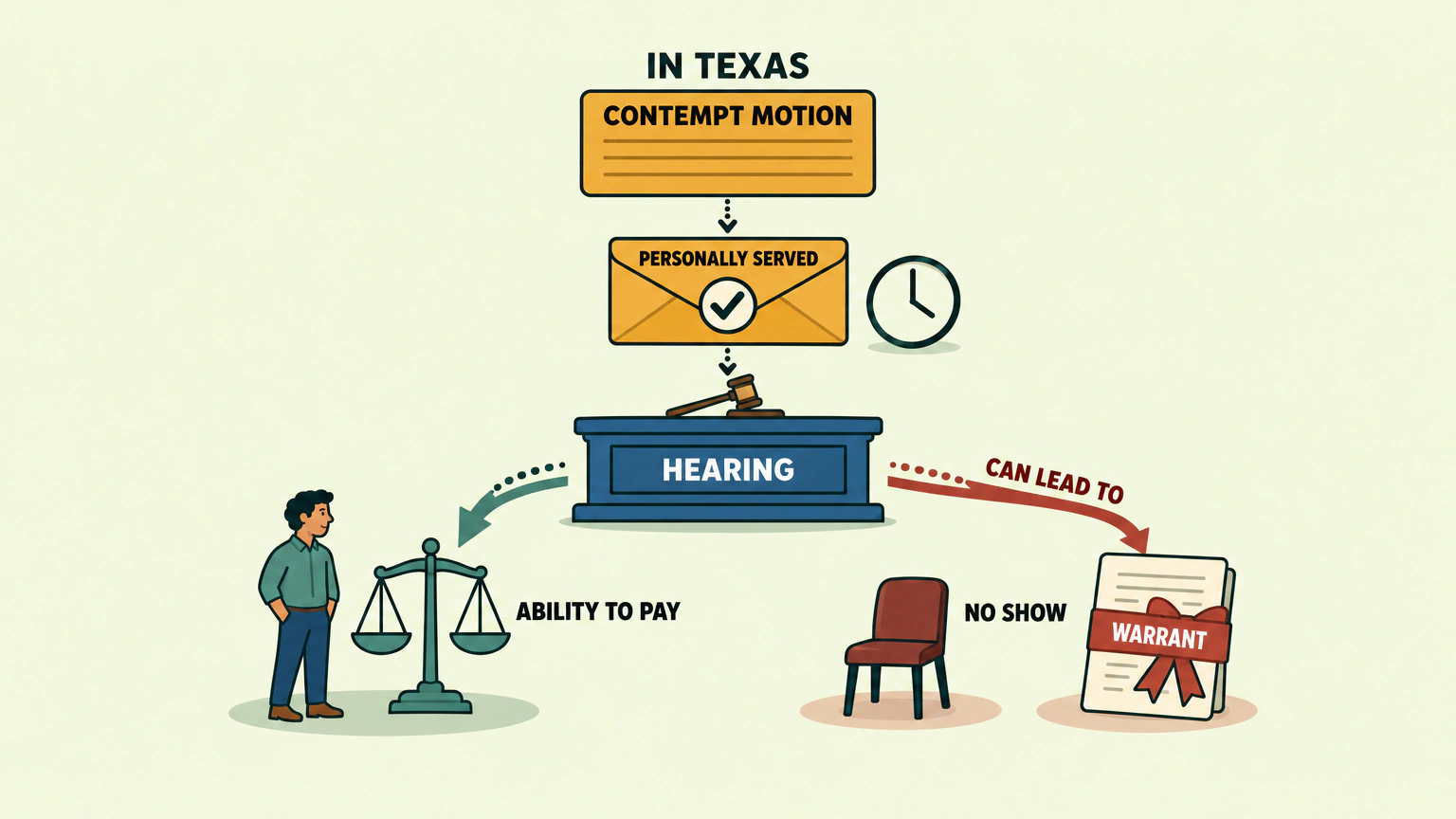
Texas spells out what happens next. Its Family Code says the court "may order a capias to be issued for the arrest of the respondent" when three things are true. The motion asks for contempt. You were personally served. And you don't appear. A capias is Texas's word for what most people call a bench warrant for child support: an arrest order a judge issues from the bench. The same code says the court can't find you in contempt while you're absent. It can order your arrest so you're brought in.
The hearing you skip is more dangerous than the balance you owe.
What happens at a child support contempt hearing
Show up, and the judge's question changes. Could you have paid, and did you choose not to?
The Supreme Court dealt with exactly this in Turner v. Rogers in 2011. A South Carolina father was $5,728.76 behind and got 12 months in jail for civil contempt. The judge never decided whether he could pay. The Court said a parent in his spot, with no lawyer on either side, doesn't automatically get a free one. Instead, he's owed safeguards: clear notice that ability to pay is the main issue, a form or questions that draw out his finances, a real chance to answer, and "an express finding by the court that the defendant has the ability to pay." In cases the state child support agency handles, federal rules tell it to screen for ability to pay and to warn you that it "constitutes the critical question in the civil contempt action."
That's where your financial affidavit matters most. It's the sworn form listing your income and every expense. If it shows money going to things you didn't need while support went unpaid, "I couldn't pay" falls apart fast. Fill it in accurately and completely. Don't pad it, and don't shave it.
Civil contempt jail is meant to end the moment you do what the judge ordered. That's why the judge has to believe you can do it.
When unpaid support becomes a crime
The second road has a different driver. In a criminal case, a prosecutor brings the charge, not the other parent. And a balance alone isn't enough: state nonsupport laws require a failure that's willful, knowing or without a lawful excuse. Several states give you a defense if you truly couldn't pay, including Texas, Nevada and Colorado. Arizona's version has a catch: it won't help a parent who "voluntarily remained idle." We'd call one of the criminal defense attorneys in your county before saying a word about a charge to anyone else.
The federal line, if your child lives in another state
Federal law reaches only two situations. Either your child lives in a different state from you, or you crossed state lines or left the country to dodge paying. In the first case, willfully skipping support becomes a federal crime once the unpaid amount passes $5,000 or has stayed unpaid more than a year. A first offense carries up to 6 months. Past $10,000 or more than two years unpaid, the maximum rises to 2 years in prison. Traveling to evade support carries the same maximum after that first threshold is crossed. If you're convicted, the court must order you to repay everything you owe. The law also presumes you were able to pay for the whole period charged, though you can try to prove otherwise.
This is the rule behind the $5,000 and $10,000 figures you'll see quoted online. It doesn't apply when you and your child live in the same state.
How much back child support is a felony in your state
Each state writes its own nonsupport law, and they fall into four patterns. In some, the felony turns on a knowing or willful failure to support, not a dollar or time threshold. Others draw a line in dollars or months. New York needs a prior conviction first. And some states have no felony tier at all.
Of the 14 states we checked, four have felony nonsupport laws with no dollar or time threshold: Arizona, Colorado, Oregon and Texas. Four draw a dollar or time line, and four have no felony level. California sits apart, because its misdemeanor can become a state prison term once a court has ruled you're the parent. You'll see $2,500 quoted online as a misdemeanor line for California. California's statute has no dollar line at all.
Table B: When unpaid child support is a crime, in 14 states
| State | The law | Basic charge | When it becomes a felony |
|---|---|---|---|
| Arizona | A.R.S. § 25-511 | Class 6 felony | No dollar or time threshold; knowing failure to provide reasonable support |
| California | Penal Code § 270 | Misdemeanor: up to 1 year in county jail, up to $2,000 fine | Once a court has ruled you're the parent, a state prison term of 1 year and 1 day is possible |
| Colorado | C.R.S. § 14-6-101 (2025 edition) | Class 5 felony | No dollar or time threshold; willful failure to provide reasonable support |
| Florida | Fla. Stat. § 827.06 | First-degree misdemeanor | $5,000 or more owed for more than 1 year, or a fourth or later conviction |
| Maryland | Md. Code, Fam. Law § 10-203 | Misdemeanor: up to 3 years, up to $100 fine | No felony level |
| Minnesota | Minn. Stat. § 609.375 | Misdemeanor: up to 90 days | After an attempt to obtain a contempt order: more than 180 days unpaid, or arrears of at least 9 times the monthly amount |
| Missouri | Mo. Rev. Stat. § 568.040 | Class A misdemeanor | Arrears over 12 monthly payments |
| Nevada | NRS 201.020 | Misdemeanor | $10,000 or more owed, or $5,000 or more on a second offense |
| New York | Penal Law §§ 260.05, 260.06 | Class A misdemeanor | A prior nonsupport conviction within 5 years |
| Oregon | ORS 163.555 | Class C felony | No dollar or time threshold; knowing failure to provide support, with lawful excuse as a defense |
| South Carolina | S.C. Code § 63-5-20 | Misdemeanor: up to 1 year, $300 to $1,500 fine | No felony level |
| Texas | Penal Code § 25.05 | State jail felony | No dollar or time threshold; intentional or knowing failure, with inability to pay as a defense |
| Virginia | Va. Code § 20-61 | Misdemeanor: up to 12 months, up to $500 fine | No felony level |
| Washington | RCW 26.20.035 | Gross misdemeanor | No felony level |
Live in another state? Search your state legislature's own website for "nonsupport" or "failure to support," call your state child support agency, or ask a local family lawyer. If a charge could send you to jail, you may have a right to a free lawyer, so check whether you qualify for a public defender as soon as you're charged.
Passports, licenses and tax refunds
Passports and tax refund offsets run through agencies. License suspension follows state law, and the process can include notice and a hearing.
Passport. Once your state certifies that you owe more than $2,500, the State Department must refuse you a passport and can revoke the one you have. Paying your balance down below $2,500 doesn't release you, and that's the part that catches people. The federal child support office says you stay in the program until the state that certified you asks for your removal, your balance reaches zero, or "the case is deleted." So if you need to travel, the deal to make is with that state.
Tax refund. Your federal refund can be taken at $150 when the support is owed to the state, which usually means your child's household got public assistance. In other cases the state agency handles, the line is $500.
Licenses. Federal law requires every state to have the power to suspend driver's, professional and recreational licenses for overdue support. Each state sets its own trigger. Texas uses three months of support overdue plus a repayment plan you were offered and didn't keep.
Credit reports. The state reports past-due support to the credit bureaus. First, though, you get notice and a chance to dispute the amount.
Questions people ask about child support warrants
How many child support payments can you miss before you go to jail?
There's no set number. Each missed payment is already an enforceable debt on the day it's due. Jail comes one of two ways: a contempt finding after a hearing where the judge weighs whether you could pay, or a criminal conviction. In Texas, a judge can order your arrest if a contempt motion was personally served and you skip the hearing.
How much back child support is a felony?
It depends on your state. Arizona, Colorado, Oregon and Texas have felony nonsupport laws with no dollar or time threshold. Each still requires a knowing or willful failure. Florida's line is $5,000 owed for more than a year, Nevada's is $10,000, and Missouri's is twelve monthly payments. Federal law adds a felony above $10,000 or after more than two years unpaid when your child lives in another state.
How much child support do you have to owe to lose your passport?
More than $2,500. Once your state certifies you, the State Department refuses new passports and can revoke the one you hold. Paying the balance down below $2,500 doesn't clear it. You stay blocked until the certifying state asks for your removal, the balance hits zero, or the case is deleted. If you need to travel, make your payment arrangement with the state that certified you.
Can child support take your tax refund?
Yes. The federal refund offset kicks in at $150 when the support is owed to the state, and at $500 in other cases your state's child support agency handles. If you filed jointly and the debt belongs only to your spouse, you can ask the IRS for your share back through injured spouse relief.
Can child support suspend your driver's license?
Yes. Federal law requires every state to have the power to suspend driver's, professional and recreational licenses for overdue support, and each state sets its own trigger. In Texas, it takes overdue support equal to three months of payments plus a repayment plan you were offered and didn't keep. Call your state child support agency and set up payments before the suspension date.
Will filing bankruptcy stop child support collection?
No. The automatic stay, the legal freeze on most collection that starts when you file, doesn't stop income withholding for support, license suspension, credit reporting, tax refund interception or a criminal case. A discharge doesn't wipe out past-due support either. Bankruptcy can still help with your other debts, and bankruptcy attorneys can tell you whether filing is worth it for those.
Can you become a US citizen if you owe child support?
Possibly, but it's a real obstacle. Federal immigration rules say that willfully failing to support your dependents during the period your application covers means you lack good moral character, unless you show extenuating circumstances. Naturalization requires good moral character. Bring a current payment statement from your state child support agency to the interview.
What to do this week if you're behind
Start with the date rule, because it's the one that costs people money. Federal law says a past-due payment is "not subject to retroactive modification." Your order can be lowered only as far back as the date the person owed support got notice of your request. Every month you wait is a month you'll owe in full, even if your income fell to zero.
That's unfair when a layoff hits and the order doesn't budge, and you're right to be angry about it. But it's the rule. So file for modification the week your income drops. You can go through the court or through the state child support agency. If the agency enforces your order, it has to review the order when you ask. Outside the regular three-year cycle, you'll need to show a substantial change in your circumstances, so bring proof of what changed. If you've been jailed, federal rules say "incarceration may not be treated as voluntary unemployment" when your order is set or changed.
Then do the plain things. Pay what you can through the official channel and keep proof. Answer every letter. Never skip a hearing. Family law attorneys can file the request for you and stand beside you at a hearing.
If you're the parent who's owed
You don't have to wait for a warrant. Ask your state child support agency to enforce the order, or file your own motion to enforce or for contempt. Enforcement tools run side by side, so a passport block or a refund offset can collect money without anyone going to jail.
What you can't do is keep the children from the other parent. Support and parenting time are separate orders. Texas law says a court can't make support depend on whether the other parent gets time with the child. Withholding visits can put you in contempt of the parenting-time order. In Texas, a court can even suspend the license of a parent it has found in violation of a possession or access order. If the fight has spilled into custody, custody and visitation attorneys handle exactly that.
If you think there's already a warrant
This is frightening, and hiding from it only raises the stakes. Our advice: call the clerk of the court that issued your support order and ask whether a warrant or capias is active in your case. Then talk to a family lawyer before you walk in. Coming back to court by choice, with a lawyer beside you, looks nothing like being picked up at a traffic stop.
We're not your lawyer, and once a hearing date or a warrant is in the picture, a family or criminal defense lawyer in your county can tell you in one call what your judge will expect.
Whatever brought you to court, walk in with your paperwork in order.
Take these to your contempt hearing
- Your support order and every notice or motion you've been served with.
- A payment history from the state child support agency, plus receipts for anything you paid another way.
- Proof of your income for the months you fell behind: pay stubs, a layoff letter, benefit statements.
- Your job applications and interview dates if you were out of work.
- Medical or disability records if you couldn't work.
- Your financial affidavit, filled in accurately, with every expense on it.
- Your modification request and proof of the date the person owed support got notice of it.
- A monthly payment you can actually keep up.
Put the hearing date in your calendar today, and file for modification this week. If you want someone standing next to you at that hearing, start with family law attorneys near you, and check the lawyer's license first.