

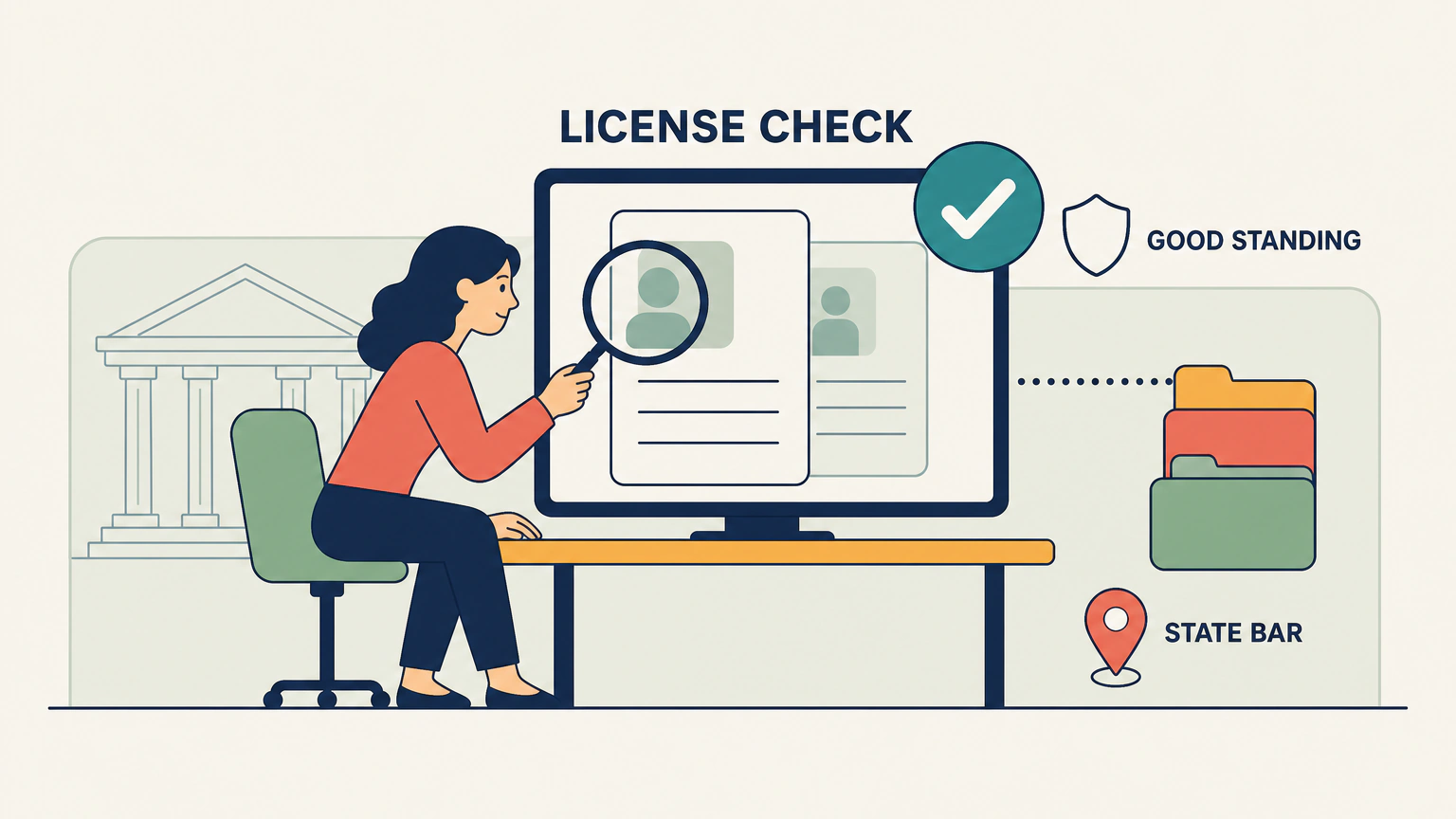
That record answers a narrower question than most people assume. It describes today, not everything that ever happened, and a lawyer blocked over unpaid dues looks much like one blocked for misconduct.
The five-minute routine comes first, then the seven status labels you can run into, then what the record leaves out, and finally what to do with the answer. We're not your lawyer, and this is general information about public records rather than legal advice.
On this page
The license check, start to finish
Where the regulator offers a public online search, these five steps are free and usually take about five minutes. If you are hiring under pressure, calling criminal defense attorneys the night before a first appearance, do this before you talk about money.
Step 1: Find the official record for the right state
Who keeps the record differs by state. In some it's a mandatory bar association, in others an office of the state's highest court. Colorado's Office of Attorney Regulation Counsel calls itself "An Independent Office of the Colorado Supreme Court," and it runs that state's attorney search and disciplinary history.
Use a search pattern rather than a saved link. Search the state name plus "attorney regulation" or "attorney search," then confirm the page belongs to that state's court or bar. Lookup addresses move often, and a stale link sends you to a dead page or a paid lookalike. A request for a credit card does not prove a site is unofficial: formal certificates and the ABA's national name search may carry fees. Confirm the domain first, and do not pay a third-party lookalike.
Step 2: Search by name, and by bar number if you have one
Names are shared, hyphenated and misspelled. The bar number is the unambiguous key, and official searches take it. Colorado asks for either a registration number or a first and last name. Find the number on letterhead, in the engagement agreement, on the firm's website, or by asking.
Step 3: Read the status line
The status line sits near the top of the profile with the attorney's number, year of admission and contact details. The Florida Bar's public records instructions describe exactly that. Under the name sits a status line carrying entries such as "Member in Good Standing" or a disbarred notation. Colorado states the test plainly: an attorney must have a status of "active" and be in good standing to practice there.
Step 4: Open the discipline history
Discipline sits in its own section further down. The Florida Bar's instructions describe a "10-Year Discipline History" section reading either "None" or "Show Details," with the details linking to the sanction, the action date and the underlying court documents. Open the documents. A summary line gives you a category. The order tells you what happened.
Step 5: Repeat for every state they claim
A lawyer admitted in three states has three separate records held by three different bodies. A clean result in one says nothing about the other two, so run steps 1 through 4 for each.
Red flags before you pay anyone: - No bar number and no state of admission. Ask once, in writing. A licensed attorney has no reason to withhold either. - The name on the agreement is not the name on the record. Do not sign until they explain it; the person representing you should identify the license or court authorization they rely on. - A retainer by wire, gift card or cryptocurrency before anything is in writing. Pay nothing until you have the fee agreement, then pay by a traceable method. - "Licensed nationally" or "in all fifty states." There is no national license to practice law. Ask which state, then check that state.
What each status label actually means
Some labels mean the lawyer hasn't finished their paperwork and some mean a regulator found they did something wrong. On screen they look alike. Both block the person from representing you today, and only one of them is misconduct.
| What the record says | What it means | Can they represent you right now? | Is this misconduct? | Do this next |
|---|---|---|---|---|
| Active / Member in Good Standing | Licensed and authorized to practice today | Yes | No | Read the discipline section anyway; this describes today, not history |
| Inactive (voluntary) | Chose to step back from practice; not a sanction | No | No | Ask whether they intend to return to active status |
| Not eligible to practice law / administratively suspended / delinquent | A compliance hold: unpaid fees, missed continuing legal education or similar | No | Not necessarily | Do not sign or pay; ask when the hold clears, then re-check the record |
| Suspended (disciplinary) | A sanction that removes the right to practice under the duration and reinstatement terms in the order | No | Yes | Read the published order; do not engage them while it remains in effect |
| Disbarred | License terminated through discipline; the most serious sanction | No | Yes | Read the order; report anyone still offering to represent you |
| Resigned or revoked while charges were pending | Left the roll with a disciplinary matter open; Florida treats disciplinary resignation or revocation as tantamount to disbarment | No | Disciplinary; charges may be unadjudicated | Treat it as disbarment in Florida and check your own state's wording elsewhere |
| No record found for that name | Wrong state, name variant, misspelling, or not licensed there | Cannot be confirmed | Unknown | Re-search by bar number and name variants; if still nothing, call the bar |
Attorney Status Decoder
Tell it what the record says. It will tell you what that means.
Not legal advice. This explains what a public record says, not whether a lawyer is right for your case.
Status line: Active, or "member in good standing"Inactive (voluntary)Not eligible to practice, administratively suspended, or delinquentSuspended (disciplinary)DisbarredResigned or revoked while charges were pendingNo record found for that name Discipline section: It says "None"It lists one or more entriesThere is no discipline section on the page
Clear to practice
- Can they represent you right now?
- Yes
- Is this misconduct?
- No
- What it means
- This person holds a current license and is authorized to practice in this state today. It is a statement about their status right now, not a certificate that nothing has ever happened.
- Do this next
- Read the discipline section before you decide, then move on to the ordinary hiring questions about experience, scope and fees.
Not clear to practice
- Can they represent you right now?
- No
- Is this misconduct?
- No
- What it means
- A voluntary inactive status generally means an eligible attorney asked to step back from practice. It is not a sanction, but the attorney may not represent clients while that status remains in effect.
- Do this next
- Ask whether they intend to return to active status and when. Do not sign an engagement agreement while the status reads inactive.
Not clear to practice
- Can they represent you right now?
- No
- Is this misconduct?
- Not necessarily
- What it means
- This is usually a compliance hold - unpaid fees, missed continuing legal education, or a similar requirement - rather than a finding of misconduct. The two look almost identical on screen and mean very different things. Either way, the hold blocks them from practicing.
- Do this next
- Do not sign anything and do not pay a retainer. Ask what the hold is for and when it will be cleared, then check the record again yourself before you proceed.
Not clear to practice
- Can they represent you right now?
- No
- Is this misconduct?
- Yes
- What it means
- A suspension imposed through the discipline process removes the right to practice under the duration and reinstatement terms in the order. The order is normally published.
- Do this next
- Open and read the published order rather than relying on the one-word label. Do not engage them while the suspension remains in effect.
Not clear to practice
- Can they represent you right now?
- No
- Is this misconduct?
- Yes
- What it means
- Disbarment is the most serious sanction a state can impose, and it ends the license.
- Do this next
- Read the published order. If a disbarred person is still offering to represent you, report it to the state's attorney regulation body.
Not clear to practice
- Can they represent you right now?
- No
- Is this misconduct?
- Disciplinary matter; charges may not have been adjudicated
- What it means
- The person left the roll while a disciplinary matter was still open. Florida treats disciplinary resignation or revocation as tantamount to disbarment, but pending charges are not necessarily an adjudicated finding.
- Do this next
- Treat it as disbarment in Florida, and read your own state's description of what the term means elsewhere.
Cannot be confirmed
- Can they represent you right now?
- Cannot be confirmed
- Is this misconduct?
- Unknown
- What it means
- The most common causes are searching the wrong state, a name variant or married name, or a misspelling. The other possibility is that this person is not licensed in this state.
- Do this next
- Search again by bar number and by name variants. If nothing comes up, contact the state bar before you pay anyone anything.
No public discipline is listed - but publication windows are limited. Florida, for example, posts discipline documents for the past ten years only and asks the public to email for anything older, so check how far back your state's record actually reaches.
Open every entry and read the underlying order, not the summary line. The order tells you what happened, when, and whether it has been resolved.
If no discipline section appears, look for a separate discipline or attorney regulation search or contact the regulator before concluding there is nothing to find.
This record covers one state and reflects what is published today. Private discipline, pending complaints, malpractice suits and fee disputes generally do not appear here, and some states remove administrative actions from a profile over time - California began doing so under a policy approved in November 2024. Check every state where this person is admitted.
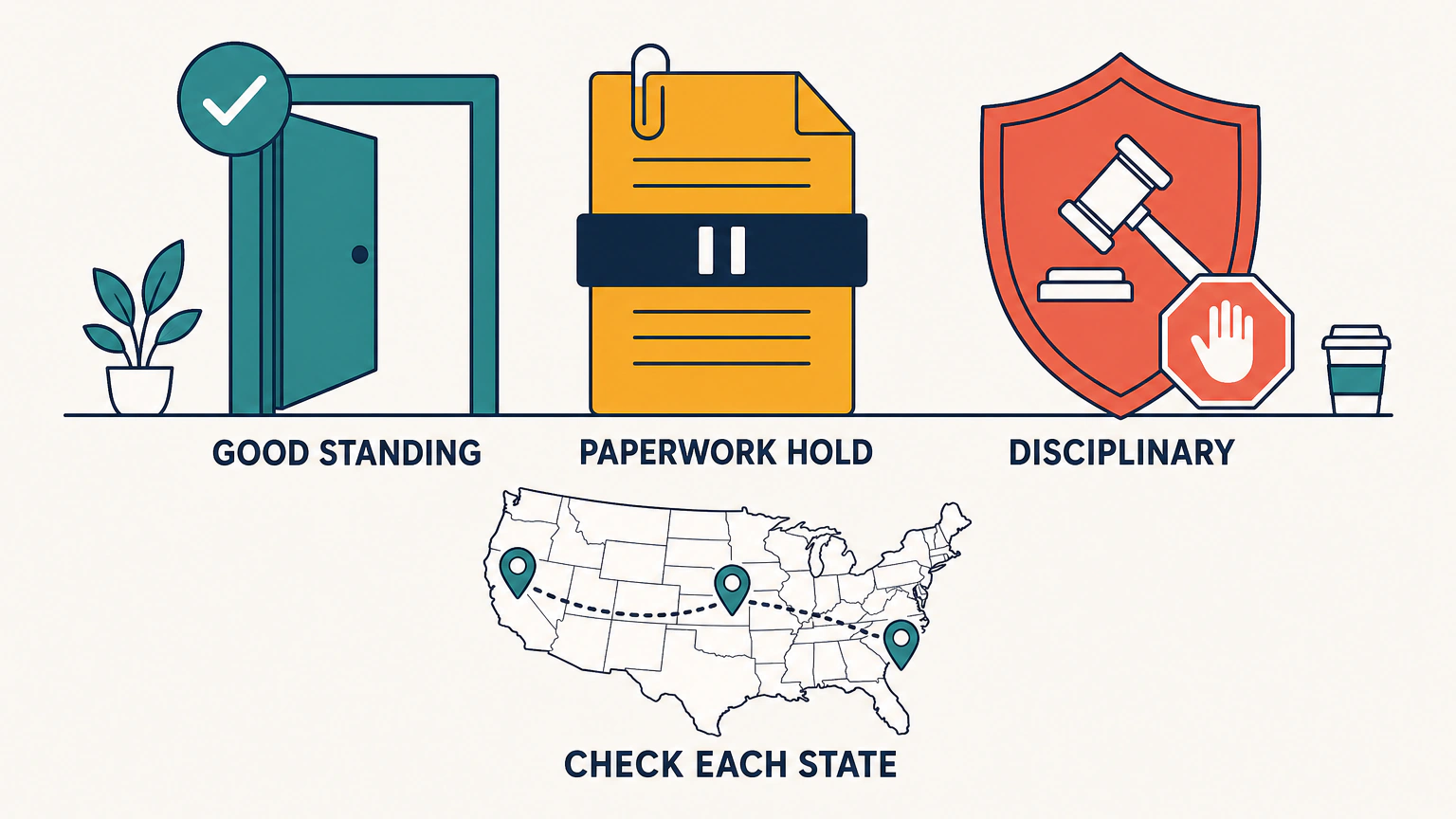
A status label falls into one of three families, only one of which lets someone represent you.
GOOD STANDING
Clear to practice
- Active, or "member in good standing"
PAPERWORK HOLD
Not clear to practice
- Inactive (voluntary)
- Not eligible to practice, administratively suspended, or delinquent
DISCIPLINARY
Not clear to practice
- Suspended (disciplinary)
- Disbarred
- Resigned or revoked while charges were pending
The disciplinary-action family and the paperwork family can look alike but do not mean the same thing.
CHECK EACH STATE Check every state where this person is admitted.
"Active" and "Member in Good Standing"
This is the result you want, and it certifies one thing: a current license, valid in that state, today. The State Bar of California's status chart puts active in a single row: eligible to practice, with continuing legal education still required. It's not a certificate that nothing ever happened, which is why step 4 exists.
Voluntary inactive status is not discipline
In California an attorney who isn't practicing and is otherwise eligible may file to transfer to inactive. The State Bar's chart records that transfer as voluntary, marks inactive attorneys as not eligible to practice, and exempts them from continuing-education reporting. Treat it as an ordinary career step rather than a warning, and remember they can't represent you until they reactivate.
"Not eligible to practice law," "administratively suspended," "delinquent"
This is the family people misread. In California an attorney can be placed on administrative inactive status, shown as not eligible to practice law, for failing to meet the continuing legal education requirement. The State Bar's chart marks that transfer involuntary and says the lawyer is reinstated only after every reason has ended, including a separate hold such as unpaid annual fees. Florida calls the same category "delinquent." Its reinstatement manual, revised August 2025, says members delinquent for five years or longer are not reinstated at all and must apply to the Florida Board of Bar Examiners for readmission.
These are compliance holds, not findings of misconduct, and the person still cannot represent you today. Both halves matter.
Disciplinary suspension, disbarment, and resignation while charges are pending
Here the label reflects a disciplinary sanction or a departure while a disciplinary matter was still pending; the latter is not necessarily a finding that the charges were proved. A disciplinary suspension removes the right to practice under the duration and reinstatement terms in the order, which is normally published.
The scale shows in how a state handles the way back. Under The Florida Bar's reinstatement manual, only a lawyer ineligible because of a court-ordered suspension of 91 days or more may use the reinstatement process at all. That lawyer must petition the Florida Supreme Court and establish rehabilitation and current fitness by clear and convincing evidence. A disbarred Florida member must instead apply to the Board of Bar Examiners and pass the bar examination again. The same manual treats disciplinary resignation and disciplinary revocation as tantamount to disbarment, with identical readmission requirements. Leaving the roll with charges open is a disciplinary event, not a career pause. Read the order, not the label.
When the name doesn't come up at all
Work the causes in order of likelihood: wrong state, then a name variant or married name, then a misspelling, then the possibility that the person isn't licensed there at all. Search by bar number and try both surnames.
If nobody by that name is admitted in any state they claim, ask which license or court authorization permits the work and confirm it with the regulator. Colorado publishes a standing list of people ordered to stop unauthorized practice.
What the public record does not show
The assumption to lose is that a clean lookup equals a clean history. The record has a defined scope and a publication window, and some things were never in it at all.
| Not in the license record | Why | Where to look instead |
|---|---|---|
| Private discipline and admonishments | Non-public where the jurisdiction's rules keep them private | Not published; ask the lawyer directly |
| Pending complaints and open investigations | Often confidential until the jurisdiction's rules make the matter public | Usually nowhere yet; re-check the record later |
| Discipline older than the publication window | Some states publish only a limited number of years online | Ask the bar's records office in writing |
| Records removed under a state removal policy | Some states take administrative actions off the profile over time | A public records request to that state bar |
| Malpractice suits and fee disputes | Civil matters, not license matters | Court case search; the bar's fee arbitration program |
| Full criminal case records | Court records are separate from the license profile, even when a conviction also leads to discipline | County or state court records; PACER for federal cases |
Private discipline and pending complaints
Public sanctions are published. Private admonishments, dismissed complaints and open investigations generally are not. The State Bar of South Dakota says so directly: proceedings stay confidential until the Disciplinary Board or the Attorney General files formal charges at the state Supreme Court's direction. A complainant shouldn't expect detailed reasons unless public discipline is imposed.
Discipline that aged out of the window
The Florida Bar's public records instructions state that it publishes attorney discipline documents for the past ten years and asks the public to email a request for anything older. So "10-Year Discipline History: None" describes a decade, not a career, and it comes with a route to look further. Ask how far back your own state's published record reaches.
Records that were removed from the profile
On November 14, 2024 the State Bar of California's Board of Trustees approved a policy allowing administrative suspensions, including administrative inactive enrollments, to be removed from an attorney's public profile page. The first two come off automatically at the end of the suspension period. Once two have been removed, each further one comes off four years after its end date, and suspensions falling within 60 days of each other count as one. The Board amended the policy on July 16, 2026 to add noncompliance with the attorney oath.
Removal is not expungement. The State Bar asked the California Supreme Court to approve a rule automatically expunging public records of non-disbarment discipline after eight years for a lawyer with a single discipline. On October 22, 2025 the Court denied that request. The full profile, including nondisciplinary actions not displayed publicly, remains available through a public records request.
That's not a claim about any individual lawyer. It means a California profile is a curated view, and you have a documented route to the uncurated one.
What was never in there: malpractice, fees, and criminal cases
A malpractice suit is filed in court, not with the bar, so it lives in the county or state court case index. Criminal matters live there too, with federal cases in PACER. Fee disputes usually go to a bar fee-arbitration program rather than to discipline, and the State Bar of South Dakota notes that fee matters are rarely a basis for discipline unless the fee is illegal or clearly excessive.
Why one clean state record isn't enough
Discipline is held state by state
Each jurisdiction admits, regulates and disciplines its own lawyers. Someone sanctioned in one state can hold a clean-looking license in another for a while. Reciprocal discipline is a separate proceeding in the second state, and it is neither instant nor visible to you. Check every state the lawyer names.
The one national repository, and how to use it
The American Bar Association describes its National Lawyer Regulatory Data Bank, established in 1968, as the only national repository of public regulatory actions concerning US lawyers. By its account, all states and the District of Columbia report into it, along with many federal courts and agencies. According to the ABA it conducts name searches on request for the public. The ABA asks inquirers to start with the state where the lawyer is known to be licensed, and to confirm the request in writing. Expect a paid written request with a turnaround, not a public search box.
Pro tip: Make the request actionable the first time. Give the lawyer's full name with any former or alternate spellings, every bar number you have found, the states where you already confirmed admission and what the record said, and your own contact details. Then state plainly that this is your written confirmation. Run the state search first, because the ABA's own instruction is to begin where the lawyer is known to be licensed.
Two states that require direct verification
The Department of Justice's Executive Office for Immigration Review tells the public to call the New Hampshire Bar Association or the State Bar of South Dakota to verify an attorney's license and good standing. That page was last updated on January 25, 2023. Both routes have moved since.
New Hampshire now publishes an online Attorney Verification / Good Standing Request form on the state bar's site, so you can submit the request rather than call. Its member directory sits behind a login. South Dakota's directory also needs a login, and the bar takes verification requests by phone on 605-224-7554, at an address it now gives as 111 W. Capitol Ave. #1 in Pierre rather than the East Capitol Avenue one the federal page still prints.
One trap applies in both. A state occupational-license lookup is not the attorney record, because attorney licensing sits with the bar and the state's high court. Finding nothing there is not a finding.
What to do with what you found
Green, amber, red: reading your result
Green: active, no published discipline. Move on to the ordinary hiring questions about experience, scope, timeline and fees. If you're comparing personal injury attorneys from advertising, check every name on the shortlist before the first call. Badges and awards are a starting point rather than an endpoint, ours included: read how Legal Directorate selects the firms it lists, then read the state record yourself.
Amber: active, with published discipline. Open the orders and ask the lawyer about them directly. People do recover from sanctions, and we'd pay close attention to how they answer.
Red: any status that blocks practice. Do not sign, do not pay, and confirm with the bar first.
Before money moves, you should be able to tick every line:
- I searched every official state record for every license they claim and confirmed any separate court authorization they rely on
- I searched by bar number as well as by name
- The status line says they may practice right now
- I opened the discipline section and read every published order, not just the summary
- I checked every other state where they say they are admitted
- I know the publication window for this state's discipline records
- I have the engagement agreement in writing before any money moves
- I know which body to complain to if something goes wrong
If something is wrong: complaints, and getting your money back
Complaints go to the state's attorney regulation body, not to a national office. In Colorado that's the Office of Attorney Regulation Counsel, which takes complaints about attorneys and about non-attorneys practicing without a license. In South Dakota it's a signed letter to the Disciplinary Board of the State Bar setting out the facts, names, dates and documents. The Federal Trade Commission points consumers the same way.
Discipline punishes the lawyer. It rarely returns your money, and South Dakota's bar says plainly that a loss cannot be recovered through a disciplinary proceeding. That's what client protection funds are for, and most states run one for losses caused by dishonest conduct, such as Colorado's Client Protection Fund. If you paid someone who was never entitled to practice, consumer protection attorneys handle the recovery side while the bar handles the license.
Frequently asked questions
How do I check if a lawyer is licensed for free?
Many states offer a free official attorney search. Find the state's attorney regulation office or bar association, search by name or bar number, read the status line, then open the discipline section. New Hampshire and South Dakota use direct verification routes instead, and formal certificates or the ABA's national search can carry fees.
What does "administrative suspension" mean for a lawyer?
It's a hold imposed for a compliance failure, such as unpaid fees or missed continuing legal education, rather than a finding of misconduct. California shows it as administrative inactive status, or not eligible to practice law. Either way, the lawyer may not represent you while it lasts.
What does it mean if an attorney is listed as "inactive"?
A voluntary inactive status means they asked to step out of active practice; other inactive labels can carry different rules. In California an eligible attorney who is not practicing may file to transfer to inactive status, which the State Bar records as voluntary and which exempts them from continuing-education reporting. It is not a sanction, but they cannot represent you.
Are attorney disciplinary records public?
Public discipline is. Reprimands, suspensions and disbarments are published, normally with the underlying order. Private discipline, dismissed complaints and investigations in progress generally are not: South Dakota, for example, keeps proceedings confidential until formal charges are filed at the state Supreme Court's direction.
Can I find out if an attorney was disbarred in another state?
Yes, by checking that state's own record, because each state holds its own. For a national view, the American Bar Association says its National Lawyer Regulatory Data Bank conducts name searches on request, beginning with the state where the lawyer is known to be licensed and confirmed in writing; the ABA says name searches are available for a fee.
Is there a national database of disciplined attorneys?
The ABA describes its National Lawyer Regulatory Data Bank, established in 1968, as the only national repository of public regulatory actions concerning US lawyers, fed by all states and the District of Columbia plus many federal courts and agencies. It is not a public search box: you request a paid name search in writing.
What happens if I hire someone who isn't licensed to practice law?
Stop paying and report it. State attorney regulation offices handle unauthorized practice of law, and some publish the results, as Colorado does with its list of people ordered to stop. Then have a licensed attorney review anything already filed or signed for you.
How do I find out whether a lawyer has complaints against them?
You'll generally see outcomes rather than complaints. Bar records publish discipline that was actually imposed, while open matters stay confidential and dismissed ones are not posted. Read every published order in the discipline section, check each state where the lawyer is admitted, and ask them directly.
Where to go from here
The state-by-state online check is often free and takes only a few minutes, making it inexpensive due diligence before hiring. Run it before the first payment, and again if the matter drags on for years. When you are ready to hire, browse verified providers by service and put every name through the same five steps.
Licensing and discipline rules are set state by state, so confirm anything decisive with the body that keeps your state's record.