

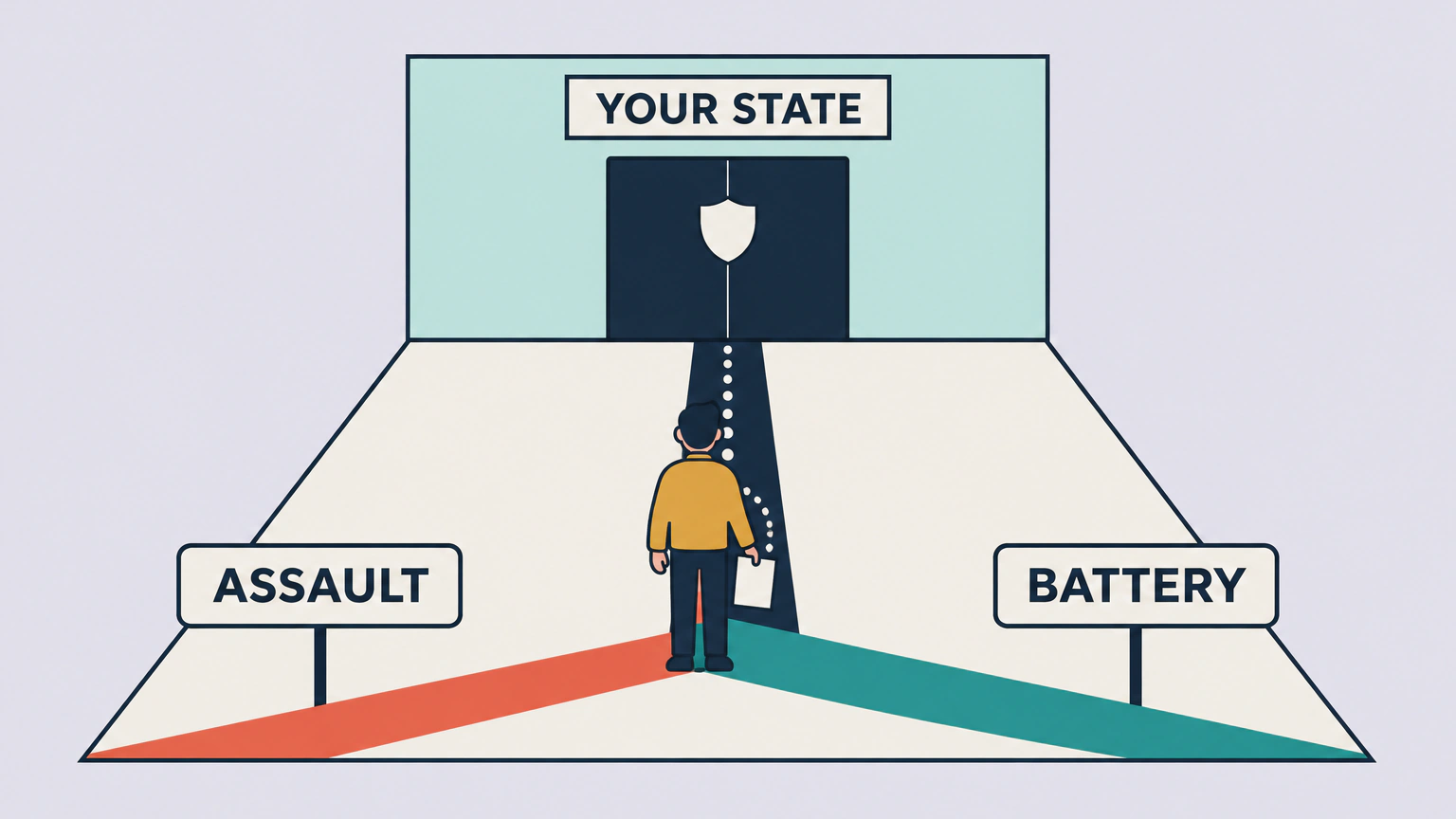
Assault traditionally means making someone fear being hit, and battery means touching or hitting them without permission. Whether those are two crimes depends on where you are: of the 11 states we checked, three charge them separately, five have one crime called assault, and three use one combined charge. The stakes vary just as widely. A shove that doesn't hurt anyone can be a fine-only offense in Texas. In Florida, the same shove can carry up to a year in jail.
On this page
- The difference in one swing
- What your state actually calls it
- Can you be charged if nobody got hurt?
- What turns it into a felony
- What happens after you're charged
- Two consequences that outlast the sentence
- If you're the one who got hit
- What a lawyer costs, and when you get one free
- Frequently asked questions
The difference in one swing
Picture a fist. Swing and miss, and that's assault: the other person saw it coming and feared the hit. Swing and connect, and that's battery. Both can happen in the same second, which is why people can face both charges at once in states that keep the two apart.
Battery doesn't need an injury. The US Supreme Court has said the force behind common-law battery was "satisfied by even the slightest offensive touching." That's the textbook answer to what battery means in law. Your state's code may not follow the textbook.
Assault and battery in their classic sense
| Assault | Battery | |
|---|---|---|
| The core idea | Making someone reasonably fear being hit | Unwanted physical contact |
| Does anyone have to be touched? | No | Yes |
| Does anyone have to be hurt? | No | No, an offensive touch can be enough |
| The classic example | You swing and miss | You swing and connect |
What your state actually calls it
Past the textbook, assault vs battery becomes a question about your state's code, because assault is state law. The main federal assault statute reaches only places like federal land. We read the assault laws of 11 states and grouped them by how each code is built. If you live somewhere else, look up your own state's penal code under "assault" and match it to the section number on your paperwork.
What 11 states call it, and what it can cost you
| State | What the code calls it | Basic charge and top penalty | One common felony step | Statutes |
|---|---|---|---|---|
| California | Two crimes: assault and battery | Assault: up to 6 months, $1,000. Battery: up to 6 months, $2,000. | Battery causing serious bodily injury: up to 1 year in jail, or 2, 3 or 4 years. | Penal Code §§ 240-243 |
| Florida | Two crimes: assault and battery | Assault: up to 60 days, $500. Battery: up to 1 year, $1,000. | Aggravated assault, such as a threat with a deadly weapon: up to 5 years, $5,000. | Stat. §§ 775.082, 775.083, 784.011, 784.021, 784.03 |
| Illinois | Two crimes: assault and battery | Assault: up to 30 days, $1,500. Battery: under 1 year, $2,500. | Aggravated battery, such as great bodily harm: usually a Class 3 felony. | 720 ILCS 5/12-1, 12-3, 12-3.05, 730 ILCS 5/5-4.5-55, 5-4.5-65 |
| Texas | One crime: assault | Threat or offensive touch: fine up to $500. Bodily injury, which includes pain: up to 1 year, $4,000. | Aggravated assault, meaning serious injury or a deadly weapon: 2 to 20 years. | Penal Code §§ 1.07, 12.21, 12.23, 12.33, 22.01, 22.02 |
| New York | One crime: assault, in degrees | Third degree, physical injury: up to 364 days, $1,000. | Second degree, such as intentionally causing serious injury: class D felony. | Penal Law §§ 70.15, 80.05, 120.00, 120.05 |
| Ohio | One crime: assault | Causing or trying to cause physical harm: up to 180 days, $1,000. | Felonious assault, such as serious harm or a deadly weapon: second-degree felony. | Rev. Code §§ 2903.11, 2903.13, 2929.24, 2929.28 |
| Arizona | One crime: assault | Intentional injury: up to 6 months, $2,500. Reckless injury: up to 4 months, $750. Fear or offensive touch: up to 30 days, $500. | Aggravated assault with serious injury or a deadly weapon: class 3 felony. | A.R.S. §§ 13-707, 13-802, 13-1203, 13-1204 |
| Washington | One crime: assault, in four degrees | Fourth degree: up to 364 days, $5,000. | Second degree, such as a deadly weapon: up to 10 years, $20,000. | RCW 9A.20.021, 9A.36.021, 9A.36.041 |
| Virginia | One combined charge: simple assault or assault and battery | Up to 12 months, $2,500. | Malicious wounding: Class 3 felony. | Code §§ 18.2-11, 18.2-51, 18.2-57 |
| South Carolina | One combined charge: assault and battery, in four tiers | Third degree: up to 30 days, $500. Second degree: up to 3 years, $2,500. | First degree: up to 10 years. High and aggravated: up to 20 years. | Code § 16-3-600 |
| Michigan | One combined charge: assault or assault and battery | Up to 93 days, $500. | Felonious assault with a dangerous weapon: up to 4 years, $2,000. | MCL 750.81, 750.82 |
These are the top penalties in each state's code for one count. Listed victims, repeat offenses and domestic cases can change them.
Where assault and battery are two crimes
California, Florida and Illinois keep the old split, and battery usually carries more. How much more depends entirely on the state. Illinois caps assault at 30 days in jail and battery at just under a year. Florida's gap runs from 60 days for assault to a full year for battery. California barely separates them at all: six months for either one, with the battery fine doubled.
So in a two-crime state, the word on your paperwork can matter a great deal, or hardly at all, depending on which state wrote it.
Where the only crime is assault
Texas, New York, Ohio, Arizona and Washington have no crime called battery in their assault chapters. The word assault does all the work, and it covers very different conduct from one state to the next.
Texas's assault statute is the broadest. It reaches causing an injury, threatening someone with one, and contact the other person would find offensive or provocative. A threat or an offensive touch is usually a fine-only misdemeanor. But Texas defines bodily injury as "physical pain, illness, or any impairment of physical condition." So a shove that hurts can jump from a fine to a Class A misdemeanor, with up to a year in jail.
New York sits at the other end. Assault in the third degree needs a physical injury. A threat backed by a physical menace is a different crime, menacing in the third degree, which is a class B misdemeanor with up to three months and a $500 fine. A shove meant to harass or annoy, with no injury, is harassment in the second degree. That's a violation, with up to 15 days and $250.
Ohio's basic assault reaches causing physical harm or trying to. Arizona grades by what you did and your state of mind. An intentional injury, a reckless one, and a touch meant to insult or provoke each sit in a different class.
Where it's one combined charge
Virginia's statute punishes "a simple assault or assault and battery" as the same Class 1 misdemeanor, and that section never defines either one. South Carolina runs four tiers, from third degree up to assault and battery "of a high and aggravated nature." Its second degree is still called a misdemeanor, yet it carries up to three years. In South Carolina, the word "misdemeanor" tells you very little. Michigan's basic statute covers a person who "assaults or assaults and batters" someone, with one penalty for both.
If you're holding charging papers, treat the words as a pointer. The statute number is what your lawyer will read, and it's what sets the stakes.
Can you be charged if nobody got hurt?
Yes, in most of these states, and it happens two ways.
The first is a threat with no contact. Texas reaches a threat of imminent injury. Illinois and Arizona reach conduct that puts someone in reasonable fear of being hit or hurt. Florida's assault statute asks for more: a threat, the apparent ability to carry it out, and "some act" that creates the fear. Words alone usually fall short there. California defines assault as an "unlawful attempt" with "a present ability" to injure, so a threat with no attempt doesn't fit.
The second is a touch with no injury. Texas, Illinois and Arizona reach contact that's offensive or provoking, and Florida reaches a touch "against the will of the other." Illinois Legal Aid Online gives spitting on someone as an example of contact that can count.
A pure accident usually falls outside all of these, because each statute requires a mental state, such as acting knowingly, intentionally or recklessly.
Claiming self-defense won't stop the charge from being filed. Texas calls justified force "a defense to prosecution," which means you raise it inside the case.
What turns it into a felony
Each state writes its own felony list. Still, the same five facts keep turning up, and in most of the states we read they mark the line between aggravated assault and simple assault.
Five facts that usually move the charge up
- Serious injury. In Arizona, "a fracture of any body part" makes an assault aggravated, so one punch that breaks a nose can be a felony.
- A weapon, even with no contact. In Florida, a threat with a deadly weapon is a felony. Michigan treats it the same way.
- Who was hurt. Texas makes injuring a public servant on official duty a third-degree felony.
- Choking. Texas, Florida and Arizona all have felony charges for blocking someone's breathing. In Texas and Arizona the charge applies to domestic cases, such as a partner or a member of the household. Florida's newer version reaches anyone.
- A prior conviction. In Florida, a second battery is a felony, even if the first ended in a no-contest plea with adjudication withheld.
Why "aggravated" doesn't always mean felony
The label misleads in both directions. Illinois charges many aggravated assaults as Class A misdemeanors, though some exceptions rise to Class 4 felonies. Michigan's aggravated assault is an assault without a weapon that causes serious injury, and it's a misdemeanor capped at one year and $1,000. Michigan saves its felonies for other names, such as felonious assault.
Ohio turns the words around. Its aggravated assault is the lesser offense, a fourth-degree felony for causing serious harm in a sudden passion or fit of rage brought on by serious provocation. Felonious assault is the heavier one.
Read the class on the charge, not the adjective.
What happens after you're charged
Three decisions are coming: whether the case can be dropped, whether there's a way out for a first charge, and how to plead. Two of them are easy to get wrong in the first week.
What to do in the first 48 hours
- Follow any no-contact order exactly, even if the other person reaches out first. Only a judge can change it.
- Don't explain what happened to police until you have a lawyer. You can stay silent, and saying so admits nothing.
- Write down what happened while it's fresh, and show it only to your lawyer.
- Don't discuss the case on a jail phone. Those lines are recorded.
- Save texts, photos, video and witness names. Don't delete anything.
- Find out your next court date and who will stand beside you on it.
- Before any plea, tell your lawyer if you aren't a US citizen, or if you own a gun or need one for work.
The other person can't simply drop it
A criminal case belongs to the state, not to the person who was hit. Tarrant County's District Attorney puts it plainly: "The decision to drop charges in any criminal prosecution can only be made by a prosecutor with the approval of a judge." The same office says a victim's wishes alone don't decide whether a case is filed, tried or dismissed.
So don't count on the other person backing out, and never ask them to. If there's a no-contact order, asking can break it.
There's one narrow exception most people never hear about. Virginia and California let a judge end some misdemeanor cases when the injured person comes to court and says they've been made whole for the injury. Both states carve out cases involving police officers and cases against family or household members. In both, the judge makes the call. It's something your lawyer raises, never something you arrange with the other person.
A first charge can have a way out
A first charge doesn't always have to end in a conviction. Two routes have names worth knowing.
In New York, an adjournment in contemplation of dismissal puts the case on hold with a view to dismissing it. You and the prosecutor both have to agree. In California, a judge can offer misdemeanor diversion even over the prosecutor's objection, for up to 24 months, and must dismiss the case if you comply. Domestic violence charges, stalking and offenses that require sex-offender registration are excluded.
Other states have versions under their own names. If this is a first time assault and battery charge, ask your lawyer about diversion or deferred disposition before any plea. A careful lawyer gets the evidence first, weighs the odds of a deal, diversion or dismissal, and only then asks you to decide.
Read the terms closely, because some programs require an admission. If you aren't a US citizen, that admission can count against you even after the case is dismissed.
Guilty or no contest, if you might get sued
If the other person might sue you, how you plead matters twice. A guilty plea can follow you into a civil suit, where it can leave little to argue about except how much you owe.
A no-contest plea often works differently. In federal courts, the rules of evidence bar a no-contest plea from being used against the person who made it. For crimes punishable by more than a year, a conviction after a guilty plea can come into a later case as evidence, and one after a no-contest plea can't. California protects no-contest pleas in non-felony cases from use as an admission in a civil suit. For felonies, it treats them the same as guilty pleas.
It isn't a free pass, though. In California the court still finds you guilty. In Florida a no-contest plea still counts as the prior conviction that turns the next battery into a felony. California also needs the court to approve the plea, so ask whether your court will take one. Other states set their own rules.
Two consequences that outlast the sentence
Two federal rules reach well past any jail time or fine, and both turn on how your case ends.
Guns: one misdemeanor can be enough
Federal law bars anyone convicted of a "misdemeanor crime of domestic violence" from having a gun or ammunition. The ban reaches state misdemeanors when two things are true. The offense must involve using or trying to use physical force, or threatening someone with a deadly weapon. And the victim must be your current or former spouse, your child or ward, someone you share a child with, someone you lived with as a spouse, or a current or recent dating partner. A dating partner counts only when the conviction was entered on or after June 25, 2022. Someone you've treated like a spouse, a child or a ward is covered too.
The Supreme Court has set the bar for force low. In United States v. Castleman, it held that the force behind common-law battery, an offensive touch, is enough. In Voisine v. United States, it held that a reckless domestic assault counts too. So a battery with no injury can qualify, and the name of the state crime doesn't matter.
There are three ways out. An expungement, pardon or restoration of rights can lift the ban, unless it says otherwise. If you have a single conviction against a dating partner and nothing else bars you, the right comes back five years after the later of the judgment or the end of the sentence. A later disqualifying conviction undoes that.
The third route is new, and it's narrow. Since September 21, 2026, people can apply to the Justice Department to have gun rights restored. But the department's own final rule on restoring rights says applications will be denied, "absent extraordinary circumstances," within 10 years of such a conviction or of serving any part of the sentence. For anyone convicted in the last 10 years, that door is all but closed.
If you hunt, carry a gun for work or serve in the military, say so before you plead.
Immigration: a plea can count even if the case is dismissed
For a noncitizen, the risk runs deeper. Federal law makes you deportable if you're convicted of a crime of domestic violence at any time after admission. Whether a given assault counts depends on the exact wording of the state statute. That's why an immigration lawyer's first questions are about the precise charge, its maximum sentence, and whether you admitted anything.
For immigration purposes, "conviction" reaches further than most people expect. Even where a court withholds judgment, it's still a conviction if you pleaded guilty or no contest, or admitted enough facts, and the judge ordered any punishment or restraint. So a diversion deal that requires an admission may not protect you, even though the state case ends in dismissal.
The Supreme Court held in Padilla v. Kentucky that defense counsel must tell a client whether a plea carries a risk of deportation. Hold your lawyer to that. Then bring in an immigration lawyer before you sign anything.
If you're the one who got hit
You didn't choose any of this, and you have two separate paths open. If someone hurt you, start with two calls: the police and a doctor. The police report and the medical record are your evidence, so get both even if the injury looks minor.
In the criminal case, the prosecutor runs things and you're a witness. You can also bring your own civil suit for money. It's a separate case with a lower bar: you have to show it's more likely than not that they hurt you, not prove it beyond a reasonable doubt. A dropped charge doesn't end your suit, but the clock does, and these deadlines vary a lot from state to state. Talk to personal injury attorneys before yours runs out.
How long you have to sue
| State | Time to file a civil suit | Statute |
|---|---|---|
| New York | 1 year, or 2 years for domestic violence, or at least 1 year after a related criminal case ends. If you were hurt and the person who hit you is convicted for it, at least 7 years from the attack | CPLR 213-b, 215(3), (8), (9) |
| California | 2 years, or at least 3 years for domestic violence. If the person who hit you is convicted of a felony for it, at least 1 year after judgment | Code Civ. Proc. §§ 335.1, 340.15, 340.3 |
| Texas | 2 years, the personal injury deadline | Civ. Prac. & Rem. Code § 16.003 |
| Florida | 4 years | Stat. § 95.11(3)(n) |
What a lawyer costs, and when you get one free
Our own planning estimates put misdemeanor defense before trial at starting fees of about $2,500 to $5,000 and up. State felony defense before trial starts at about $6,000 to $10,000 and up. A trial is priced separately, in a written quote. These are entry figures built from published US provider prices, not a national average and not a quote for your case.
If you can't afford a private lawyer, ask the court about a public defender early. Eligibility depends on your finances and the charge, and our guide to choosing a public defender or a private attorney walks through how it works. If you're hiring, ask whether the fee covers your next court date, and who will stand beside you on it. Before you pay anything, check the lawyer's license.
We're not your lawyer, and a charge like this deserves one. Take your paperwork to a defense attorney before you decide anything. You can start with criminal defense attorneys in your area.
Frequently asked questions
Is battery worse than assault?
In states that separate them, usually, though not always by much. Illinois and Florida punish battery far more heavily than assault. California sets the same six-month jail cap for both and raises only the fine. In Texas, New York and Ohio the question doesn't come up, because assault is the only crime.
Can you be charged with assault without touching someone?
Yes, in many states. Texas, Illinois and Arizona all reach a threat or conduct that makes someone fear being hurt. Florida also wants an act that creates the fear, so words alone usually fall short there. New York treats a physical threat as a different crime, menacing.
Is pushing someone assault or battery?
Usually one or the other, if the push was deliberate and unwanted. It's battery in California, Florida and Illinois, and assault in Texas and Arizona. New York generally treats a shove with no injury as harassment, which it classes as a violation. If the push causes pain or an injury, expect a heavier charge in Texas, Arizona or New York. In the other three states, the injury itself has to be serious.
Is aggravated assault always a felony?
Usually, but not always. Illinois charges many aggravated assaults as Class A misdemeanors. Michigan's aggravated assault, an assault without a weapon that causes serious injury, is a misdemeanor with a one-year cap. The felony versions in those states sit in other subsections or go by other names.
What is simple assault?
Simple assault is the common name for the basic, non-aggravated charge. Virginia's statute uses those exact words. Other states use their own: third-degree assault in New York, fourth-degree assault in Washington. In most of the states we read, a simple assault charge is a misdemeanor unless a weapon, a serious injury or another felony factor is involved.
Can you be charged with assault if you were defending yourself?
Yes. Police and prosecutors can still file the charge, and self-defense becomes your answer to it. Texas, for one, treats justified force as a defense to prosecution. Tell your lawyer early, and don't argue the point with officers at the scene.
Can someone sue you for assault if the charges were dropped?
Yes. A civil suit is a separate case brought by the person who says you hurt them, and it asks for money, not punishment. They need only show it's more likely than not, a lower bar than a criminal case. A dropped charge doesn't stop them if they file before the deadline.