

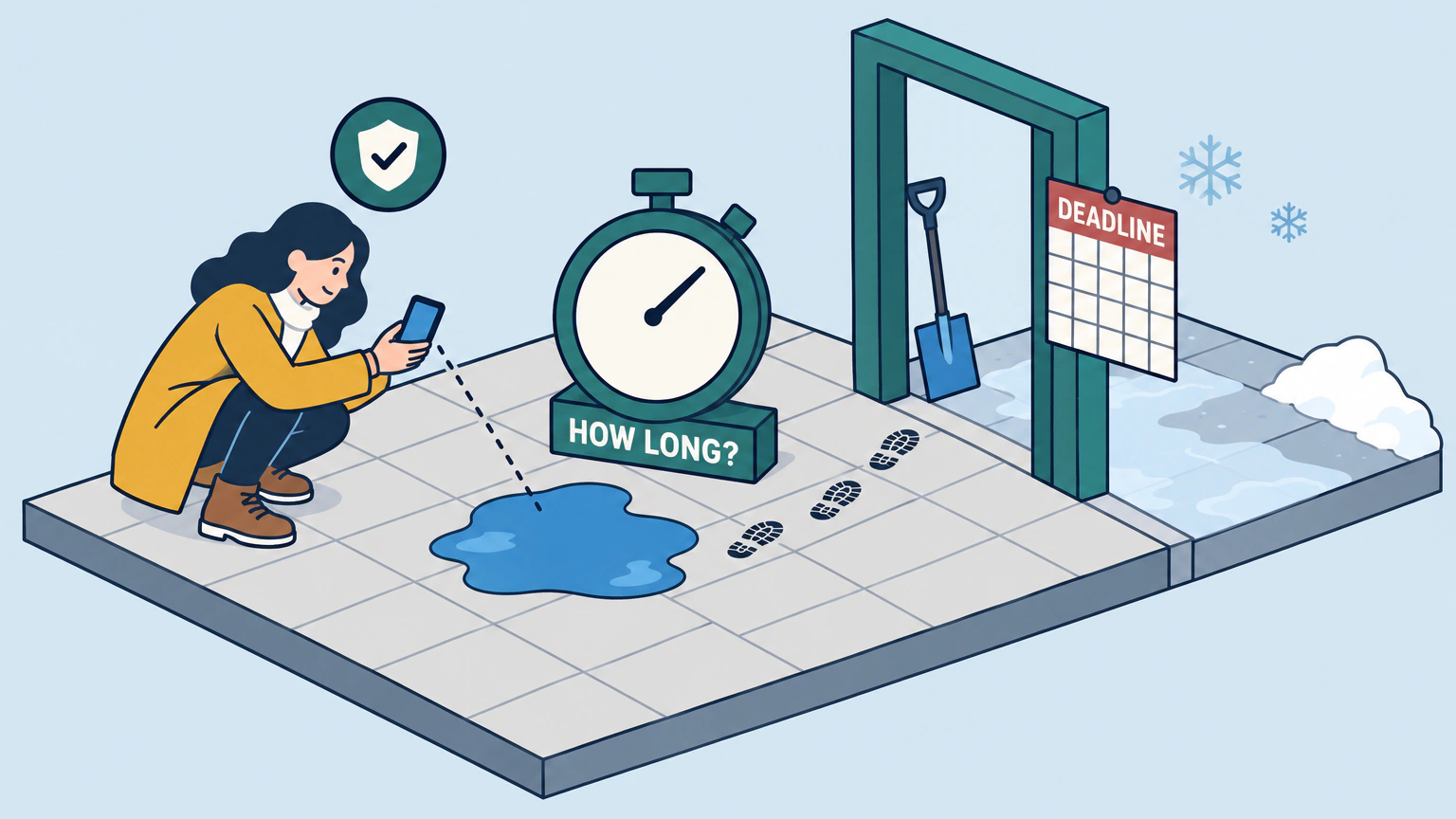
Yes, you can sue after a slip and fall, but falling isn't the case. You have to show the owner created the hazard, or knew or should have known about it in time to fix it. Then your state decides two things that matter as much as the fall. One is how much your own share of the blame cuts what you collect. The other is how fast you must act, which can be as little as 90 days in New York, or 30 days for a defect in a Massachusetts public way, when the government is responsible.
On this page
- What a slip and fall case has to prove
- How your share of the blame changes what you collect
- Ice and snow: the winter rules that decide who pays
- When a city or state owns the property, a different clock runs
- The rules in eight states, side by side
- What to do in the first days after a fall
- Who pays, and what fall cases bring
- When to call a lawyer
- Slip and fall questions people ask
What a slip and fall case has to prove
A fall case is a negligence case, which asks whether the owner was careless. California's version of the duty makes everyone responsible for harm caused by their "want of ordinary care or skill in the management of his or her property." Every state words it a little differently. In a typical store fall, you need a hazard the store created or should have fixed, proof it caused your fall, and real harm.
Showing the owner knew, or should have known
Notice is where most fall cases are won or lost. Actual notice is the plain kind: someone told the manager, or an employee walked right past the spill. Constructive notice means the owner should have known. New York's highest court says the defect must be "visible and apparent," and there long enough before the accident for the owner's staff "to discover and remedy it."
Florida wrote this into a statute for spills in a business. You must prove the business "had actual or constructive knowledge of the dangerous condition." You can show that by how long the spill sat there, or because the condition "occurred with regularity and was therefore foreseeable."
That's why records matter. Grocery stores typically check their aisles on a set schedule because shoppers drop things, so the sweep log can show how long a spill went unseen. A spill reported to a manager minutes before your fall is one the store knew about. A sidewalk slab pushed up by tree roots tells its own story, because it didn't happen overnight. If a broken stair your landlord was told about is what tripped you, see our guide to suing your landlord over unsafe conditions.
The honest other half: a jar that broke seconds before you stepped in it gave the store no time to know, and that case is hard to win.
Tying the hazard to your fall
Causation is where the defense stops looking at the floor and looks at you. Start with what you remember about the fall. What was the weather? What did you have on your feet? Do you wear glasses, and were you wearing them? Any history of dizziness, or a medicine that causes it? What exactly did you slip on, and did you see it after you fell? Who saw it happen?
Each question points to another cause the owner's insurer could blame for your slip and fall injury. Clear answers close those doors. Even when the owner was plainly careless, though, your own share of the blame decides the money.
How your share of the blame changes what you collect
The defense script is predictable. The owner salted, sanded and plowed, the lighting was fine, and you weren't watching your step. If a judge or jury agrees even in part, your state's fault rule takes over. There are three families.
Pure comparative fault: your award drops by your share, whatever that share is. California's Supreme Court adopted this rule in 1975, and New York has it by statute. Found 10% at fault, you'd collect 90%.
Barred above 50%: Texas, Florida, Illinois and Massachusetts cut your award the same way until your share passes half, and then you get nothing. Texas bars a claimant whose share is "greater than 50 percent."
Contributory negligence: in Maryland and Virginia, any fault of yours, however small, can end the claim.
This isn't an edge case. A federal survey of 2005 state-court trials found that when plaintiffs won a premises case, about two of every five awards were cut for the plaintiff's own negligence, by about half on average. Run a $40,000 claim through each rule and the cliff shows up at 51%.
| Your share of the blame | Pure comparative: California, New York | Barred above 50%: Texas, Florida, Illinois, Massachusetts | Any fault bars you: Maryland, Virginia |
|---|---|---|---|
| None | $40,000 | $40,000 | $40,000 |
| 20% | $32,000 | $32,000 | $0 |
| 50% | $20,000 | $20,000 | $0 |
| 51% | $19,600 | $0 | $0 |
| 70% | $12,000 | $0 | $0 |
Amounts are before any fees or costs. A judge or jury sets the percentages, not you.
Where any fault at all can sink your claim
In 2013 Maryland's highest court was asked to drop the rule and refused: "we decline to abrogate Maryland's long-established common law principle of contributory negligence." The state's legislative analysts wrote in 2026 that an injured person's fault, "however slight," bars all recovery. A dissenting judge in the 2013 case named the other holdouts: Virginia, Alabama, North Carolina and the District of Columbia.
A 2026 bill to soften the rule covered only motor-vehicle cases brought by pedestrians, cyclists and other "vulnerable" road users, and it went to interim study. Falls were never part of it. Maryland does allow one narrow way out, "last clear chance," when the defendant had a fresh chance to avoid the harm and didn't take it.
In Maryland, being 1% careless can cost you everything, and that's as unfair as it sounds. If you fell in any of these five places, talk to a lawyer before you say a word to an insurer.
Ice and snow: the winter rules that decide who pays
Winter falls follow their own rules, and no corner of fall law varies more from state to state. New York lets owners wait out a storm, and New Jersey does the same for commercial owners. Texas and Illinois generally don't make owners answer for ice that formed naturally. Massachusetts treats snow and ice like any other hazard.
Illinois shows how hard the strict version is. In a 2010 case, its highest court restated that an owner has "no duty to remove natural accumulations of ice, snow, or water." The woman who brought that case slipped on snow and water on a Chicago train platform, and she lost on exactly that rule. So in Illinois, ice the owner caused is the case to make. The state's Snow and Ice Removal Act protects residential owners, occupants and their snow crews from negligence claims over sidewalk clearing. It allows claims for "willful or wanton" misconduct.
Write down whether snow melted and refroze, or a plow crew missed a patch. Those details matter, but Texas still treats ordinary melt-and-refreeze ice as natural.
Sidewalks have their own rules. In New York City, adjacent owners must repair sidewalks and clear snow and ice. Injury liability generally shifts to them, except for owner-occupied one- to three-family homes used only as residences.
State by state, the winter rules look like this.
| State | The winter rule | What it means for a fall |
|---|---|---|
| New York | Storm in progress (Solazzo, 2005) | Owners generally needn't clear storm-related ice until a reasonable time after the storm |
| New Jersey | Ongoing storm rule (Pareja, 2021) | Commercial owners get a reasonable time after the storm, unless they made the risk worse or it was there before the storm |
| Illinois | Natural accumulation rule (Krywin, 2010) | No duty to remove snow and ice that built up naturally. Ice the owner caused is different |
| Massachusetts | No natural-accumulation defense since 2010 (Papadopoulos) | Owners owe the same reasonable care for snow and ice as for any other hazard |
| Texas | Naturally formed ice (Scott & White v. Fair, 2010) | Ice that forms naturally outside a business in a winter storm isn't treated as an unreasonable risk |
When a city or state owns the property, a different clock runs
A fall on government property can start a separate clock, and it's the trap that catches people. For the local-government claims below, seven of eight states set an earlier deadline. Florida is the exception. Claims against a state can follow different rules. Meeting a deadline doesn't overcome government immunity.
New York gives you 90 days to serve a notice of claim, a sworn written statement of what happened, on a city, county or other local body. The lawsuit deadline is one year and 90 days from the injury. A court may allow late notice, but only in its discretion, so don't plan on it. Massachusetts wants notice within 30 days for a defect in a public way, meaning a road the town must keep in repair. A town there also isn't liable for snow or ice on a public way that was "otherwise reasonably safe and convenient for travelers." California and Texas give you six months. Virginia gives six months for claims against a county, city or town.
Virginia and Maryland forgive a missed notice in narrow cases. Virginia excuses it when the locality's attorney, chief executive or mayor, or its insurer, actually knew of your claim within six months. Maryland excuses it when the local government had actual or constructive notice of your injury, or of the defect, within the year.
Texas adds a twist. For ordinary premises defects, a Texas government generally owes you only "the duty that a private person owes to a licensee on private property." That's a lower duty than a business usually owes its customers. Paying to use the premises can raise it. Toll roads keep the lower duty, and special road hazards have a different warning rule.
Florida runs the other way. You get three years for a written claim and four to sue, both from when the claim arises. The usual payment caps are $200,000 a person and $300,000 an incident. Lawmakers can authorize more, and insured settlements can exceed those limits.
The rules in eight states, side by side
Here's the fault rule beside the basic deadlines in eight states. Extensions and notice exceptions can change your deadline. If yours isn't here, ask a lawyer for your state's version of each column.
| State | If you're partly to blame | Deadline to sue a private owner | If a public body owns it |
|---|---|---|---|
| California | Award cut by your share (Li v. Yellow Cab, 1975) | 2 years (Code Civ. Proc. § 335.1) | Written claim within 6 months (Gov. Code § 911.2) |
| Florida | Barred if more than 50% at fault (§ 768.81(6)) | 2 years for claims accruing after March 24, 2023. Earlier claims generally had 4 years (§ 95.11(5)(a), ch. 2023-15 § 28) | Written claim within 3 years, lawsuit within 4 (§ 768.28(6), (14)) |
| Illinois | Barred if more than 50% at fault (735 ILCS 5/2-1116) | 2 years (735 ILCS 5/13-202) | Lawsuit within 1 year against a local body (745 ILCS 10/8-101) |
| Maryland | Any fault can bar you (Coleman, 2013) | 3 years (Cts. & Jud. Proc. § 5-101) | Written notice within 1 year to a local government (§ 5-304) |
| Massachusetts | Barred if your share is greater than everyone you sue, combined (ch. 231, § 85) | 3 years (ch. 260, § 2A) | 30 days' notice for a defect in a public way (ch. 84, § 18). Other claims: written claim within 2 years (ch. 258, § 4) |
| New York | Award cut by your share (CPLR 1411) | 3 years (CPLR 214) | Notice of claim within 90 days to a local body (Gen. Mun. Law § 50-e). Lawsuit within 1 year and 90 days of the injury (§ 50-i) |
| Texas | Barred if more than 50% responsible (Civ. Prac. & Rem. Code § 33.001) | 2 years (§ 16.003) | Notice within 6 months of the incident, unless actual notice excuses it (§ 101.101) |
| Virginia | Any fault can bar you (a court-made rule) | 2 years (Va. Code § 8.01-243) | Written notice within 6 months to a county, city or town (§ 15.2-209) |
Texas cities can set their own notice period by charter. Check the exact rule for whoever owns the property.
What to do in the first days after a fall
The first days matter more than they feel like they do. The spill gets mopped, the camera footage gets recorded over, and if a public body owns the property, a notice clock may already be running.
- Get medical care, and tell the doctor exactly where and how you fell.
- Report the fall to the manager or owner before you leave, and ask for a copy of the incident report.
- Photograph the exact spot, the hazard, the lighting and your shoes before anyone cleans up.
- Get the names and phone numbers of anyone who saw the fall or the hazard.
- Write down the time, the weather, and whether it was still snowing or raining.
- Ask the store in writing to keep its camera footage and its floor-inspection records.
- If a city, county or state owns the property, find your notice deadline this week.
- Keep your shoes, your receipts and every medical bill.
Who pays, and what fall cases bring
The property owner's insurance
If the owner has liability insurance, it can pay a covered fall claim. Ask for the insurer's details. If you fell at someone's home, ask about "medical payments to others" coverage. Amica says it's included in many standard homeowners, condo and renters policies. It pays certain medical bills when a guest is hurt "regardless of fault," up to the policy's limit. Most policies set it between $1,000 and $5,000. Bigger claims go to the liability coverage, which applies when the owner is legally responsible. If you fell at a business, ask for its liability insurer's details too.
What happens when fall cases go to trial
The most recent national count we found dates from 2005. In that year's Bureau of Justice Statistics survey of state courts, plaintiffs won about 38% of premises liability trials, the category that covers falls and other property hazards. They won about 64% of car-accident trials. The median award for premises winners was $98,000.
These are trial numbers, and cases that settle never appear in them. Read them as a rough guide, not a promise. A slip and fall lawsuit is harder to win than a car case, and that's why the notice evidence matters so much.
If you fell at work
A fall on the job is usually a workers' compensation claim, a separate system with its own forms and its own deadlines. California shows how different it is. There, the employer's liability exists "without regard to negligence," so the comparative fault rules don't decide it. Workers' comp is also, with narrow exceptions, "the sole and exclusive remedy" against your employer. And you generally must give your employer written notice within 30 days of the injury. A claim against someone who isn't your employer, such as the owner of a building you were sent to, may still be possible alongside it. Every state runs its own system, so talk to workers' compensation lawyers where you work.
When to call a lawyer
If you're weighing a slip and fall lawsuit, call early, ideally the same week, when any of these is true. A city, county or state owns the property, so a notice clock may already be running. You fell in Maryland, Virginia, North Carolina, Alabama or D.C., where any fault can end the case. You need surgery or you're missing work. Or the owner's insurer wants a recorded statement, or offers you a quick check.
Personal injury attorneys usually work on a contingency fee, meaning they're paid a share of what you recover. Our car-accident guide explains how contingency fees work out. Get the fee agreement in writing and read how costs come out. Before you sign, check the lawyer's license and record. If you're a tenant who fell in a building's common area and the fight is also about repairs, landlord and tenant attorneys are worth a call too.
This is general information, not legal advice about your fall. Deadlines can be shorter than they look, so talk to a lawyer in your state before one passes.
Slip and fall questions people ask
How long do you have to sue for a slip and fall?
Usually two or three years from the day you fell in the eight states we checked. It's two in California, Florida, Illinois, Texas and Virginia, and three in Maryland, Massachusetts and New York. Florida's two-year limit applies to claims accruing after March 24, 2023. Earlier Florida claims generally had four years. The earlier public-property deadline catches people: 90 days for a New York local notice of claim, six months in California and Texas, and 30 days for a Massachusetts public-way defect. Virginia gives six months for claims against a county, city or town.
How much is a slip and fall case worth?
We couldn't find a trustworthy national average for settlements. The best public numbers are trial figures from a 2005 federal survey of state courts: people who sued over falls and other property hazards won about 38% of the time, and the winners' median award was $98,000. Your medical bills, lost pay and share of the blame will move your number far more than any average.
Can you sue a store for slipping on water?
Yes, if the store created the spill or knew, or should have known, about it in time to clean it up. Florida writes this into law for spills in a business: you must prove "actual or constructive knowledge," which you can show by how long the spill sat or because spills there "occurred with regularity." Ask the store for its floor-inspection records.
Can you sue the city for falling on a sidewalk?
Sometimes, but check who's responsible first. In New York City, adjacent owners must repair sidewalks and clear snow and ice. Injury liability generally shifts to them, except for owner-occupied one- to three-family homes used only as residences. For New York local bodies, a notice of claim is due within 90 days. California and Texas generally give six months, and Massachusetts gives 30 days for a public-way defect.
Does homeowners insurance cover a slip and fall?
Often, in two ways. Many homeowners policies include "medical payments to others" coverage, which pays certain medical bills when a guest is hurt "regardless of fault," up to the policy's limit, usually $1,000 to $5,000, according to Amica. Bigger claims go to the policy's liability coverage, which applies when the homeowner is legally responsible.
Can you sue for slipping on ice?
Yes, but winter rules vary more than any other part of fall law. Texas and Illinois generally don't hold owners responsible for ice that formed naturally. New York gives owners until a reasonable time after a storm ends. New Jersey generally gives commercial owners a reasonable time after the storm too. Massachusetts treats snow and ice like any other hazard. An owner-created hazard can change the result, but ordinary salting and refreezing alone won't defeat Texas's natural-ice rule.