

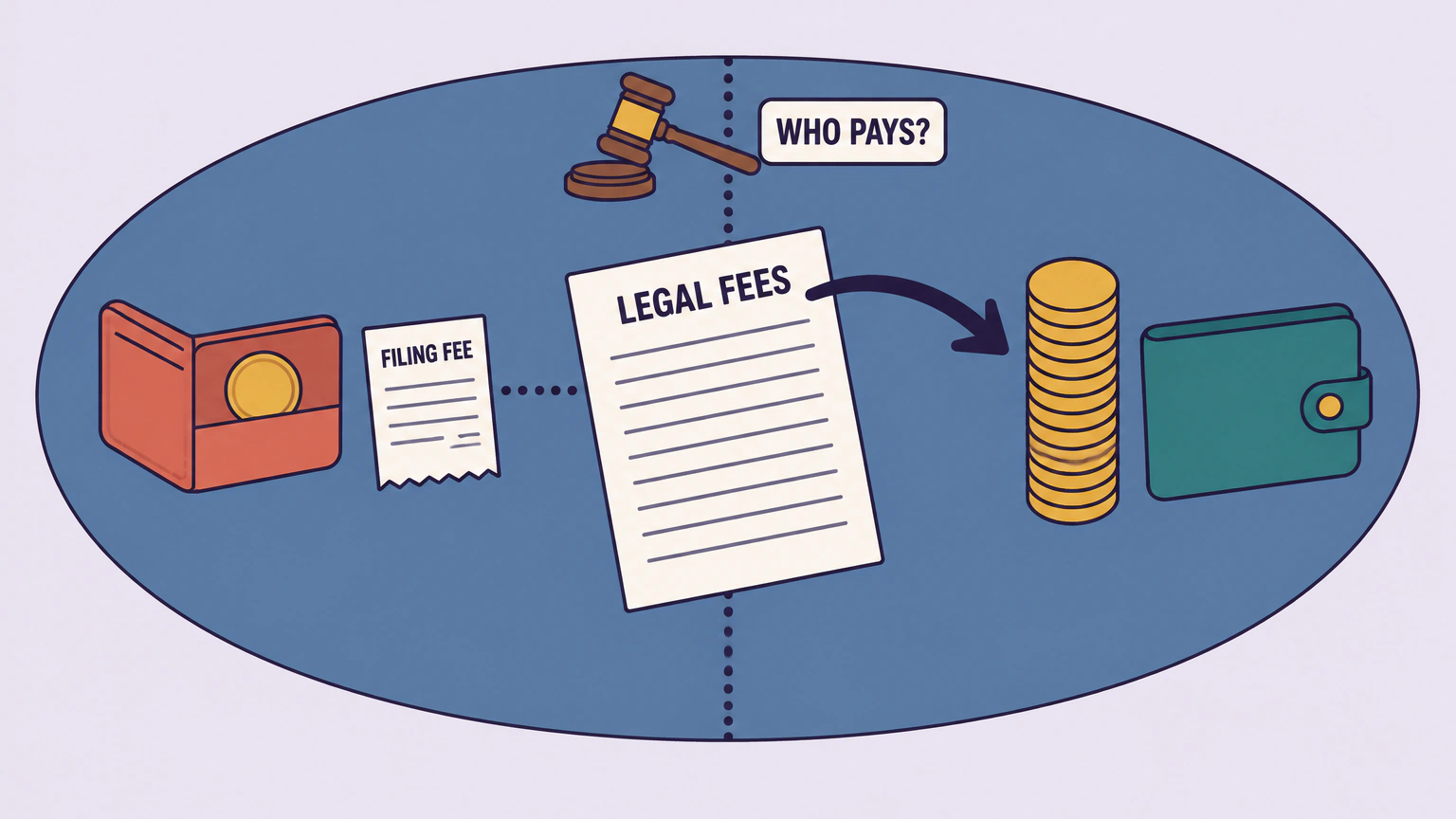
You'll pay the court a filing fee of a few hundred dollars: $435 to $450 in California, and at least $335 in New York. The lawyer is the real cost, and it climbs with every issue you and your spouse can't settle. People surveyed in 2019 paid about $4,100 in total when they agreed from the start, and $20,400 once even one issue went to trial.
If your spouse controls the money, here's the part that can change your math. All eight states we checked give judges some power to make them pay toward your lawyer, and most let you ask while the case is still going.
On this page
Start with the filing fee
The court charges a fee to open your case, and it's a few hundred dollars. California's court self-help site puts it at $435 to $450.
New York splits its fee in two. The fee statute charges $210 for the index number (the number your case is filed under) and $125 more to get a judge assigned and the case on the court's calendar. New York's own court guide adds it up: an uncontested divorce "costs at least $335 in court filing fees." Each later motion or cross-motion normally adds another $45.
Other states set their own amounts, and Nolo notes that in some states the fee even changes from county to county. So the number to trust is the one on your county clerk's fee schedule.
That's how much it costs to file for divorce. Even so, it's small next to what comes next.
If you can't afford the filing fee
You can ask the court to waive it. In California the request form is FW-001, and you only have to meet one of three tests. You get public benefits such as Medi-Cal or CalFresh, or your household income is under a set limit, or you can't cover your household's basic needs and the court fees too.
New York's fee law exempts a "poor person" from the index-number fee. Its court guide also points anyone facing extreme financial hardship to a fee waiver.
Those are the two states we checked. Everywhere else, call your county clerk or the court's self-help center and ask for your state's fee waiver form. There's no shame in asking. That's what the form is for.
What a divorce lawyer actually costs
This is where the money goes. Nolo describes the bulk of a divorce bill as simple arithmetic: the lawyer's hourly rate times the hours spent on your case.
You usually pay for that work through a retainer, which is an advance you hand over at the start and the lawyer draws down as the hours add up. When it runs low, you may be asked for another lump sum. In New York, the written agreement has to tell you up front whether that can happen.
So how much does a divorce lawyer cost by the hour? Clio, a legal software company, currently puts California family lawyers at $410 an hour on average. Its 2025 data puts US lawyers across all practice areas at $349. Nolo's 2019 survey found $270.
Our own cost profiles for divorce and separation attorneys currently show a range of $4,590 to $8,670, based on 801 profiles. That's our own aggregate, a snapshot rather than a national figure, and it's a fair yardstick to hold a first quote against.
Why divorce lawyers bill by the hour
An injury lawyer can take a cut of what you win. A divorce lawyer generally can't.
California's ethics rules ban any family-law fee that depends on getting the divorce or on the amount of support or property you end up with. The American Bar Association's model rule, the model for most states' ethics rules, carries the same ban.
We think the logic is simple. A lawyer paid on the size of the settlement would have a reason to keep the fight going, and you need the opposite.
So there's no percentage deal in a divorce. Hourly billing is the norm, although LegalZoom notes that some lawyers charge a flat fee for a simple uncontested case.
What the law says your fee agreement has to cover
California and New York spell this out, and their rules are worth borrowing wherever you live.
In California, a case expected to cost you more than $1,000 generally needs a written fee contract. You can also ask for a bill at any time. As a rule, the lawyer has 10 days to send it, or up to 31 days after the last bill if you got one within the past month. After that, you can ask again every 30 days.
New York goes further for divorce cases. Its court rules say the written retainer agreement must spell out 13 things. They include what the retainer covers and how any unused part comes back to you, the hourly rate of every person who may bill you, and itemized bills at least every 60 days. You also can't be charged for time spent talking about your bill.
Treat New York's list as a model for what to ask for anywhere. And if you end up changing lawyers partway through, read up on what happens to an unused retainer when you switch lawyers.
How much the fighting adds
The bill follows the fight. The more issues end up argued in front of a judge, the more hours two lawyers bill, and the more you pay. Nolo's 2019 survey is the one public dataset we found that splits the cost this way, and the climb it shows is steep: from about $4,100 when everything was agreed at the start to more than $20,000 once any issue went to trial.
| How the divorce went | Average total cost |
|---|---|
| No lawyers hired | $925 (median $300), mediation not included |
| Lawyers hired, everything agreed from the start | $4,100 |
| Early disputes, all settled without a trial | $10,600 |
| Trial on one contested issue | $20,400 |
| Trial on two or more issues | $23,300 |
Source: Martindale-Nolo Research 2019 divorce survey, as published by Nolo. Averages include attorney fees.
These are 2019 figures, and Nolo itself says, "Average hourly rates are likely to be higher now." The shape of the climb is still the useful part.
Every issue you and your spouse settle between yourselves is one you don't pay two lawyers to argue. In New York, a motion or cross-motion normally carries that $45 court fee, on top of the hours it takes to write. You don't have to give in on what matters to you. You're choosing which fights are worth their price.
The cheaper middle: a lawyer for the hard parts only
Not everyone needs a lawyer for the whole case. In Nolo's 2019 survey, people who hired a lawyer only to consult on specific pieces paid about $4,600 in attorney fees on average, with a median of $3,000. People with a lawyer handling everything paid $11,300 on average.
That middle path suits a divorce that's mostly agreed but has one piece that needs a professional. It might be a pension, the house, or a parenting schedule.
If the parenting schedule is the hard part, take that piece to one of the custody and visitation attorneys in our directory. Ask at the first meeting whether they'll handle that issue on its own, and what it would cost.
When a judge can make your spouse pay your lawyer
Here's the unfair part, and you're right to be angry about it. One spouse runs the business or holds the accounts. The other can't scrape together a retainer. Left alone, that gap can decide the divorce before a judge ever looks at it.
The law has an answer, at least in part. Judges in all eight states we checked have some power to order one spouse to pay toward the other's lawyer. California's court self-help guide explains the point plainly: the money "isn't to punish your spouse or the other parent or to reward you, but to even the playing field so you both have access to a lawyer."
California and Illinois are the two states we checked where an award becomes mandatory on the required findings. In California, when a judge finds a gap in access to money and one spouse can pay for both lawyers, the statute says the court "shall" order it. Illinois requires an interim award when the other spouse can pay and the requester lacks sufficient access to assets or income. New York starts from a presumption that fees go to "the less monied spouse." North Carolina is the narrowest of the eight: it ties the power to alimony.
So who pays attorney fees in a divorce? In these eight states, the answer can be your spouse if you ask and meet your state's test.
| State | Can a judge order your spouse to pay toward your lawyer? | Can you ask before the divorce is final? | The law |
|---|---|---|---|
| California | Yes. If there's a gap in access to money and one spouse can pay for both lawyers, the judge must order it | Yes. You can ask early, even before you hire a lawyer | Fam. Code §§ 2030, 2032 |
| New York | Yes. The law presumes fees go to the spouse with less money | Yes, any time before the final judgment | Dom. Rel. Law § 237(a) |
| Texas | Yes. The judge may award "reasonable and necessary" fees, court costs and expenses | Yes, in temporary orders while the case is pending | Fam. Code §§ 6.502(a)(4), 6.708(c), as amended Sept. 1, 2025 |
| Florida | Yes, after weighing both spouses' financial resources | Yes. Awards can be temporary | Fla. Stat. § 61.16(1) |
| Illinois | Yes. For interim fees, the judge must order enough for the requesting spouse to take part adequately when the other spouse can pay. The requester must also lack sufficient access to assets or income | Yes, as interim fees, and a contribution can also be ordered at the end | 750 ILCS 5/501(c-1), 508(a) |
| Ohio | Yes, all or part, if the judge finds it equitable. Assets, income and conduct can all count | The fee statute doesn't set a timetable | Ohio Rev. Code § 3105.73(A) |
| Washington | Yes, after weighing both spouses' financial resources, and it can cover work done before the case was filed | Yes. The court can order it "from time to time" | RCW 26.09.140 |
| North Carolina | Only for a dependent spouse who qualifies for alimony or postseparation support, and a valid agreement can bar fees if it is performed | Yes, while that spouse qualifies | N.C. Gen. Stat. §§ 50-16.4, 50-16.6(b) |
If you live in another state, ask one of the family law attorneys listed with us, or your court's self-help center, whether your state has a similar rule.
We're not your lawyer, and a fee request is exactly the kind of thing a local family lawyer can size up in one consultation. Ask about it before you pay a retainer.
Ask at the start, not at the end
Most people's instinct is to pay their own lawyer, keep the receipts, and hope the final decree pays them back. The law in most of these states is built for asking early instead.
California's statute tells courts to make sure each side has access to a lawyer, "including access early in the proceedings." A spouse who hasn't hired a lawyer yet can ask the court to order money to hire one. If that's you, you can find a lawyer in California by city and raise the request at your first meeting.
New York tells courts to award fees "pendente lite," which means while the case is pending, so that both sides are represented "from the commencement of the proceeding." Texas judges can build the fees into temporary orders. Illinois calls them interim fees, and Florida allows temporary awards. Ohio's fee statute sets no timetable at all.
The practical move is to bring it up at the very first consultation. Ask the lawyer straight out whether they'll request a contribution from your spouse, and how soon.
What the judge will want to see
A fee request lives or dies on paperwork.
In California, you file a Request for Order (form FL-300) with three attachments: the fee request itself (FL-319), a supporting declaration (FL-158), and a support declaration (FL-157), which the court needs even if you aren't asking for support. You also file an Income and Expense Declaration (FL-150) with proof of your income from the past two months. Filing costs $60 unless you have a fee waiver, or $435 to $450 if these are the first papers you've filed in the case.
In New York, both spouses and their lawyers file an affidavit. It shows the retainer, what's been paid and what's still owed, and the lawyer's hourly rate.
Watch the deadlines, too. File every required financial form on time.
The fee order can run against you, too
Fee awards aren't only about who has more money. California lets a judge order fees as a sanction against a spouse whose behavior makes settling harder or runs up the cost of the case. The spouse asking for fees doesn't have to show any financial need. The judge still has to weigh both spouses' incomes, assets and debts, and can't impose a sanction that puts an unreasonable financial burden on the spouse who has to pay it. Ohio's statute lets judges consider "the conduct of the parties," too.
The habit that keeps your own bill down is the same one that protects you here: cooperate, meet deadlines and try to settle what you can.
Questions people ask about divorce costs
Can I make my spouse pay for my divorce lawyer?
In all eight states we checked, you can ask a judge to order your spouse to help pay. North Carolina limits this to a spouse who qualifies for alimony or postseparation support. California requires an award when one spouse can pay both lawyers and there's a gap in access to money. Illinois requires interim fees when the requester lacks sufficient access to assets or income and the other spouse can pay. New York presumes fees go to the spouse with less money. Ask early and have your paperwork ready.
Does the person who files for divorce pay more?
Not really. The spouse who files pays the fee to open the case, but in California the spouse who responds pays a first-paper fee too, set at the same amount by statute. Who filed first doesn't decide who pays the lawyers. When judges shift fees, they look at each spouse's money and, in some states, at how each one behaved during the case.
How much is a retainer for a divorce lawyer?
There's no standard amount. A retainer is an advance that the lawyer bills hourly work against, and you may be asked for another lump sum when it runs out. Get in writing what it covers and how any unused part comes back to you. New York requires both in the retainer agreement. If you change lawyers, here's what happens to an unused retainer when you switch lawyers.
Will a divorce lawyer work on contingency?
Not for the divorce itself. California's ethics rules bar any family-law fee that depends on getting the divorce or on the amount of support or property, and the American Bar Association's model rule carries the same ban. Expect hourly billing. Some lawyers quote a flat fee for a simple uncontested divorce, so it's worth asking whether yours will.
Can I get the divorce filing fee waived?
Often, yes, if money is tight. In California, you use form FW-001, and you qualify if you get public benefits, if your household income is below a set limit, or if you can't cover basic needs and court fees. New York exempts a "poor person" from the index-number fee. Elsewhere, ask your county clerk or the court's self-help center whether your state has a waiver form.
How much does a divorce cost if we agree on everything?
Far less than a fight. In Nolo's 2019 survey, people who agreed from the start and hired lawyers paid about $4,100 in total. People who used no lawyers at all averaged $925, with a median of $300, not counting mediation. You'll still pay the court's filing fee, which is $435 to $450 in California and at least $335 in New York.
Are divorce lawyer fees tax deductible?
No. The IRS says it plainly: "You can't deduct legal fees and court costs for getting a divorce." The same goes for legal fees for tax advice connected with the divorce and fees you pay to get alimony. Your filing status can change once you're divorced, so read up on how divorce changes your taxes before you file.
Before you sign a retainer
The first consultation is where your bill really gets decided, long before a judge sees anything. Walk in knowing what to ask for, and get the answers on paper before any money changes hands.
Five things to get in writing before you pay a retainer
- The hourly rate for every person who may bill you: the lawyer, any associate, any paralegal.
- What the retainer covers, and how any unused part comes back to you.
- How often you'll get an itemized bill. New York requires one at least every 60 days.
- What happens when the retainer runs out: another lump sum, or monthly bills.
- Whether the lawyer will ask the court to make your spouse contribute, and how soon.
Start with our divorce and separation attorneys page for your area. Take that list to two or three of the lawyers you find there, and compare their answers on items 2 and 5 in particular. Before you sign with anyone, check the lawyer's license first.