


Two questions decide how expensive this gets. What do you owe, and who keeps your file? Both are state law, so how to fire your lawyer cleanly depends on where your case sits. Money first, then the file, then the paperwork.
On this page
- Yes, you can fire your lawyer. Here is the one thing that changes it.
- Before you send anything: five things to do this week
- What firing your lawyer actually costs you
- Can your old lawyer keep your file? It depends on your state.
- How to make the switch, step by step
- If the money is in dispute
- When switching is the wrong move
- Frequently asked questions
Yes, you can fire your lawyer. Here is the one thing that changes it.
Your lawyer works for you, and ending that relationship is your call. One thing changes the mechanics: whether a court is already involved.
The rule almost everywhere: discharge is the client's call.
Almost every state builds its conduct rules on the same framework, and that framework doesn't treat your decision as negotiable. ABA Model Rule 1.16 says a lawyer must withdraw when "the lawyer is discharged," and California's rule says the same.
A model rule binds only where a state adopts it, so your state's version is the one that counts.
The Federal Trade Commission puts the other half plainly: "You might be allowed to fire your lawyer when you want, or you might need a judge's permission."
When court notice or permission is required.
That second half of the FTC sentence is the condition. The model rule tells your lawyer to obey whatever the court requires about notice or permission. California goes further and bars ending things "before that tribunal without its permission."
Where local rules require court action, the switch happens by a filing, not just a letter. If the timing would disrupt a trial date, the judge can refuse.
What firing does not do.
It doesn't automatically erase what you already owe in earned fees or expenses, and it doesn't reset your case clock. Every deadline, any statute of limitations included, keeps running while you look for someone new.
Before you send anything: five things to do this week
Plenty of avoidable trouble happens early, before anybody writes a letter.
- Find and re-read your fee agreement or engagement letter, especially any clause about ending the relationship.
- Write down every deadline you know about, including court dates, filing dates and any statute of limitations your lawyer has mentioned.
- Download or copy everything you already have, including emails, texts, invoices and documents you sent in.
- Ask, in writing, for a current itemized statement of fees and costs. You want this before you terminate, not after.
- Have one honest conversation about the actual problem before you decide. A missed call is not always a failing case.
What firing your lawyer actually costs you
You want to know whether you're about to pay for one case twice. Whether you face one fee claim or several turns on how you were paying, and on your state.
| How you were paying | Write a check now? | What comes back to you | What to ask for in writing |
|---|---|---|---|
| Hourly, against an advance | Maybe; outstanding earned fees and incurred costs are settled | Any advance not yet earned or incurred | Itemized statement of time and expenses to the termination date |
| Flat fee, paid up front | Maybe; check when the agreement and state rule treat it as earned | Any unearned portion required by the governing rule | A breakdown of scope items completed |
| Contingency | Maybe; check the agreement for advanced costs and termination terms | No automatic fee refund; confirm costs already paid or advanced | Statement of costs advanced, hours claimed and any lien or fee election |
| "True retainer" for availability | Maybe; check the agreement and state rule | California's rule excludes a true retainer from its refund duty | The clause saying what the money bought |
If you pay by the hour or from an advance.
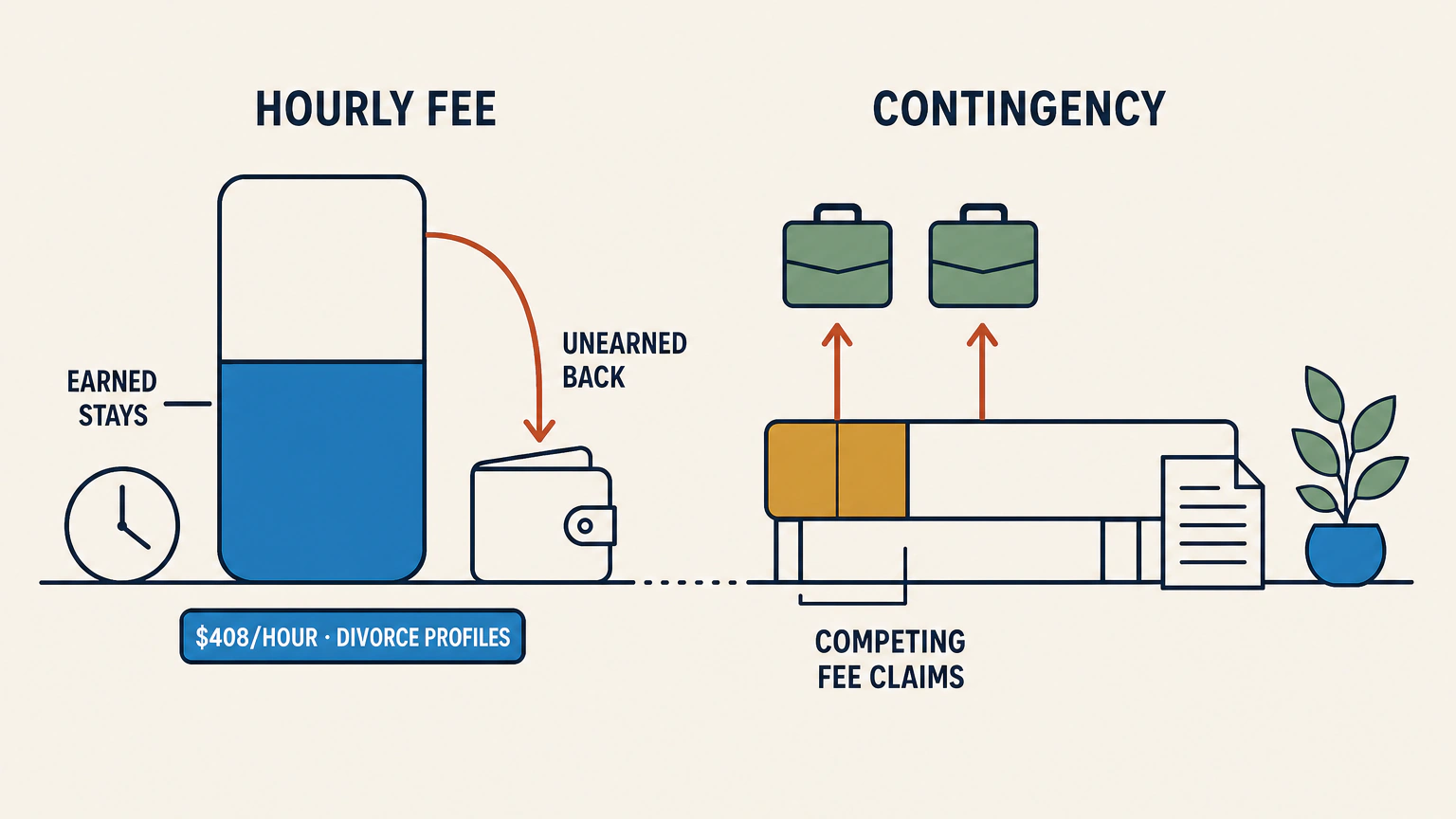
You generally owe the fees your lawyer earned and the expenses already incurred, on the terms your agreement sets. Anything you paid up front that nobody has earned yet comes back, promptly. ABA Model Rule 1.16(d) requires a refund of "any advance payment of fee or expense that has not been earned or incurred," and California's rule applies the same test.
Ask for an itemized statement, not a number.
To check it you need to know what the fee is supposed to be in the first place, and some states set that by statute. For a yardstick, across our divorce and separation attorneys the average per-hour figure is $408.
How to read that figure: $408 is Legal Directorate's own platform-generated number, from 801 cost profiles in divorce and separation. Criminal defense comes out at $354 across 874 profiles. We publish no methodology behind either, so treat them as a yardstick, never a quote.
If you are on a contingency fee.
A contingency fee generally pays your lawyer out of what you recover. What catches people is expenses: your agreement may still make you responsible for case costs, even when there's no recovery. And firing the lawyer before settlement can leave the old firm with a lien or another claim for work it finished.
Picture one recovery with two firms that may both have a claim on it. Oregon's statute measures the outgoing lien by the fee agreed with the client or, absent agreement, "the reasonable value of the services." In Missouri and New York, the lien survives a settlement you and the other side reach on your own.
How those claims get resolved between old and new counsel depends on your state and your facts. We're not going to hand you a formula, because there isn't an honest one. Ask the incoming firm to put its answer in writing before you sign. Good personal injury attorneys do.
The "true retainer," the one word that changes the refund.
Under California's rule, some money you pay up front isn't an advance against future work. A true retainer buys availability, and California's refund duty doesn't reach it: the rule excludes "a true retainer fee paid solely for the purpose of ensuring the availability of the lawyer."
What you wrote on the memo line decides nothing. Read what the agreement says the money bought. If it secures availability rather than work, expect an argument.
Can your old lawyer keep your file? It depends on your state.
Your file is your case, and a new lawyer who can't get it starts from a standing stop. This is where the answer genuinely flips at the state line.
Some states hand your old lawyer a statutory lien over your papers until the bill is paid. Others make the firm return the file on request, paid or not. Even the model rule hedges. Right after telling lawyers to surrender your papers, it adds that they "may retain" them "to the extent permitted by other law."
Two different liens, and why the difference matters to you.
A retaining lien claims your papers. The file itself, held until the bill is settled.
A charging lien claims your money. The settlement or judgment at the end.
A retaining lien can slow a handoff by keeping documents from your new lawyer. A charging lien can change how a recovery is distributed.
| State | Source | Lien on your file or papers? | Claim against your money or recovery? |
|---|---|---|---|
| California | Rules of Professional Conduct 1.16(e), eff. June 1, 2020 | No. Must "promptly ... release ... all client materials and property," "whether the client has paid for them or not" | Refund of any unearned advance, except a true retainer. The lawyer may still sue for the money |
| Iowa | Iowa Code § 602.10116 (2026) | Yes. On "any papers belonging to a client which have come into the attorney's hands" | Yes. On money the attorney holds, and on money the adverse party owes you once written notice states the amount |
| Washington | RCW 60.40.010 | Yes. "Upon the papers of the client, which have come into the attorney's possession" | Yes. On money held by either side, on the action and its proceeds, and on a judgment; the last two rank "superior to all other liens" |
| New York | N.Y. Judiciary Law § 475; common-law retaining-lien cases | Yes, if discharged without cause. An attorney in possession may have a common-law retaining lien; a court may order turnover after a fee hearing in exchange for payment or adequate security | Yes, from the start of the case, on any verdict, award, settlement, judgment or final order in your favor and its proceeds, which no settlement between the parties can defeat |
| Missouri | Mo. Rev. Stat. § 484.130 | Not addressed | Yes, from commencement or service of an answer with a counterclaim, on your cause of action; also unaffected by a settlement, before or after judgment |
| Minnesota | Minn. Stat. § 481.13, subd. 1 to 2 | Not addressed | Yes, from service of the summons, on the cause of action and your interest in money or property, under an express or implied fee agreement. Real-property liens need owner notice within 30 days |
| Oregon | ORS 87.430, 87.445 | Yes. ORS 87.430 covers client papers, personal property and money in the lawyer's possession | Yes, on the case and any judgment or award in your favor, for the fee agreed with the client or, absent agreement, "the reasonable value of the services" |
| Montana | Mont. Code Ann. § 37-61-420(2), (3), (5) | Not addressed | Yes, to a settlement, decree, verdict, arbitration award or judgment in your favor. No lien on property outside the matter without your written consent |
What eight jurisdictions actually say.
The contrast is the point. Iowa, Washington and Oregon have statutes whose liens reach client papers, and New York recognizes a common-law retaining lien when counsel is discharged without cause. California runs the opposite way and keeps the lawyer to a money claim instead. Same problem, opposite answers, settled by a state line you had no say in.
Two of those states hand you a route through the court. New York's lien statute lets a court act "upon the petition of the client or attorney." Minnesota lets any interested person have the amount decided summarily.
If your state is not in the table.
We read the statutes and rules in those eight states. We didn't read the other forty-two, and we won't guess. Three steps get you your own answer:
- Search your state's code for "attorney's lien" or "charging lien," usually under a professions or liens title.
- Check your state bar's client-resources pages, which often explain the rule plainly.
- Ask any lawyer you're thinking of hiring how the rule applies to your file.
How to make the switch, step by step
Once you know what you owe and where your file stands, the rest is short.
Line up the replacement first (with one exception).
Ask the lawyer you're considering whether they want to be hired before or after you fire the current one, then plan the handoff so no deadline slips through the gap.
Before you sign, check that the replacement is licensed and in good standing.
The termination letter.
It doesn't need to be an argument. Write it, date it, keep proof it arrived. Six things belong in it:
- A clear opening sentence stating that you are ending the representation, effective on the date of the letter.
- A request that your complete file be released, and where to send it.
- A request for a final itemized statement of fees and costs to that date.
- A request for the refund of anything paid in advance and not yet earned.
- The name and contact details of your new lawyer, if you have one.
- A record of delivery, meaning certified mail or email with a read receipt kept, plus a copy of everything for yourself.
Substitution of counsel, the court, and moving the file.
In a filed case, local rules may call for a substitution of counsel, a motion to withdraw or some other filing. Ask incoming counsel who prepares it.
Who notifies the other side, or the adjuster on an injury claim, depends on those same rules and on the kind of case. Then follow the file until it lands on the new desk. Requested is not delivered.
If the money is in dispute
Before you argue about the total, get the arithmetic in writing.
Ask for the itemized accounting first.
Ask for a statement showing the dates, who did the work, the time recorded, the task, the rate applied and every cost advanced, through your termination date.
Then do the dull part. Read it against your own calendar and email, and write back naming every entry that looks duplicated or covers work you never asked for.
Fee arbitration, with California's client-triggered mandatory rule.
Fee arbitration is a bar-run process for deciding what you actually owe. Some programs offer a faster and less expensive route than court.
California's version is client-triggered, and its business and professions code spells it out. Arbitration is voluntary for you and mandatory for the attorney if you start it. There's a trap in the timing. If your lawyer sends the required notice and you don't ask for arbitration within 30 days, you have waived it. Once an award is served it binds 30 days later, unless somebody asks for a trial.
That is California, not the country. Many bars run their own programs on their own terms, so ask yours what it actually offers.
Keep three doors separate. A fee dispute is about money. A discipline complaint is about conduct. A malpractice claim is about harm. California's program excludes claims for affirmative malpractice damages.
Stop and get help if any of this happens.
- The old firm won't release your file and won't name the rule it relies on. Ask for that rule in writing, then ask your state bar whether it has a client-assistance contact.
- Your advance money is unaccounted for and no statement arrives. Put the request in writing, dated, then ask your bar about its fee-dispute program.
- Somebody tells you the case can't be transferred at all. In a filed case a transfer is a court process; ask the lawyer you're interviewing how it works.
- You're pushed to sign a release of all claims to get your file back. Don't sign under a clock. Get a second opinion.
When switching is the wrong move
Sometimes switching is an expensive answer to a cheap problem. We'd tell you to stay put in three situations.
Three situations where staying is the better call, and the second-opinion alternative.
The first is late-stage timing. With a hard date weeks away, a new lawyer must read the whole file and may have to ask the court to move that date. The court can refuse.
The second is a strategy disagreement, which is often a communication failure in disguise. Ask your lawyer to walk you through the reasoning.
The third is a case other firms already declined. If nobody wants it, the problem may be the case, and a new name on the letterhead won't change that.
Pro tip: consider a second opinion. You can pay a different lawyer for one consultation to review your file without leaving the firm you are with. Ask what it would cost before you decide whether to switch.
Frequently asked questions
Can I fire my lawyer at any time?
Almost always, yes. It's your decision, and under the conduct rules most states follow, being fired is a reason your lawyer must stop, not something they can refuse. The wrinkle is a case already in court, where local rules may require notice to the judge or the judge's permission.
Will I have to pay two lawyers if I switch?
Not necessarily, but don't assume there'll be only one fee claim. On an hourly or advance arrangement you owe the earned fees and the costs already incurred, and any refundable unearned advance comes back. On a contingency matter both firms may have claims, and your agreement may leave case expenses with you.
Can I get my retainer back if I fire my lawyer?
That depends on what the money was for. The model rule most states build on calls for a prompt refund of an advance not earned or incurred, but your state's rule and your agreement govern. California carves out a true retainer paid solely to reserve the lawyer's availability.
Can a lawyer refuse to give me my file?
In some states, yes. Iowa, Washington and Oregon statutes provide liens over client papers, and New York recognizes a common-law retaining lien when counsel is discharged without cause. California runs the opposite way and requires prompt release of client materials on request, paid or not, subject to the restrictions its rule sets.
Do I need the judge's permission to change lawyers?
If your matter is pending before a court, possibly. Local rules may require notice, a substitution filing or the judge's permission, and a judge can decline a withdrawal that would disrupt the case. If nothing has been filed, court permission may not come into it, but check your agreement and local rules first.
Does it look bad to switch lawyers?
The timing and the circumstances matter more than the fact of a switch. A change requested days before trial, especially after earlier substitutions, may raise questions about delay. A change made early, for a reason you can state in one sentence, reads differently.
Can I fire my lawyer by email?
Email can document your notice, and there's nothing magic about paper. Check your fee agreement and any court rules first, though: an email doesn't replace a substitution or withdrawal filing your case may require. Keep proof of delivery and a copy.
What can I do if my former lawyer's final bill is too high?
Start by requesting an itemized statement of time, tasks, rates and costs, then write back identifying the entries you dispute. If that gets you nowhere, ask your state or local bar whether it offers fee arbitration or another fee-dispute program. Availability and terms vary.
One last note. We're not your lawyer, and this isn't advice about your matter. File-return, lien and conduct rules are state law and they change, so confirm your state's current rule before you act on it. Then take the next step: ask for the itemized statement, and browse verified providers by service when you're ready to line up someone new.