

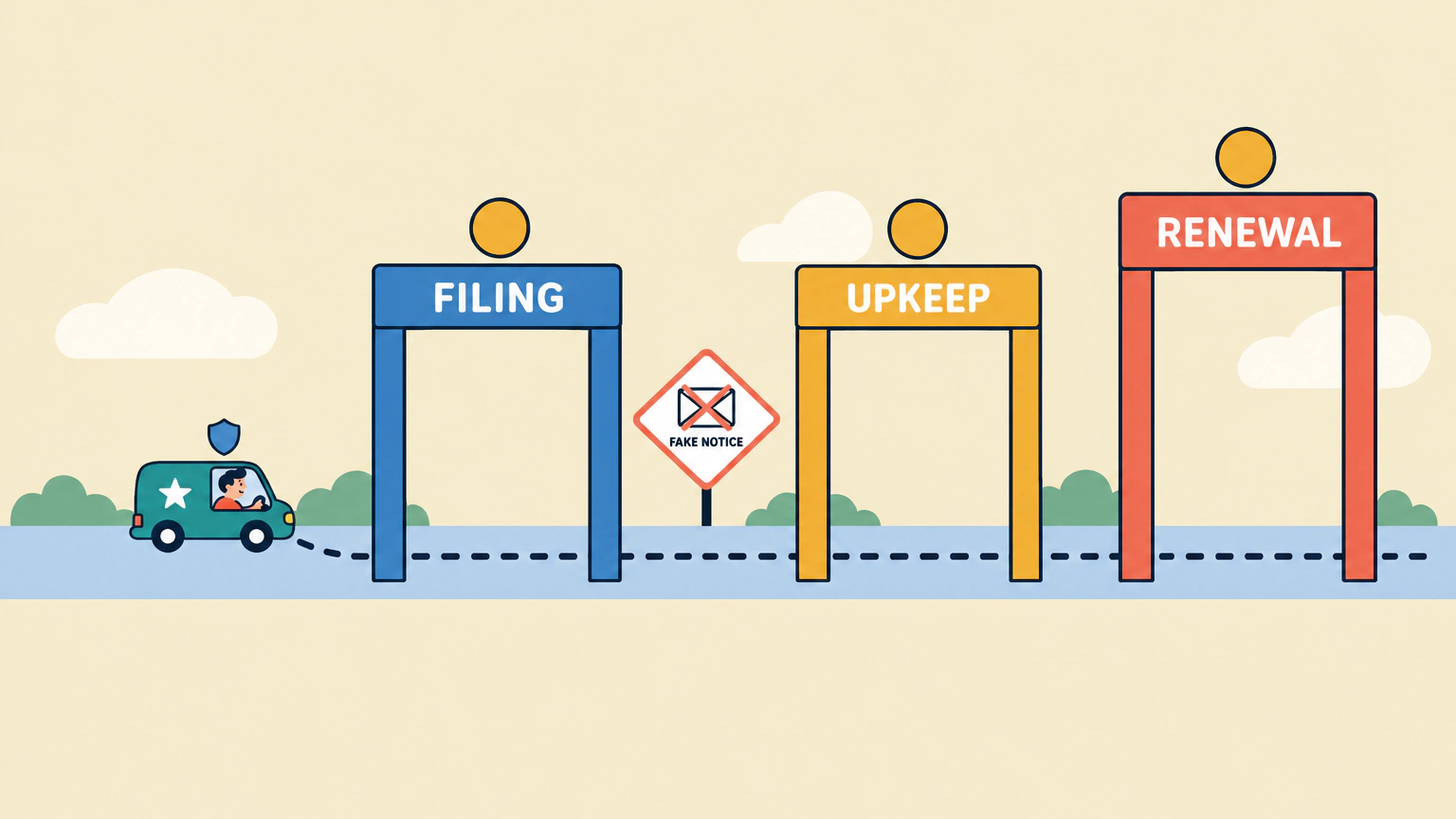
The U.S. Patent and Trademark Office (USPTO) charges $350 per class of goods or services for each version of your mark you file online. If you describe your goods in your own words, it's $550 or more a class. Keeping the registration costs another $975 a class over its first 10 years. A lawyer or filing service adds its own fee on top. And an unsolicited renewal offer from a private company isn't a USPTO bill.
On this page
- What the USPTO charges to file a trademark
- Three choices that set your filing fee
- Your name, your logo, or both
- Work out your own USPTO bill
- What a lawyer or filing service adds
- What it costs to keep your trademark
- The renewal notices and calls you don't have to pay
- Questions people ask about trademark costs
What the USPTO charges to file a trademark
The base fee is $350 for each class of goods or services when you file online in Trademark Center, the USPTO's filing system. One application covers one trademark. In the USPTO's own example, golf shirts, dress shirts and T-shirts all sit in one class, so the fee is $350. Add custom T-shirt printing and you're in two classes, so it's $700.
The USPTO's line on refunds is short: "Generally, we don't refund fees." That holds even when a mark is refused. Paper filing costs $850 a class, for the rare cases when you can't file online.
If you remember a lower number, it's probably an old one. The $250 application tier and the $225 Section 8 fee that some pages still quote are pre-2025 figures, replaced when the USPTO's 2025 fee rule took effect on January 18, 2025. Here are the main fees you could meet before registration.
| Fee | USPTO amount | When it applies | How to keep it off your bill |
|---|---|---|---|
| Base application, filed online | $350 per class | Every application | List only the classes you need |
| Wording typed or pasted into the free-form box | $200 more per class | At filing | Pick your goods or services from the ID Manual |
| Each extra 1,000 characters of free-form wording | $200 more per class affected | Past the first 1,000 characters in a class | Keep custom wording short |
| Missing required information | $100 more per class | At filing, or when an examiner spots the gap | Fill in every required field before you submit |
| Paper application | $850 per class | Only when you can't file electronically | File online in Trademark Center |
| Statement of use or amendment to allege use | $150 per class | Intent-to-use applications only | File on a use-in-commerce basis if you meet its rules |
| Extension to file the statement of use | $125 per class, each time | Each six months you need, up to five | Start using the mark before the first six months run out |
| Extension to answer an office action | $125 | When you need three more months to reply | Reply within the first three months |
| Petition to revive an abandoned application | $250 | After a missed deadline | Watch your record in TSDR |
Three choices that set your filing fee
The USPTO says your trademark cost depends on three things: how many classes you list, how complete and complex your application is, and whether you're already using the mark. You settle the first two at your desk before you file. The third depends on where your business stands today. Make all three choices on purpose, because nearly every extra charge that follows is billed per class.
How many classes you list
Goods and services are sorted into 45 numbered classes, and every class you add is another $350. The two never share a class, which is why the shirt line with a printing service pays twice. List the classes you sell in now, or genuinely plan to. The USPTO warns that claiming goods you don't intend to sell can mean extra proof of use, an audit after registration and, if you overclaimed on purpose, a canceled registration. Add a class after filing and you'll pay its base fee then. And every class you register is one you pay to keep, $975 more over the first 10 years.
One worry you can set down. The USPTO says a trademark gives you no rights to a word in general, "only to how that word or phrase is used with your specific goods or services." A business selling something unrelated under a similar name usually isn't a reason to buy extra classes.
Whether your wording comes from the ID Manual
This is where you can avoid an extra charge. The ID Manual is the USPTO's list of pre-approved descriptions of goods and services. Pick yours from it in Trademark Center and you stay at the base fee. Type your own into the free-form box and it's $200 more a class. Pasting ID Manual wording into that box costs the same $200. So does leaving a fill-in-the-blank entry empty or filling it with something unrelated.
Length costs money too. Past the first 1,000 characters in a class, spaces and punctuation included, each further 1,000 adds another $200 for that class. Once any free-form text is in a class, every character there counts, ID Manual picks included. In the USPTO's examples, one class at 1,001 characters costs $400 in extra fees. Two classes, one at 1,000 characters and one at 1,001, cost $600 extra. Trademark Center shows a character counter and makes you tick an acknowledgment box before it charges you.
Then there's $100 a class for missing required information. The USPTO's examples include your domicile address (your permanent home or main place of business), your legal entity type and a properly signed declaration. Your mark may also need an English translation of foreign words, written consent from a living person whose name or likeness it uses, and a description and claim of any color. The fee lands on every active class, and an examiner can charge it after you file.
Whether you're already using the name
If your use meets the USPTO's use-in-commerce rules, you can file a use-based application without a later statement of use or extensions for it. Selling only to local customers doesn't always qualify. If you plan to meet those rules later, you can file on an intent-to-use basis. That lets you apply before launch, and it costs more later.
The first extra is $150 a class for the statement of use, the filing that shows the mark is now in use. Filed before your application is approved for publication, it's called an amendment to allege use, at the same fee. Once your mark is published and the 30-day window for others to oppose it closes, the USPTO issues a notice of allowance. You then have six months to file the statement or ask for more time.
Each extension is $125 a class, up to five. Every six-month period counts from the notice date, not from your last extension. If you haven't started using the mark and filed the statement within three years of the notice, the application is finished and you start again.
Worked example: one class, two extensions and wording from the ID Manual. That's $350 + $150 + $250 = $750 to get registered.
Your name, your logo, or both
An application covers one trademark, so a name and a logo are two applications and two sets of fees. The USPTO describes the two forms a mark can take. A standard character drawing is the words alone, with no styling, color or design. A special form drawing is stylized, in color, or a design.
A standard character registration generally gives the broadest protection, because it covers the words in any lettering or color. The USPTO notes that "Small businesses without a lot of financial resources often elect to only file a standard character drawing of their trademark." Its own example runs the other way: a famous sportswear brand might file four applications, for the plain word, the stylized word, the logo, and the logo with the word.
Here's what doubling costs. A clothing brand in two classes that files its name and its logo pays 2 × 2 × $350 = $1,400 to file. By the end of year 10, it's paid the USPTO $5,300. A logo in color also needs that color described and claimed, or the $100 missing-information fee applies.
If the budget covers one filing, we'd file the name in plain text first. If the name belongs to a company you're forming now, that's two jobs. The company paperwork is work for a business attorney, and the trademark belongs with an intellectual property attorney.
Work out your own USPTO bill
Have four answers ready: how many versions you're filing, how many classes each needs, how you'll describe your goods or services, and your filing basis. For intent-to-use filings, add the six-month extensions you expect. You'll get two figures back, the USPTO's charge to get you registered and your total by the end of year 10 if you keep every class and file on time.
Some fees stay out of that total because nobody can predict them at filing: the $100 missing-information fee, the $125 office action extension, the $250 revival petition, grace-period fees, the optional Section 15 declaration, and any lawyer or service fee. That last one is the next thing to price.
USPTO Trademark Fee Estimator
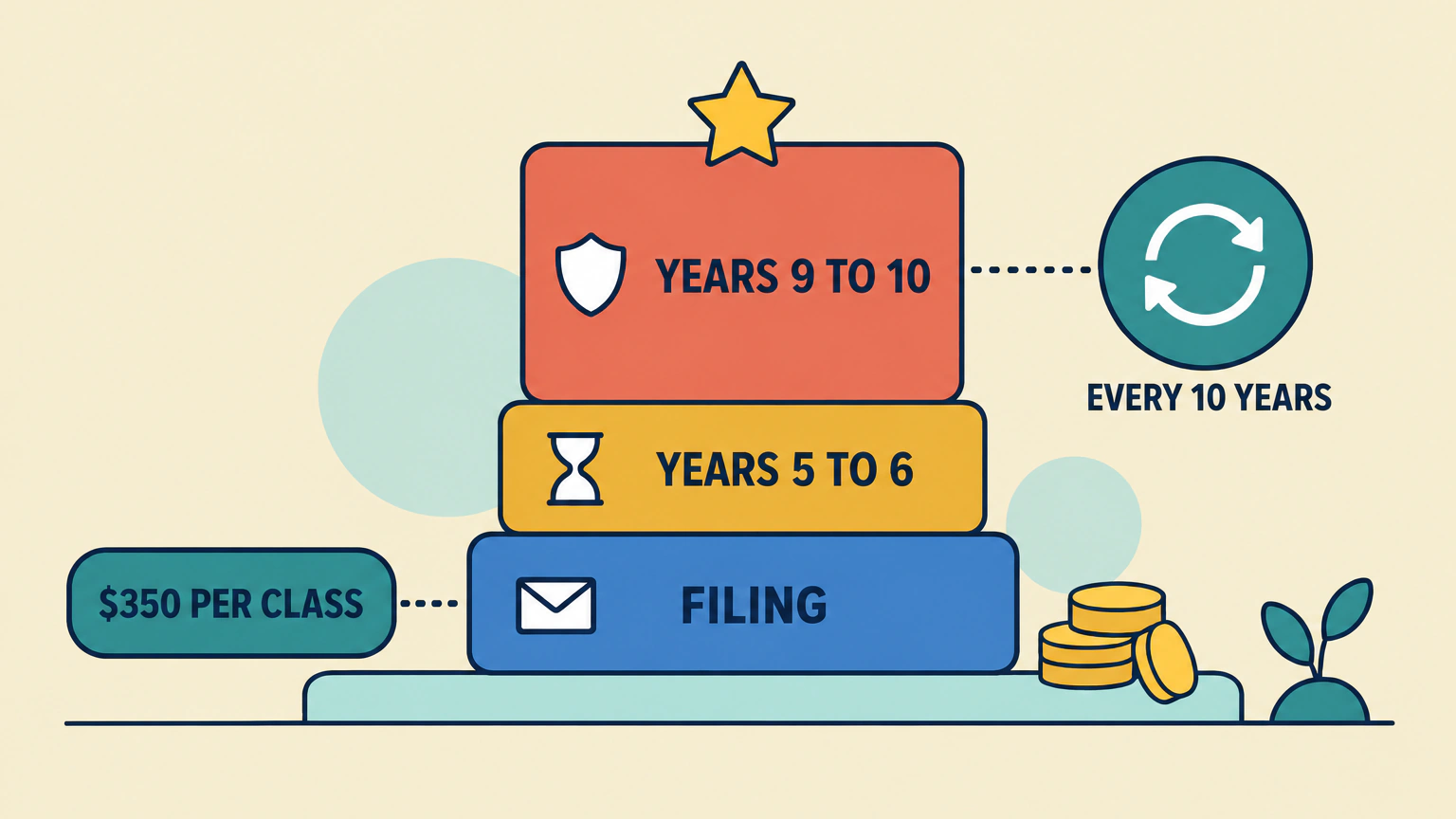
Each version of your mark is its own application, and the USPTO charges for every class in it. Per class, that's $350 to file, $325 between years 5 and 6, then $650 between years 9 and 10 and every 10 years after that.
Every class is a separate fee. Count only what you sell, or genuinely plan to. With more than one version, each is counted with this many classes.
Enter a number of classes from 1 to 45.
You get six months after the USPTO's notice of allowance, then up to five extensions at $125 a class each.
Extensions are only for intent-to-use filings.
USPTO fees to get registered: $350
By the end of year 10, if you keep every class: $1,325
- Filing: 1 × 1 × $350$350
- Years 5 to 6, Section 8: 1 × 1 × $325$325
- Years 9 to 10, Sections 8 and 9: 1 × 1 × $650$650
Filing 1 version in 1 class each, you'd pay the USPTO $350 to get registered and $1,325 by the end of year 10.
Enter a number of classes from 1 to 45.
Not in this total
- $100 a class if required information is missing.
- $125 if you need three more months to answer an office action.
- $250 to revive an application after a missed deadline.
- $100 a class for each maintenance filing made in the six-month grace period.
- The optional Section 15 declaration, $250 a class.
- Any lawyer or filing-service fee.
What a lawyer or filing service adds
If you're domiciled in the US, you don't have to hire a lawyer to file. If you're domiciled abroad, you must use a US-licensed attorney. Even when it's optional, the USPTO says "we strongly encourage you to hire" one. Its own fees stay the same whoever files. Whatever you pay for help comes on top.
An attorney can do what a form can't. First comes a clearance search before you file, across the federal register, state registers and unregistered marks already in use, plus a legal opinion on what it turns up. Later, an attorney answers office actions, the examiner's letters listing problems with your application. Most application office actions give you three months to reply, plus an optional three more for $125. Miss the deadline and the application is abandoned, and reviving it takes a $250 petition.
We're not your lawyer. If a search turns up a name close to yours, that's the moment to pay for one.
Filing companies aren't law firms, and the USPTO says it doesn't endorse them. It does list free and reduced-fee help: its Law School Clinic Certification Program, the American Bar Association's list of pro bono IP resources, and the International Trademark Association's pro bono clearinghouse pilot.
When you compare two or three intellectual property attorneys, get each firm's flat-fee terms in writing and ask what happens to your fee if the search finds a conflict. Then check they're licensed before you sign anything.
| Route | Price before USPTO fees | What it includes | Watch for |
|---|---|---|---|
| Filing it yourself in Trademark Center | $0 | Nothing. You choose the classes, the wording and the specimen. | The $100 and $200 surcharges land on you |
| Rocket Lawyer trademark service | From $350 or $400 (its two pages differ), with a Plus membership at $249 a year or Pro at $349 a year | Attorney support with the application | Help with an office action is extra, from $79.99 for members |
| LegalZoom Trademark Registration | $899 | Federal and common law search, attorney filing, replies to minor procedural office actions | Monitoring is included for three months, then renews at $249 a year until you cancel |
| A USPTO-certified law school clinic | Free or reduced | Law students working under a faculty supervisor | Check whether a clinic near you is taking clients |
| A private trademark attorney | Flat fee or hourly, set by the firm | Whatever the engagement letter lists | Ask what happens to your fee if the search finds a conflict |
What it costs to keep your trademark
Nothing is due to the USPTO every year. Your first maintenance filing is a Section 8 declaration, a statement that you're still using the mark, due between the 5th and 6th years after registration. Between the 9th and 10th years, and every 10 years after that, you file Section 8 again along with a Section 9 renewal. Each deadline has a six-month grace period that costs extra. Miss that too, and the registration is canceled or expires.
If your mark is on the Principal Register, the USPTO's main register, and meets the legal requirements, you can add an optional Section 15 declaration. These include five years of continuous use after registration and no pending court or USPTO challenge or final decision against your rights. The declaration makes your right to use the mark "incontestable," with exceptions the law lists. Filed together, Sections 8 and 15 replace the plain Section 8 filing rather than adding to it.
The USPTO sends courtesy reminder emails, but you must file on time even if one never arrives. It suggests filing early in the window, so you can fix a rejected filing without extra fees. If a lawyer handles these filings, expect their fee on top. For one class, the 10-year math is $350 to file, $325 at years 5 to 6 and $650 at years 9 to 10. That's $1,325 in all.
| When it's due | What you file | USPTO fee per class | Filed in the six-month grace period |
|---|---|---|---|
| Between the 5th and 6th years after registration | Section 8 declaration of use | $325 | $425 |
| The same window, as an option | Section 8 plus a Section 15 declaration of incontestability | $575 | $675 |
| Between the 9th and 10th years, then every 10 years | Section 8 declaration plus Section 9 renewal | $650 | $850 |
What happens if your registration gets audited
Once you've filed a Section 8 declaration, the USPTO can randomly audit your registration. A registration qualifies if it lists at least four goods or services in one class, or at least two in each of two or more classes. An audit asks for proof of use for two more goods or services in each audited class.
If you delete goods or services while your Section 8 declaration is pending, you pay $250 for each class with deletions, every time. A $100 deficiency surcharge can apply too, depending on when you filed and when you fix it. Deleting them between maintenance filings costs nothing, and so does leaving them out of the declaration itself. If audit fees go unpaid, the whole registration is canceled.
The practical rule: before year five, cut anything you've stopped selling.
The renewal notices and calls you don't have to pay
Around the time your maintenance filings come due, mail can start arriving from private companies that have nothing to do with the USPTO. The USPTO's own warning is blunt: "many are fraudulent and should be avoided." These notices borrow official-sounding words like "United States," "Trademark," "Office" and "Agency." The fine print often admits the company isn't a federal agency.
Mail is only one route. Some scammers call with spoofed caller ID and use real USPTO employees' names, some email you with your serial number to look genuine, and some sign you up for real USPTO alert emails and then call about them. They often push you to pay right now, with a threat to your trademark rights attached.
The USPTO never asks for payment information by phone, email or text. It never requires payment by wire transfer, gift card, cash, check or money order to a third-party address. Offers to record your mark in a private registry are, in the USPTO's words, services "of dubious value." Never give anyone your USPTO.gov password, because an attorney files through their own account.
Your real record lives in TSDR, the USPTO's free status and document lookup. If one of these notices already got you, the blame sits with whoever dressed it up as official. If you've paid a lookalike, a consumer protection attorney can tell you what your state lets you do about it. It's the same pattern with tax debt: a private company borrows a government office's look and charges for something you can do directly.
Before you pay anything about your trademark:
- Find the letter or email in your record in TSDR, under the Documents tab. If it isn't there, it didn't come from the USPTO.
- Check the sender. USPTO emails come from addresses ending in @uspto.gov, and its websites end in uspto.gov.
- Read the fine print. A lookalike notice often admits somewhere that the company isn't a federal agency.
- Check your real deadline in TSDR. Your first maintenance filing falls between the 5th and 6th years after registration, whatever a letter says.
- Call the Trademark Assistance Center at 1-800-786-9199 if you're unsure. Report fakes to [email protected].
- Keep your USPTO.gov password to yourself. An attorney who files for you uses their own account.
Questions people ask about trademark costs
Is a trademark a one-time fee?
No, but nothing is due every year either. You pay the filing fee once per application. After registration, you pay $325 a class between years 5 and 6, then $650 a class between years 9 and 10. That $650 filing comes back every 10 years for as long as you use the mark and want to keep the registration.
Do I get my money back if the USPTO refuses my trademark?
Generally, no. The USPTO doesn't refund fees, and it says filing doesn't guarantee registration. A refusal usually starts as a nonfinal office action, though. You get three months to answer that refusal, with an optional three more for $125. So the fee isn't lost the moment a problem letter arrives. A good answer can still get the mark through.
How much does it cost to trademark a name and a logo?
It's two applications, so it's twice the fees: $700 to the USPTO at the base fee with one class each, before any lawyer. The doubling follows every class you add, so a name and a logo in two classes each come to $1,400. If money is tight, file the name in plain text first. It gives the broadest protection for a single fee.
Can I trademark a name for free?
You can't register it federally for free, but you can own it. The USPTO says you become a trademark owner as soon as you use the mark with your goods or services, and those rights reach only the area where you do business. You can put "TM" (goods) or "SM" (services) beside it without filing. The ® comes only after registration. USPTO-certified law school clinics help with filing free or at reduced fees.
Does a trademark cost more in Texas or California?
No. The USPTO's fees are the same in every state. States also run their own trademark registers, with fees set under state law. Texas, for example, sets its fees by Secretary of State rule. But a state registration is a separate filing that works only at the state level. Nationwide rights come from the federal registration.
How much does a trademark lawyer charge to file?
There's no single rate. Firms set flat fees or bill by the hour, and the USPTO's fee comes on top either way. The published prices we found run from Rocket Lawyer's member price of $350 or $400, plus the membership, to LegalZoom's $899 package. Before you hire anyone, ask what happens to your fee if the clearance search finds a conflict. Some firms bill only the research time and refund the rest.
What happens if I miss my trademark renewal deadline?
You get a six-month grace period, at an extra $100 a class for each filing. At the 10-year renewal, where Sections 8 and 9 go in together, that's $850 a class instead of $650. After the grace period, the registration is canceled or expires. Getting federal protection back means filing a brand-new application and paying the filing fees again.