

On this page
- The short answer, and the three-part test
- The number that changes the decision: how often the IRS says yes
- What the free and near-free routes actually cost
- Who is legally allowed to represent you
- Nine warning signs, and what to do about each
- What a legitimate engagement looks like on paper
- The cost of an application that was never going to work
- Free help you may already qualify for
- If you already paid a company and nothing happened
- Deciding your own next step
- Frequently asked questions
The short answer, and the three-part test
You owe the IRS money, and someone is promising to make most of it go away for a fee you pay first. Some of these companies are legitimate. Some are not. The advertising will never tell you which one is on the phone.
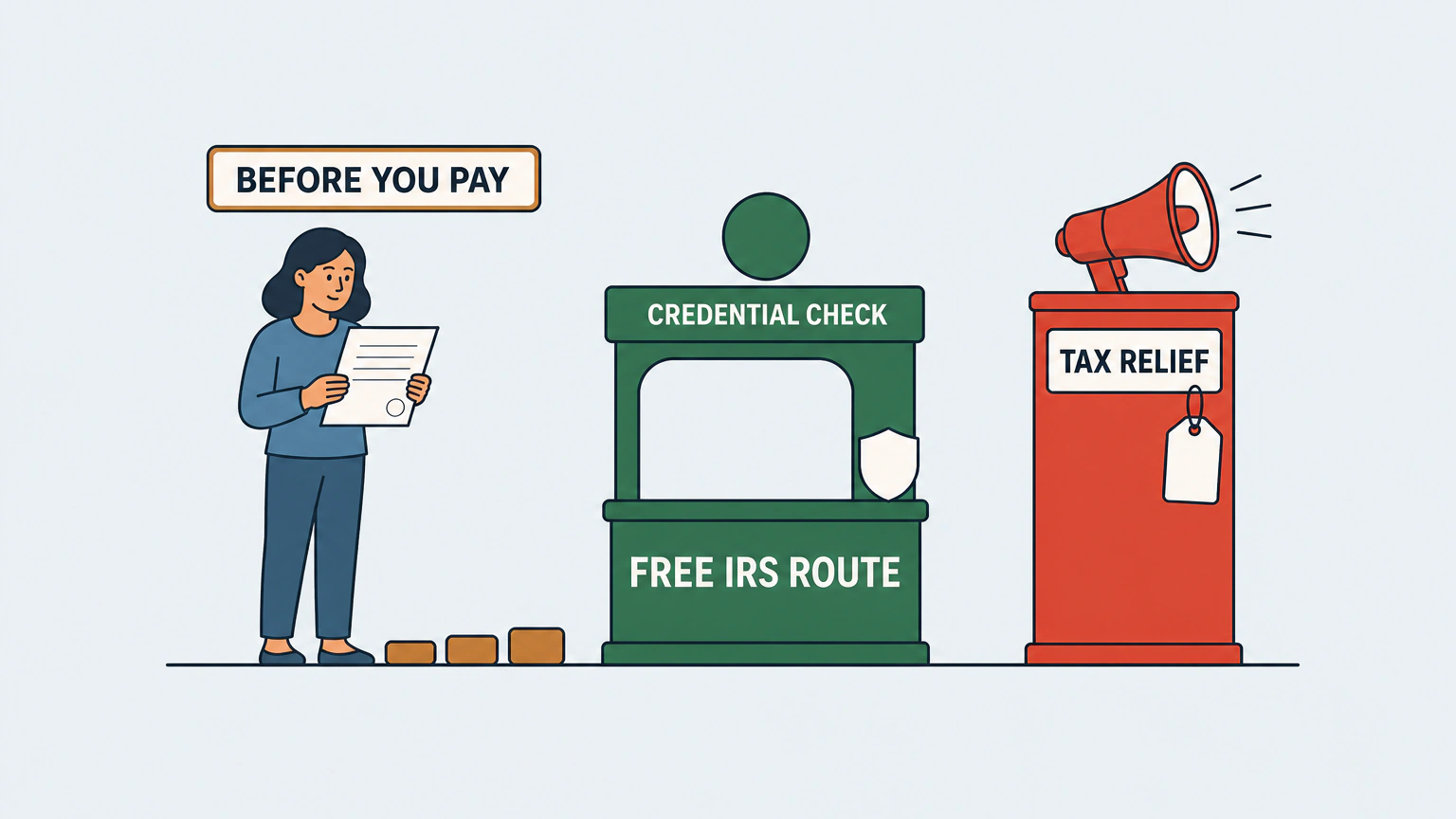
Three things will. Whether a named attorney, CPA or enrolled agent will actually represent you. How the fee is built. Whether anyone quoted you an outcome before looking at your finances.
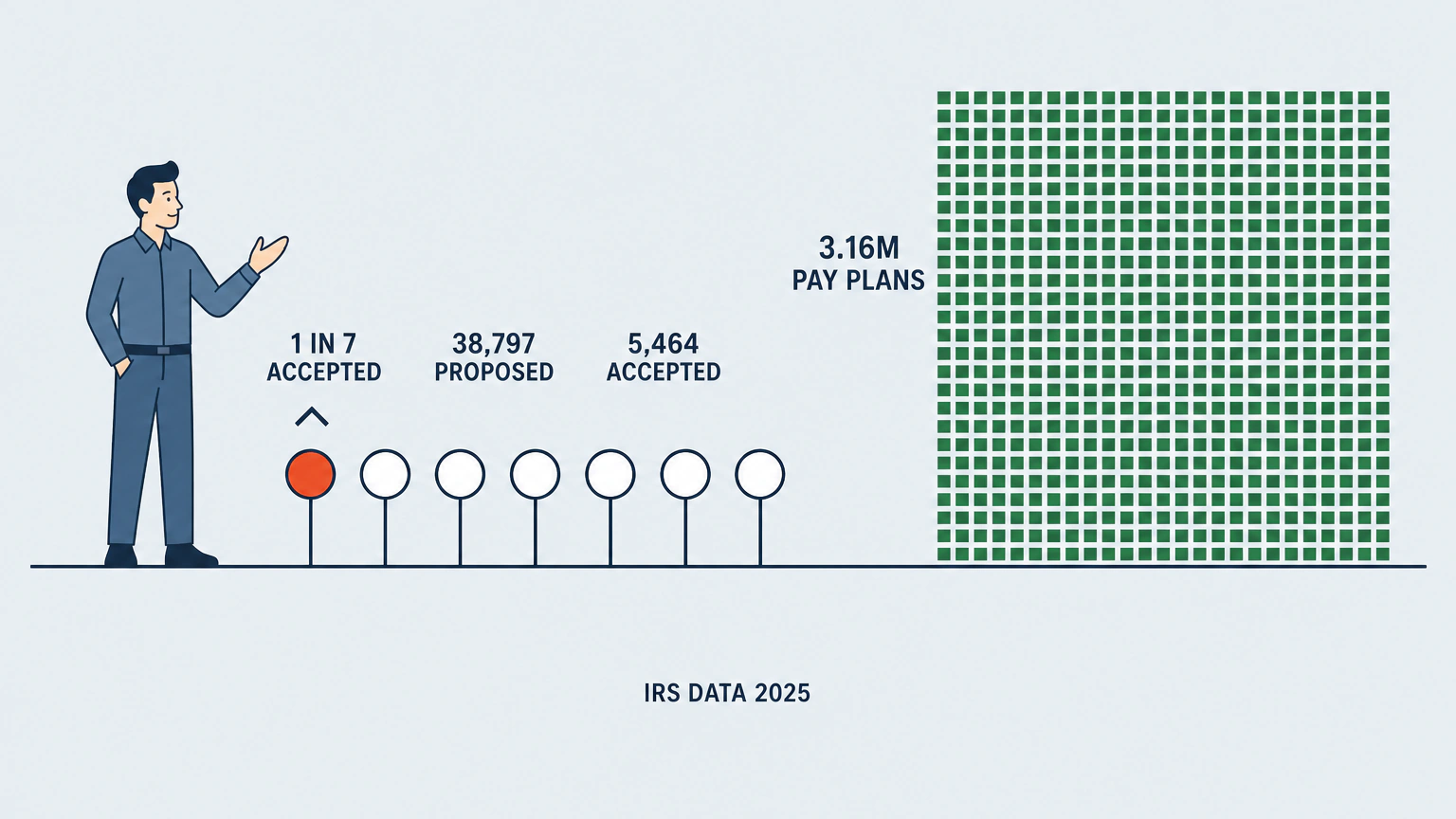
Then start where the sales pitch never starts. In fiscal year 2025, taxpayers proposed 38,797 offers in compromise. The IRS accepted 5,464 offers that same year, two separate counts rather than the same cases: about one acceptance for every seven offers received. Meanwhile 3.16 million people set up a new payment plan directly with the IRS, where online setup runs $0 to $69.
Run all three checks. Credential: will a named individual with unlimited representation rights before the IRS take your case? Fee: is the whole amount demanded upfront? Promise: were you told the outcome before anyone saw your finances?
What a company can actually do for you
Real work, priced like work. An accurate financial statement. An argument that your reasonable collection potential is lower than the IRS's arithmetic makes it. A documented penalty relief request. A Collection Due Process request filed inside its 30-day window, the deadline that slips when you're the one being collected from.
And somebody else takes the calls. That last one is worth more than people expect.
What no company can do
Make a debt you legally owe disappear. Guarantee the IRS will accept an offer. The Federal Trade Commission puts it plainly: "Only the IRS or your state comptroller can decide what you qualify for."
There's no membership fee for an IRS program either, because there is no membership. The only money the IRS takes is its own published user fees, waived or reduced for low income.
The number that changes the decision: how often the IRS says yes
An offer in compromise is easy to define and much harder to get. The figure that should move your decision is how many the IRS actually accepts.
What the IRS's own collection data shows
The IRS publishes its collection results every year in the Data Book, and the offer figures sit there in the open. Fiscal year 2025: 38,797 offers in compromise received, 5,464 accepted, worth $98.1 million. Roughly one acceptance for every seven offers received. The year before, 33,591 came in and 7,199 were accepted, closer to one in five.
Neither pair is a success rate, though. The offers accepted in a year are largely not the offers received in it, since an offer takes months to work, so the counts show relative volume rather than your odds.
The route three million people actually took
Now put those figures beside the payment plan figures. In fiscal year 2025, taxpayers established 3,160,047 new installment agreements. By year end 4,870,810 were in force, and the IRS collected $17.9 billion from accounts in installment agreement status.
That is the door most people actually walk through, and it isn't the door being advertised to you. None of which argues against hiring anyone. It argues for knowing which product you're being sold.
What the free and near-free routes actually cost
The IRS publishes its own fee schedule and it's short. Learn these numbers before anyone quotes you a price.
| Route | What it costs you | Who decides | Typical time to set up |
|---|---|---|---|
| Short-term plan, 180 days or less | $0 setup. Penalties and interest keep running | IRS | Same day online |
| Long-term plan, direct debit | $22 online, $107 by phone, mail or in person. Waived for low income | IRS | Same day online |
| Long-term plan, not direct debit | $69 online, $178 otherwise. $43 low income, sometimes reimbursed | IRS | Same day online |
| Offer in compromise, filed yourself | $205 plus 20% of the offer up front under the lump-sum option. Both waived under the Low-Income Certification | IRS | Varies |
| Representation by a tax-resolution lawyer | $1,050 to $3,675 typical, $1,838 average, per this site's 738 cost profiles | You pick the professional. The IRS decides the outcome | Varies by professional |
| A company promising you a result | "An upfront fee, which can be thousands of dollars," in the FTC's words | The IRS decides the outcome | Varies by company |
Payment plans and their setup fees
You can apply online for a long-term plan if you owe $50,000 or less in combined tax, penalties and interest and have filed all required returns. Short-term plans have a higher ceiling: under $100,000. Revising a plan later costs $10 online, $89 by any other route.
Low income here means adjusted gross income at or below 250% of the federal poverty level, and it's the line the fee waivers hang on.
Penalties and interest run until the balance is gone, whichever plan you pick. So pick the payment you can still make in a bad month. A plan you can afford beats a cheaper one that defaults.
The offer in compromise: $205, twenty percent, and the waiver
An offer costs $205 to file, plus an initial payment of 20% of the offer amount under the lump-sum option. Both are waived if you meet the Low-Income Certification.
You're eligible only if you've filed all required returns and made required estimated payments, so unfiled years get fixed first. That is work for tax preparers rather than for a settlement pitch.
The amount isn't negotiated in the ordinary sense, with somebody talking the IRS down. That is the part that surprises people. On Form 433-A (OIC) you add your available equity in assets to your remaining monthly income multiplied by 12 or by 24, depending on how fast you'd pay. That sum is generally your minimum offer, unless special circumstances support a lower amount, and the formula falls away entirely if the IRS decides you can pay the debt in full within the collection period.
Run the IRS's free Offer in Compromise Pre-Qualifier before anyone quotes you a number.
The other doors: currently not collectible, penalty abatement, and the ten-year clock
If you genuinely can't pay anything right now, say so. The IRS can place your account in Currently Not Collectible status, which pauses most collection. It forgives nothing: penalties and interest keep accruing and the debt stays yours.
Penalty relief is a separate request, under first-time abatement, reasonable cause or a statutory exception, and the IRS says some are granted over the phone. Worth making that call yourself first.
Underneath it all a clock runs: the IRS generally has 10 years from assessment to collect. Whether this is worth paying someone to handle is a fair question. Who exactly you'd be paying is the better one.
Who is legally allowed to represent you
A company is not a credential. A person is.
Unlimited, limited and none
| Credential | Who licenses them | Representation rights before the IRS | Where to verify |
|---|---|---|---|
| Attorney | State courts or the state bar | Unlimited: any matter, including audits, collection and appeals | State bar record plus the IRS directory |
| CPA | State boards of accountancy | Unlimited | State board plus the IRS directory |
| Enrolled agent | The IRS itself, after a three-part exam and 72 hours of continuing education every three years | Unlimited | The IRS directory |
| Annual Filing Season Program record of completion | A voluntary IRS program | Limited: only clients whose returns they prepared and signed, never appeals or collection | The IRS directory |
| PTIN holder with no credential | Registration only | None | Not listed as credentialed in the directory |
The Annual Filing Season Program line is the one that catches people. That record of completion doesn't reach appeals or collection, even on a return its holder prepared and signed, and a collection problem is precisely what you have. The credential isn't a formality. It is the difference between a person who can represent you and a person who legally cannot.
A CPA holds one of the three unlimited credentials, which is why CPA firms are a real alternative here, not a lesser one.
The three-minute check
- Ask, in writing, for the full name and credential of the person who will represent you. A firm name is not an answer.
- Look that name up in the free, public IRS Directory of Federal Tax Return Preparers with Credentials and Select Qualifications, knowing its limit: it covers listed preparers with a valid PTIN and does not include every attorney or CPA who may represent a taxpayer.
- If the answer was attorney, also check that a lawyer is licensed and in good standing. The IRS directory shows credentials the IRS recognizes. It isn't a current state-license check.
- Ask whether that person will sign a Form 2848 power of attorney. Only someone eligible to practice before the IRS may sign one.
Pro tip: ask by email rather than on the call, so the name and the credential exist in writing.
The fee and advertising rules that bind a practitioner
There's a rulebook here and it works in your favor, but only when a credentialed individual is on your case. Treasury Department Circular No. 230 binds the attorney, the CPA or the enrolled agent. It doesn't bind the marketing company that sold your details to them.
A practitioner "may not charge an unconscionable fee in connection with any matter before the Internal Revenue Service." Contingent fees are barred for IRS matters apart from narrow exceptions, mostly examinations and judicial proceedings, so "we only get paid if you win" is a reason to ask which exception they think they're in. Advertising may carry no "false, fraudulent, or coercive statement or claim; or a misleading or deceptive statement or claim", and an enrolled agent may not call themselves "certified" or imply they work for the IRS. A practitioner who publishes a fee schedule "may charge no more than the rate(s) published ... for at least 30 calendar days."
Insisting on a named practitioner is what puts all of that on your side of the table.
Nine warning signs, and what to do about each
One of these on its own can have an innocent explanation. Two in the same conversation, and we'd hang up.
| What you hear or see | What to do instead |
|---|---|
| "We can settle for pennies on the dollar" | The IRS names that phrasing in its scam guidance. Ask how your reasonable collection potential was calculated, then run the free IRS Pre-Qualifier |
| A guaranteed result | Nobody can guarantee acceptance. Get the promise in writing and watch it become "we will submit an application" |
| The whole fee demanded upfront | The FTC: "Don't do business with anyone that tells you to pay their whole fee upfront. If they say that, walk away" |
| An "enrollment fee" for a government program | The only fees are IRS user fees: $0 to $178 for a plan, $205 for an offer, waived or reduced for low income |
| A cold call about a debt you never disclosed | The IRS normally contacts you first by U.S. mail. Hang up, call the number on your notice, report it at ReportFraud.ftc.gov |
| No named individual, or a name with no credential | Ask who signs your Form 2848, then check the relevant licensing body and the IRS directory when applicable before money moves |
| Pressure to decide today | Circular 230 makes a practitioner who publishes fees honor them for at least 30 calendar days, and stop soliciting when you say so |
| A quote given before anyone looks at your finances | An offer amount is computed from assets and income on Form 433-A (OIC). A quote without them prices paperwork |
| Monthly "maintenance" charges with no deliverable | The FTC says to steer clear of pricey monthly maintenance fees. Ask for a written scope, deliverables and a refund policy first |
What a legitimate engagement looks like on paper
Seven questions to ask before you sign
- Who exactly will represent me, full name and credential? One name, and one of three words: attorney, CPA, enrolled agent.
- Are they an attorney, a CPA, or an enrolled agent? Any other answer means limited rights, or none at all on collection.
- Will they sign a Form 2848 power of attorney for my case? If nobody signs, nobody is representing you.
- What is the total fee, what does it cover, and what is billed separately? The financial statement, the filing and any appeal should each carry their own price.
- What outcome are you telling me is likely, and what did you calculate it from? A real answer names your assets, your income and the 12 or 24 month multiplier.
- What happens to my existing payment plan if you file an offer? A real answer separates an approved plan from one still being processed, because those two go different ways.
- If the IRS rejects this, what do I get back? Get the refund policy into the contract. A refund described in conversation isn't a refund policy.
Pricing the quote against the market
We publish our own price data, so here it is with the limits attached. Our tax resolution lawyers panel reports a national average of $1,838, a typical range of $1,050 to $3,675 and an average per hour rate of $342, from 738 cost profiles submitted to the platform. That is our own aggregate for tax resolution lawyers specifically, not a market statistic and not a price for the relief industry, which doesn't publish one.
Set it beside the FTC's description of the alternative: "an upfront fee, which can be thousands of dollars."
The cost of an application that was never going to work
An offer that was never going to be accepted costs more than the $205. What it costs is written into the undertaking you sign in the IRS's Form 656 booklet.
What it does to the payment plan you already have
The booklet is direct: "By submitting this offer I immediately withdraw any pending installment agreement that is on file for all tax periods." It adds that a pending agreement "will not be automatically reinstated after the offer is closed."
Pending means the IRS has accepted your plan for processing but has not yet approved its terms. File an offer on top of one and the plan is gone. You start again.
An approved plan is treated more gently: payments pause while the offer is considered, and if the offer fails and you've taken on no new tax debt, the IRS reinstates it.
So find out which one you have. Before anyone files anything.
It pauses the clock that was running in your favor
The same undertaking says "the statutory period for collecting my tax debt will be suspended during the time my offer is pending with the IRS, for 30 days after any rejection of my offer by the IRS, and during the time that any rejection of my offer is being considered by the Independent Office of Appeals."
Set that against a 10-year collection period and the arithmetic turns unkind. A rejected offer can hand the IRS months of extra time to collect from you.
The IRS says the same suspension applies when you ask for a payment plan, so this isn't a reason to stay quiet and wait the years out. It's a reason not to file an application that never had a chance.
Ask before you sign: two questions, both answered in writing.
- What happens to my current payment plan the day you file this offer?
- How many months does this add to the collection period if it is rejected?
Free help you may already qualify for
Some of the best help here costs nothing, and nobody buys ads for it.
Low Income Taxpayer Clinics
These clinics are independent of both the IRS and the Taxpayer Advocate Service, and they take real cases: audits, appeals, collection disputes. Free, or for a small fee.
The gate is income. For the 2026 calendar year the ceiling, set at 250% of the federal poverty guidelines, is $39,900 for a household of one in the 48 contiguous states and D.C., and $82,500 for a household of four. The amount in dispute is usually under $50,000.
In 2024 the clinics represented over 21,000 taxpayers. If you're near those income lines, this is the first call, not the last.
The Taxpayer Advocate Service
The Taxpayer Advocate Service is an independent organization inside the IRS, there to get taxpayers' problems unstuck, and it's blunt about the price: "our services are always free."
Use it when a collection action is causing hardship, or when calling the number on your notice has gotten you nowhere. Ask with Form 911, or call 877-777-4778.
If you already paid a company and nothing happened
This happens, and if it happened to you, the anger is fair. Start with facts anyway, because facts are what the complaint routes run on.
Ask the company in writing for your complete file and an itemized accounting of what the fee actually bought. Ask whether a Form 2848 was ever filed for you. Then confirm that answer with the IRS rather than with the company.
Now use the routes that exist. Report the company at ReportFraud.ftc.gov and complain to your state attorney general's consumer protection office. If the person who took your case is credentialed, the IRS Office of Professional Responsibility disciplines Circular 230 violations, and a complaint about a preparer goes on Form 14157. Where the money is large enough, consumer protection attorneys handle this kind of claim. If you've signed with a firm and want out, see what it takes to change representatives mid-matter.
Deciding your own next step
One of these is you.
- You can pay in full within 180 days.
- Short-term plan at IRS.gov. Setup fee $0, same day, and nobody needs to do it for you.
- You owe $50,000 or less and can pay monthly.
- Long-term plan online. $22 with direct debit, waived if you're a low-income taxpayer.
- You genuinely cannot pay anything right now.
- Ask about Currently Not Collectible status. An offer isn't the fix for a cash-flow problem, whatever you're being told.
- Your income is at or below 250% of the federal poverty level.
- Start with a Low Income Taxpayer Clinic. Free or close to it, and collection disputes are what they do.
- You dispute the amount, you face a levy or lien, or your finances are complex.
- This is what representation is for, and it's worth paying for. Check the credential with the appropriate licensing body, use the IRS directory where it applies, then engage. Our tax resolution lawyers category is one place to start, and if the real problem turns out to be unfiled returns, browse verified providers by service.
Please note: this is general information about federal tax collection, not legal or tax advice, and only the IRS can decide what you qualify for. We earn from provider relationships, including the categories linked here, which is why the free routes come first.
Frequently asked questions
Do tax relief companies really work?
Sometimes, and what works is ordinary professional work: an accurate financial statement, a payment plan set up properly, a documented penalty relief request, a deadline caught. The advertised outcome rarely lands. The IRS received 38,797 offers in fiscal year 2025 and accepted 5,464, separate counts rather than the same cases, about one acceptance for every seven received.
How much do tax relief companies charge?
Nobody publishes an authoritative industry-wide price, so treat any range you see online as an estimate. The FTC describes the model as help offered "in exchange for an upfront fee, which can be thousands of dollars." Our own cost profiles for tax resolution lawyers, which are a different service, average $1,838 and typically run $1,050 to $3,675.
Is the IRS Fresh Start Program real, and do I need a company to use it?
It's real, but it isn't a program you enroll in. Fresh Start is the name the IRS gave a set of changes beginning in 2011 that eased lien withdrawals, installment agreements and offers in compromise. Nothing to join, no company required. You apply directly with the IRS.
Can I negotiate with the IRS myself?
Yes, and millions of people do. A payment plan goes up online in minutes. Some penalty relief requests get handled by calling the number printed on your notice. You can file an offer yourself using Form 656 and Form 433-A (OIC). Representation earns its fee on the hard cases: disputes, levies, liens and business complications.
How long does the IRS have to collect back taxes?
Generally 10 years from the date the tax was assessed. The IRS calls the end of it the Collection Statute Expiration Date, and each assessment carries its own. The clock doesn't always run, though: it's suspended while the IRS considers a payment plan or an offer, plus 30 days after a rejection.
Someone called me about my tax debt — is that legitimate?
Probably not, if it arrived out of nowhere. The IRS normally contacts you the first time by U.S. mail, so an unexpected call about a debt you've never discussed is a reason to stop talking. Hang up and call the number printed on your own notice. A caller who rushes, threatens or demands payment belongs at ReportFraud.ftc.gov.
Can the IRS take my house, my paycheck or my Social Security while I sort this out?
A levy can garnish wages, take bank funds and seize property, and the Federal Payment Levy Program can take up to 15% of Social Security. Limits apply: part of your wages is exempt, and a principal residence has its own protections. A Final Notice of Intent to Levy usually comes first, and it gives you 30 days to request a Collection Due Process hearing.
Does hiring a tax relief company hurt my credit?
Hiring anyone does nothing to your credit by itself. What reaches your borrowing is a Notice of Federal Tax Lien, the public document the IRS files to alert creditors of its legal claim on your property. Pay the debt and the lien is released within 30 days. A withdrawal removes the notice.