


A no-fault divorce is one where neither of you has to prove the other did anything wrong. One of you tells the court the marriage is over, in the words your state's law uses. It exists in all 17 states and D.C. that we read, but the rules change from one state to the next. Texas can grant one 60 days after filing, North Carolina wants a full year of living apart first, and in Mississippi it only works if your spouse doesn't contest it.
So the useful question isn't whether you live in a no-fault state. It's which kind.
On this page
What no-fault divorce really means
The statutes explain the idea better than any definition. California grants a divorce for "irreconcilable differences, which have caused the irremediable breakdown of the marriage." Texas asks whether the marriage "has become insupportable because of discord or conflict of personalities." Florida needs only a marriage that is "irretrievably broken." D.C. is the plainest of all. A court there can grant a divorce when one or both spouses say "they no longer wish to remain married."
Look at what's missing from those sentences. Nobody is accused. Nobody proves anybody did anything.
The idea is also newer than it feels. California's Family Law Act took effect on January 1, 1970, and New York became the last state to enact a version in 2010.
No-fault isn't the same as uncontested
These two words get mixed up, and they answer different questions. No-fault is about the ground, which is the reason for the divorce. "Uncontested" is about the terms: whether the two of you agree on property, support and custody.
A no-fault divorce can still be a long fight over money and children. New York builds that into its statute. One spouse states under oath that the marriage has been broken for at least six months, and even then the court holds the judgment until the two of you settle property, support, custody and legal fees, or the judge decides them.
That fight, not the ground, is what drives the bill. Our guide to what a divorce actually costs prices it.
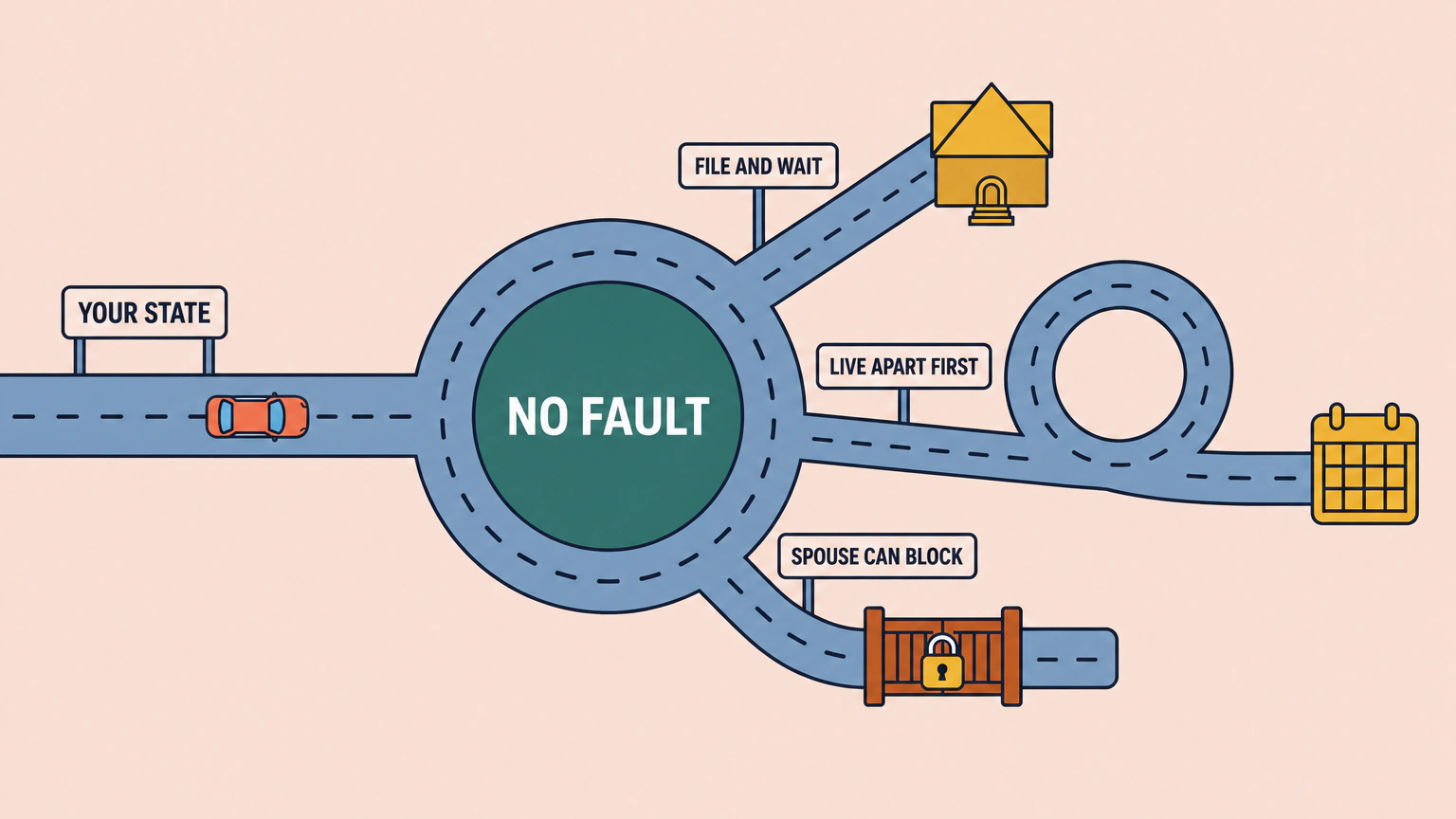
The three shapes no-fault takes
Which shape your state uses is most of your answer.
The first is file and wait. You file, a clock runs, and then the court can act. Texas can't grant the divorce before the 60th day after filing. California won't end the marriage sooner than six months after your spouse is served or appears, whichever comes first. D.C. has no wait at all.
The second is live apart first. Here the waiting comes before the divorce, and it's counted from the day you separated. That's a year in North Carolina and South Carolina, 18 months in Arkansas, six months to a year in Virginia, and 180 or 365 days in Louisiana.
The third is the one almost nobody mentions. In some states your spouse's objection closes the no-fault door. Mississippi closes it outright. Tennessee and Ohio close it on their quickest ground.
Find your shape before you read any further.
How no-fault divorce works in 17 states and D.C.
Start with your own state. The second column is your clock: what the no-fault route is called and how long it takes. The third column matters most if your spouse doesn't want this divorce, because it tells you whether you can use that route without them. The states where a spouse can block come first, then the live-apart states, then file and wait.
| State | The no-fault route, and how long it takes | Can one spouse use it alone? | Where the rule lives |
|---|---|---|---|
| Mississippi | Irreconcilable differences. The case must sit on file 60 days before it's heard. | No. Any contest or denial ends this route, and you'd need a fault ground instead. | Miss. Code § 93-5-2 |
| Tennessee | Irreconcilable differences, or two years in separate homes with no minor children. Cases wait 60 days on file, or 90 with a child under 18. | Not on irreconcilable differences, unless you both sign a marital dissolution agreement. The two-year route works alone. | Tenn. Code §§ 36-4-101, 36-4-103 |
| Ohio | Incompatibility, or one year living apart without interruption. | Not on incompatibility, which fails if either spouse denies it. The one-year route works alone. | Ohio Rev. Code § 3105.01(J), (K) |
| Arkansas | Eighteen continuous months living apart. There is no irreconcilable-differences ground. | Yes, once the 18 months have run. | Ark. Code § 9-12-301(b)(5) |
| North Carolina | One year living separate and apart. | Yes. | N.C. Gen. Stat. § 50-6 |
| South Carolina | One year living separate and apart. | Yes. | S.C. Code § 20-3-10(5) |
| Virginia | One year apart, or six months if you have a signed separation agreement and no minor children. | Yes. | Va. Code § 20-91(A)(9) |
| Louisiana | 180 continuous days apart without minor children, or 365 with them. Complete the period before filing, or file first and wait from service or waiver while remaining apart. | Yes. Covenant marriages follow stricter rules. | La. Civ. Code arts. 102, 103, 103.1 |
| Pennsylvania | Mutual consent, finished 90 days after filing and service, or one year apart. | Not on mutual consent. The one-year route works alone. | 23 Pa. Cons. Stat. § 3301(c), (d) |
| Vermont | Six consecutive months apart, with the court finding you're not likely to reconcile. | Yes. | Vt. Stat. tit. 15, § 551(7) |
| New Jersey | Irreconcilable differences lasting six months, or 18 months living apart. | Yes. | N.J. Stat. § 2A:34-2(d), (i) |
| New York | Irretrievable breakdown for at least six months, sworn to by one spouse. Money and custody must be settled or decided first. | Yes. | N.Y. Dom. Rel. Law § 170(7) |
| Maryland | Six months apart, even under one roof; irreconcilable differences; or mutual consent with a signed settlement. | Yes, on irreconcilable differences or six months apart. | Md. Code, Fam. Law § 7-103 |
| District of Columbia | Either spouse says they no longer wish to be married. There's no waiting period since 2024. | Yes. | D.C. Code § 16-904(a) |
| Texas | Insupportability. No divorce before the 60th day after filing, except in some family violence cases. | Yes. | Tex. Fam. Code §§ 6.001, 6.702 |
| California | Irreconcilable differences. The marriage can't end sooner than six months after your spouse is served or appears. | Yes. | Cal. Fam. Code §§ 2310, 2339 |
| Florida | Irretrievably broken. If your spouse denies it or you have a minor child, the court can order counseling or pause up to three months. | Yes, though a denial can delay it. | Fla. Stat. § 61.052 |
| Arizona | Irretrievably broken. If your spouse denies it under oath, there's a hearing and possibly up to 60 more days. | Yes, though a denial can delay it. Covenant marriages differ. | Ariz. Rev. Stat. §§ 25-312, 25-903 |
We read each of these 18 to its own statute or court rule. If your state isn't here, open its divorce statute and find the grounds section: look for a ground called irreconcilable differences, irretrievable breakdown, incompatibility, insupportability, or living separate and apart.
In Mississippi, your spouse can say no
Mississippi's no-fault ground is irreconcilable differences, and it comes with a condition. A court can't grant a divorce on that ground "where there has been a contest or denial," unless the spouse who objected takes the objection back with the judge's permission. The case also has to sit on file for 60 days before it's heard.
In practice the route runs on your spouse's cooperation. There are three ways through. You can agree on everything and put it in a written agreement the court approves. You can both sign a written consent that lets the judge decide whatever you can't settle, and once the court has started on the case, that consent can't be withdrawn without its permission. Or you can prove one of the fault grounds in Mississippi's code.
Lawmakers have been asked to change this. A 2026 Senate bill to add an irretrievable-breakdown ground died in committee in February. Matthew Thompson, a Mississippi family lawyer, wrote on his blog that the idea was back "for the umpteenth time in the last 20 years." He doesn't soften what the current rule allows: "Financial/divorce blackmail is legal in Mississippi under its current law."
If your spouse is using that no as leverage, that part is unfair, and you're right to be angry about it. A lawyer is the way to counter it. Find lawyers in Mississippi and talk to one before you file.
Tennessee and Ohio close the quick door, not every door
Tennessee's rule starts out like Mississippi's. If your spouse contests or denies irreconcilable differences, that ground is off the table unless you both sign a marital dissolution agreement, which is Tennessee's name for a written settlement. Even without a contest, the court wants a written agreement on the children and the property before it grants the divorce.
The difference is the fallback. Tennessee has a second no-fault ground, two years of living in separate homes, and one spouse can use it alone. It's only open if you have no minor children. So a parent whose spouse contests is out of no-fault routes and has to prove a fault ground. Every Tennessee case waits 60 days on file, or 90 if you have a child under 18.
Ohio is gentler. Incompatibility fails if either spouse denies it, but one spouse can apply alone after a year of living apart without interruption. Pennsylvania has the same split: its mutual-consent route can finish 90 days after filing and service, and when one spouse won't consent, a year apart still works.
What living apart actually means
This is where people lose months. The separation has to be real, and it has to be continuous. The statutes say so in a few sharp words. Virginia wants a year "without any cohabitation and without interruption." Arkansas and South Carolina both say "without cohabitation." Ohio says "without interruption."
Read those phrases as a warning. A few weeks of living together again is exactly what "without interruption" is written to catch.
North Carolina and Maryland give a little more room. North Carolina's statute says "isolated incidents of sexual intercourse" between the two of you don't stop the year from running. That's a narrow exception, and lawyers in North Carolina can tell you where a judge there draws the line. Maryland counts spouses who lead separate lives as living apart even under one roof, which matters when neither of you can afford to move out.
So fix your separation date and write it down. Keep the proof: a lease, a move-out date, separate bank accounts.
Where objecting triggers a delay or hearing
Some states let a spouse object and then limit what the objection can do. In Florida, if your spouse denies that the marriage is broken, the court can order counseling or pause the case for up to three months. In Arizona, a denial under oath means a hearing and a possible delay of up to 60 more days. New York asks for one spouse's sworn statement and nobody's consent. Its judgment waits on money and custody instead.
If you're the spouse who doesn't want this divorce, here's the honest message. In Florida and Arizona, an objection can lead to a hearing or delay while the court decides whether the marriage meets the no-fault ground. In New York, your energy is better spent on the terms.
When fault still matters in a no-fault divorce
Getting divorced and getting alimony are two separate questions. A state can end your marriage without asking why it failed and still ask why when support is on the table.
Cheating can still decide alimony
In these six states, the alimony statute itself brings fault back in.
| State | What the law says about fault and alimony | Where the rule lives |
|---|---|---|
| Georgia | No alimony for a spouse whose adultery or desertion caused the separation. | Ga. Code § 19-6-1(b) |
| North Carolina | A dependent spouse's affair before separation bars alimony. The supporting spouse's affair means the court must award it. If both strayed, the judge decides. | N.C. Gen. Stat. § 50-16.3A(a) |
| South Carolina | No alimony for a spouse who commits adultery before a signed settlement or a permanent support order. | S.C. Code § 20-3-130(A) |
| Virginia | No permanent support for a spouse the other could divorce for adultery, unless clear and convincing evidence shows denying it would be a manifest injustice. | Va. Code § 20-107.1(B) |
| Louisiana | Final periodic support only for a spouse who was free from fault before the divorce was filed. | La. Civ. Code art. 111 |
| Florida | The court may consider either spouse's adultery, and its economic impact, when it sets alimony. | Fla. Stat. § 61.08(1)(a) |
Two states need a closer look. North Carolina runs both ways. If the spouse who needs support had the affair, alimony is barred. If the spouse who'd be paying had it, the court must award alimony. If both strayed, the judge decides. And the court ignores any affair the other spouse condoned. Virginia's bar has an escape hatch. A judge can still award support when "clear and convincing evidence" shows that denying it "would constitute a manifest injustice."
Georgia's statute shows why filing no-fault doesn't keep an affair out of the case. Its courts must hear what caused the separation "regardless of the grounds upon which a divorce is sought or granted by the court."
We read the alimony law in these six states only, so don't assume fault is off the table anywhere else. If your support could turn on an affair, talk to one of the family law attorneys near you before you sign anything.
Why some people still file on fault grounds
Speed is one reason. In South Carolina the no-fault route takes a year apart, while a divorce on a fault ground such as adultery can be final three months after filing. Virginia's adultery ground has no separation period at all. Since July 1, 2026, though, it covers only adultery that happened before the final separation.
Necessity is the other. In Mississippi, and for a Tennessee parent whose spouse contests, a fault ground may be the only door left.
The price is proving the wrongdoing. A no-fault ground avoids that fight, though you may still have to prove a separation period. Proving a fault ground can change what a divorce actually costs.
Covenant marriage is the exception couples choose
Arizona, Arkansas and Louisiana offer a stricter kind of marriage, called a covenant marriage, that couples opt into. In Arizona you do it with a declaration on the marriage license application.
Divorce then needs one of a short list of reasons. Adultery, a felony, abuse and two years of living apart are on all three states' lists. Arizona and Louisiana add abandonment. Arkansas and Louisiana generally require counseling first, and Arizona also allows the divorce when both spouses agree.
If you married in one of those states and aren't sure what you signed, check your license.
Is no-fault divorce going away?
Not on the record so far.
A 2025 Texas House bill to repeal insupportability as a ground never left committee. Mississippi's 2026 bill, which would have added a no-fault ground, died too. The changes that did become law went the other direction. Maryland removed its fault grounds in 2023, D.C. removed its waiting periods in 2024, and Virginia's 2026 law set up a work group to study ending fault grounds, with a report due by December 1, 2026.
North Carolina has a proposal on file. A Senate bill filed in April 2026 would change the one-year separation rule. The Senate sent it to its budget committee the next day, and Hoodline, reporting on it in late September, described lawmakers as still considering it.
A bill changes nothing until it's signed and in effect. Check your state's statute, not a headline.
What to do before you file
Six things to settle before anyone files:
- Find your state's divorce statute and read its grounds section, so you know which no-fault ground you have and what it requires.
- Write down the date you separated, and keep proof of it, such as a lease, a move-out date or separate bank accounts.
- If you married in Arizona, Arkansas or Louisiana, check your marriage license for a covenant marriage declaration.
- If you're in Mississippi, Tennessee or Ohio and your spouse won't agree, get a lawyer's read on which route is left before you file.
- If you're in Georgia, North Carolina, South Carolina, Virginia or Louisiana and either of you had an affair, tell your lawyer before you sign anything about support.
- If you're filing to escape family violence, ask whether your state waives its wait. Texas does for the respondent's qualifying family violence conviction or deferred adjudication involving the petitioner or a member of their household. It also covers a petitioner's active protective order or magistrate's emergency-protection order against the respondent for family violence during the marriage.
Three situations are worth a lawyer's hour before you file. Your spouse won't agree and you live in Mississippi, Tennessee or Ohio. You live in one of the alimony states and either of you had an affair. Or yours is a covenant marriage.
We're not your lawyer, and which ground to file on can change what you walk away with. If your spouse won't agree, or alimony is on the table, talk to a divorce lawyer in your state before anyone files.
Our directory of divorce and separation attorneys is the place to start. And the decree isn't the last deadline. A tax return comes after it, and our guide to filing taxes after a divorce picks up there.
Questions people ask about no-fault divorce
Can you stop a no-fault divorce?
Usually not. In Florida and Arizona, an objection can trigger a hearing or delay while the judge decides whether the marriage meets the no-fault ground. In Mississippi a contest ends the irreconcilable-differences route. In Tennessee and Ohio it ends the quickest ground, and in Pennsylvania a spouse can withhold consent from the 90-day route. Our state table shows which rule is yours.
What's the difference between a no-fault and an uncontested divorce?
No-fault describes the reason for the divorce, and uncontested describes the terms. A divorce is uncontested when the two of you agree on property, support and custody. It can be both, either or neither. New York is the clean example: the ground is no-fault, yet the judgment waits until money and custody are settled between you or decided by the court.
Does cheating matter in a no-fault state?
Not for getting divorced. For alimony it can. Georgia, North Carolina, South Carolina, Virginia and Louisiana tie support to fault by statute, and Florida lets the court weigh adultery and its economic impact. If you live in one of those six states and either of you had an affair, raise it with a lawyer before you agree to anything about support.
Is Texas a no-fault divorce state?
Yes. Texas calls its no-fault ground insupportability, and a court can't grant the divorce before the 60th day after filing, except in qualifying family violence cases. Texas also keeps fault grounds, including cruelty and adultery, so a spouse can still choose to plead one. A 2025 House bill to repeal insupportability never left committee, and the ground is still in the Family Code.
Which states still have fault divorce?
Among the 17 states and D.C. in our table, 12 keep fault grounds. They are Mississippi, Tennessee, Ohio, Arkansas, South Carolina, Virginia, Louisiana, Pennsylvania, New Jersey, Vermont, Texas and New York. Florida, California, Maryland and D.C. list none. Arizona keeps them only for covenant marriages. We didn't read every state, so check the grounds section of your own statute.
How long does a no-fault divorce take?
The legal minimums run from no wait at all in D.C. and 60 days after filing in Texas to a year apart in North Carolina and South Carolina and 18 months apart in Arkansas. That's only the floor. Dividing the money and settling custody come on top, and that part has no fixed clock.
Will no-fault divorce be banned?
Nothing we read points that way. None of the 17 states in our table, nor D.C., has repealed it. Texas's 2025 repeal bill stayed in committee. The changes that became law went the other direction: Maryland dropped its fault grounds in 2023, D.C. dropped its waiting periods in 2024, and Virginia's 2026 law ordered a study of ending fault grounds.