

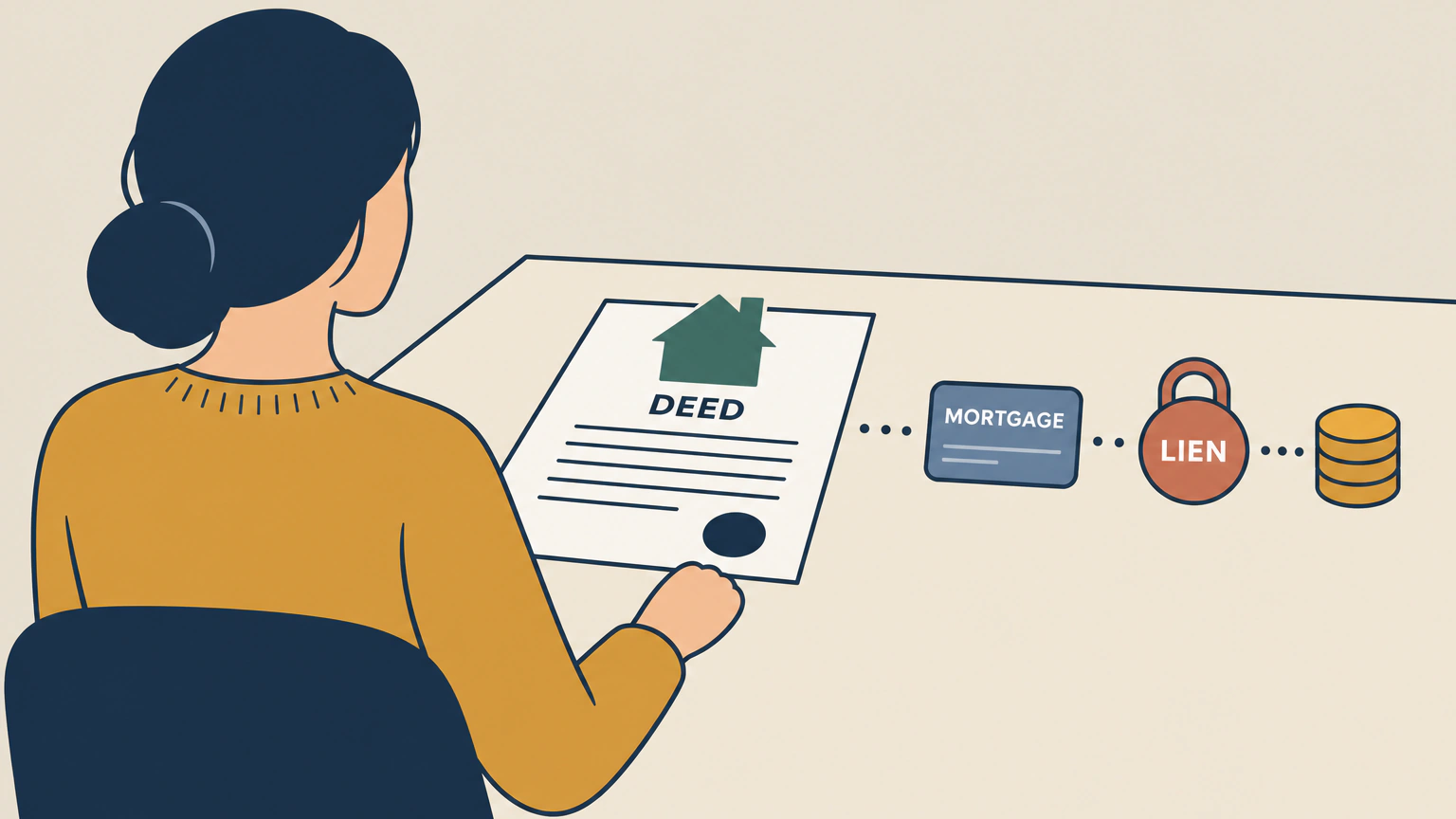
A quitclaim deed hands over whatever you own in a piece of property and promises nothing about what that is. It moves your interest and nothing else. Your mortgage stays exactly where it is. The liens already on the property stay there. And if you give the house away, the person receiving it generally takes over your adjusted basis, which is the part almost nobody is warned about.
On this page
What a quitclaim deed actually does
The promise it makes, and the one it never makes
Cornell's legal encyclopedia, Wex, defines a quitclaim deed as a document by which a grantor (the person signing) "conveys his or her present interest, if any" to a grantee (the person receiving), "without representing, covenanting, or warranting that the title is good."
"If any" does the heavy lifting. The deed passes along whatever interest the signer can convey when the deed takes effect. If that's nothing, the grantee gets nothing. Whether the deed itself is valid still depends on state law.
A warranty deed instead makes specified promises about title and can give the recipient a claim against the grantor if those promises are broken.
The five jobs it is genuinely good at
None of this makes the quitclaim a bad document. It's the right tool when both people already know exactly what's changing hands, and that covers five common jobs:
- a divorce settlement where one spouse keeps the house;
- adding or removing a name after a marriage or a name change;
- moving your home into your own revocable living trust;
- clearing a cloud on the title, such as a relative releasing a share they might hold;
- fixing a mistake in an earlier deed.
Nobody in those situations is buying from a stranger. A warranty protects a buyer from surprises in the property's past. When everyone already knows that past, the warranty has little left to do.
What the deed leaves behind
Your mortgage does not move
This is the worry most people bring to the form. The deed says who owns the house. The loan says who owes the money, and a quitclaim doesn't touch the loan.
The Consumer Financial Protection Bureau puts it plainly: "taking your name off a home or vehicle title doesn't take your name off the mortgage or auto loan." You stay responsible "unless you were contractually released by the creditor or your former spouse refinanced the loan and removed your name." Two common ways out while the other person keeps the home need the lender. They can refinance in their own name, or the lender can approve an assumption and release you in writing.
In a divorce, a decree assigning the mortgage to your ex binds them, not the bank. Before you sign a deed the other side's lawyer sent over, talk to a divorce attorney.
Liens and title problems ride along
A quitclaim makes no promise about the title, so it can't clean anything off it either. Whatever is recorded against the house stays with the house: the mortgage, a judgment lien from a lawsuit, a contractor's lien for unpaid work. The property remains subject to those liens, but the new owner doesn't become personally liable for the old owner's debts just by accepting the deed. There is no warranty to fall back on.
So the protective step comes before the signature. Order a title search, which is a review of the county's public records for everything filed against the property. Go over the results with the other person before anyone signs.
Why title insurers treat a quitclaim differently
You may hear that a quitclaim anywhere in a property's history spoils the title. Florida's legislature says otherwise, in so many words: quitclaim grantees "shall be deemed and held to be bona fide purchasers without notice within the meaning of the recording acts." Taking title by quitclaim doesn't make anyone a suspect buyer in Florida. A later buyer may still ask why the quitclaim is there, but it doesn't poison the title by itself.
The real difference sits in the insurance policy. The American Land Title Association's 2021 standard owner's policy keeps covering you after a transfer only in narrow cases, such as while you still hold an interest in the property or owe warranties you gave in the deed. A quitclaim gives none. The policy also doesn't carry over to a new owner who isn't an insured.
That form also treats some family grantees as insureds. They include the trustee or beneficiary of an estate planning trust you created. They also include a spouse who gets the house because of a divorce and someone who receives it through a transfer on death. A child who is simply given the house isn't on that list. Older policies can read differently, so check your own policy's definition of "Insured."
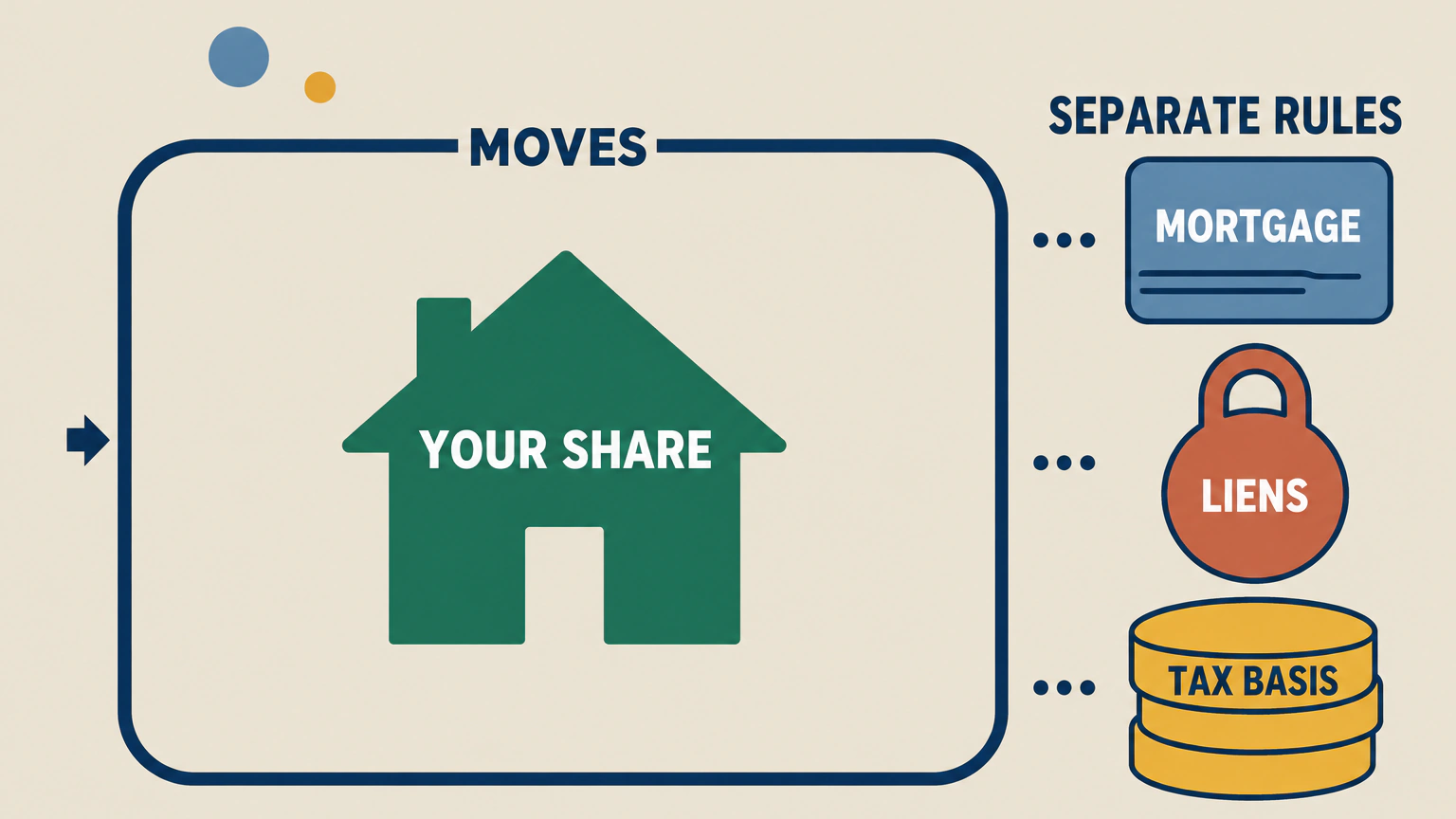
The deed conveys the ownership interest. The loan, liens, tax basis and title coverage each follow their own rules.
| What it is | Does the deed move it? | What actually moves it |
|---|---|---|
| Your ownership interest in the property | Yes, whatever interest you can convey when the deed takes effect | A deed that meets your state's rules. Recording protects it against later claims |
| An interest you do not actually hold | No | Nothing. A quitclaim cannot convey more than you own |
| The mortgage or deed of trust | No | A refinance, or an assumption with a written release from the lender |
| Recorded liens and judgments against the property | No | Payment, a recorded release, or a court order clearing the lien |
| The recipient's tax basis | The deed alone doesn't decide it | Under the usual federal rules, a gift carries over the donor's adjusted basis, a purchase uses cost, and inherited property uses its date of death value |
| A title insurance policy | Sometimes, if the new owner fits the policy's definition of Insured | Check the policy. A new owner outside that definition needs a new policy |
The tax risk that shows up years later
A gift you did not think of as a gift
Most parents putting a house in a child's name don't think of it as a gift. The IRS does. It defines a gift as "any transfer to an individual, either directly or indirectly, where full consideration (measured in money or money's worth) is not received in return." Sign the house over for no money and you've given away its value. Add a child to the deed and you've given away their share.
For 2026, the federal annual exclusion is $19,000 per recipient, the same as in 2025. An outright gift above that amount generally means the donor files Form 709. The recipient does not file Form 709.
Filing isn't paying. Larger gifts count against a lifetime exclusion the IRS puts at $15 million for 2026, so most families never owe gift tax. The real cost is the one coming next.
The IRS generally doesn't count gifts to your spouse as taxable gifts, and a transfer to an ex in a divorce follows its own tax rule. Our guide to filing taxes after a divorce covers that case.
Carryover basis, in one worked example
Read this one slowly. It's where the money is.
Adjusted basis often starts with what you paid, then changes for items such as improvements and depreciation. When a house sells, the amount realized minus adjusted basis determines the gain. For a gift, the tax code says the recipient's basis "shall be the same as it would be in the hands of the donor." Your basis becomes your child's.
Take round numbers, chosen to keep the arithmetic easy. Assume your adjusted basis is $100,000 and the house is worth $500,000 today. You give it to your daughter by quitclaim deed, so her basis is $100,000. A few years later she sells for $500,000. Before selling costs or any home sale exclusion, the gain is $400,000.
Now leave it to her when you die instead. Property that passes at death takes "the fair market value of the property at the date of the decedent's death." Her basis resets to $500,000. She sells for $500,000, and her gain is zero.
Same house, same daughter, same price. Giving it away early may spare a child probate, but in this example it leaves the child with that gain.
One reassurance. Moving the house into your own revocable living trust doesn't set this off, because the tax code treats property in a trust you could revoke until death as passing from you at death.
| Quitclaimed to your child now | Left to your child at death | |
|---|---|---|
| Your adjusted basis | $100,000 | $100,000 |
| What the house is worth when it changes hands | $500,000 | $500,000 |
| Your child's tax basis | $100,000, your basis carries over | $500,000, reset to value at death |
| Gain before selling costs or any home sale exclusion if your child sells at $500,000 | $400,000 | $0 |
| Federal paperwork the transfer can trigger | Form 709 gift tax return for the donor | An estate tax return or basis reporting may apply |
The home sale exclusion your child probably cannot use
There's a second trap under the first. The home sale exclusion shields up to $250,000 of gain, or $500,000 for a married couple filing jointly who both lived there. But the home must have been "owned and used by the taxpayer as the taxpayer's principal residence for periods aggregating 2 years or more" in the five years before the sale.
A daughter living across the country never used your house as her home. The $400,000 gain doesn't shrink by a dollar.
It flips if she moves in. Once she has owned the house and lived there as her main home for two of the five years before she sells, the exclusion opens up to her.
Two more consequences before you sign
Medicaid and the five year look back
If long-term care is anywhere in the picture, this may matter more than the tax. Federal Medicaid law says giving assets away "for less than fair market value" inside the look-back window can leave you ineligible for help with that care for a period of months. For a transfer made today, the window is 60 months. Give the house to your son at 74, need a nursing home at 78, and the gift sits inside the window.
The same law spares a few home transfers. They include a transfer to your spouse, and one to a child who is under 21, blind or disabled. The list also reaches a transfer to a son or daughter who lived in your home for at least two years right before you entered care and gave the care that kept you at home.
Count back five years before you move anything. If care is even a possibility, take the plan to an estate planning attorney first.
The due on sale clause, and the federal law that blocks it
You may have read that a quitclaim lets your lender call the whole loan due. That's the due-on-sale clause, and federal law does let lenders enforce one. But the same law lists nine transfers where a lender on a home with fewer than five units "may not exercise its option." Three of them are the reasons families sign quitclaims:
- a transfer where "the spouse or children of the borrower become an owner of the property";
- a divorce decree or separation agreement that makes the borrower's spouse an owner;
- a transfer into a living trust where the borrower "is and remains a beneficiary."
The federal banking rule that carries out this law adds a condition you won't see in that list. The home has to be one the borrower lives in or will live in. For the spouse, child and divorce transfers, the new owner has to live there or plan to.
Now the honest limit. An LLC isn't on the list, even one you own outright. Neither is a lifetime gift to a sibling, a parent or a friend. Read the clause in your own loan papers and check your transfer against the list before you sign.
Red flag: warning signs on a deed someone else prepared, and what to do about each.
- Pressure to sign today. A deed is permanent, so take the week.
- An offer to clean up your title for a fee. Ask which specific lien, and get the payoff letter yourself.
- A legal description you can't match to your own parcel number. Stop and call the county assessor.
- A notary chosen by the other side. Use one you pick yourself.
- A lender who won't put a release in writing. You're still on the loan.
Recording protects the deed from later claims
What two states actually say about an unrecorded deed
Recording means filing the signed deed in the county's land records, and each state sets its own rules for it.
Minnesota's law is blunt. Every conveyance "shall be recorded in the office of the county recorder." An unrecorded one is "void as against any subsequent purchaser in good faith and for a valuable consideration" whose deed is recorded first, and against a creditor who wins a judgment against the old owner in the meantime. Florida gets to the same place. An unrecorded transfer isn't good "against creditors or subsequent purchasers for a valuable consideration and without notice."
So a deed left in a drawer is exposed. If the old owner sells again, or a creditor comes after the house, that later buyer or creditor can end up ahead of you. Minnesota adds that a buyer's deed being a quitclaim doesn't, by itself, cast doubt on that buyer's good faith. Your state's act will use its own words, so read it before assuming it matches these two.
Your county recorder, and what filing costs
The deed usually goes to the local land records office where the property sits, called the recorder or register of deeds in many places. Los Angeles County's consumer affairs department publishes an annotated sample quitclaim that shows what a recorder expects to see:
- who requested the recording, and where to mail the deed back;
- the recorder's stamp and document number;
- a documentary transfer tax line;
- the grantor, the grantee and the legal description of the land;
- the assessor's parcel number;
- the grantor's signature and a notary's seal.
The person receiving the house doesn't sign. In LA County's words, "The grantee does not have to sign." That's one county's form, not a national standard.
There's no national filing fee either. The office that records deeds where the property sits lists its fee and formatting rules.
When a different deed is the better answer
Quitclaim, special warranty, general warranty
With the tax picture in hand, the deeds sort out quickly. A general warranty deed is the full promise: the seller defends the title against problems from any era, even ones from before they owned it. A special warranty deed covers only the seller's own years. A quitclaim promises nothing.
A buyer's basis is what they paid, whichever deed they get, because the IRS says the basis of property you buy "is usually its cost." So the basis trap is a gift problem, not a deed problem. Give your child the house with a warranty deed and your old basis still carries over.
| Instrument | What the giver promises | Where it fits | What the recipient's tax basis becomes |
|---|---|---|---|
| Quitclaim deed | Nothing. Only whatever interest they hold | Family transfers, divorce, fixing a name on title | Federal tax law, not the deed, sets basis. In the common case, a gift or divorce transfer uses adjusted basis, while a purchase uses cost |
| Special warranty deed | Only that they created no title problem while they owned it | Commercial sales, bank owned sales | What the buyer paid |
| General warranty deed | Full defense of the title, including problems from before they owned it | Arm's length sales to a stranger | What the buyer paid |
| Transfer on death deed | Nothing until death, and it can be revoked | Passing a home outside probate, where the state allows it | Generally, value at the date of death |
Transfer on death deeds, and the step up they keep
If your real goal was keeping the house out of probate, a transfer on death deed may get you there without the tax bill. You sign and record it now. It takes effect only at your death, and until then the house stays fully yours.
Minnesota's law is a good example. The deed counts only if it's recorded before you die. Until then it "has no effect on title to the real property." You can revoke it at any time by recording a revocation before your death. Because the house passes at death, your beneficiary gets the reset basis. Not every state offers one, so ask your county recorder.
Then weigh the money. Our own figures put real estate transaction attorneys at an average of $1,275 across 640 cost profiles, and estate planning attorneys at $416 across 665. Probate administration averages $4,080 across 615. Our category pages price to a location, so treat these as one snapshot rather than a fixed national line. Hold that $4,080 next to the gain in the example.
There's more on what a probate lawyer costs if you want the detail. And once the house passes outside probate, the rest of the estate may be small enough for a small estate affidavit.
We're not your lawyer, and a deed is one of the few documents you can't unwind with an apology. Take your plan to a real estate attorney before you sign anything.
Before you sign, run this list
Most quitclaim mistakes are easy to catch before the signature and expensive to fix after it. None of these steps takes long, and several cost nothing but a phone call or a careful read. Work through them in order, and bring the answers to whoever is drawing up the deed.
- Read the due-on-sale clause in your own mortgage and check whether your transfer is one of the nine federal exemptions, including who will live in the home.
- Order a title search so you know exactly which liens the deed won't clear.
- Ask your lender in writing whether it will release you from the loan, and keep the written answer.
- Work out the recipient's basis under the rule for your transaction, including adjustments to your own basis, before you sign rather than after they list the house.
- Ask whether a transfer on death deed does the same job in your state without the basis problem.
- If long-term care is anywhere in the picture, have an elder law attorney check the Medicaid timing and exceptions before you transfer anything.
- Check the local recording office's formatting rules and fee before you take the deed in.
- Record the deed promptly. Until recording, a later buyer or a creditor of the old owner may get priority under state law.
Common questions about quitclaim deeds
Does a quitclaim deed give you ownership?
Yes, but only whatever interest the signer could legally convey when the deed took effect. If they held the whole house, you get the whole house. If they held half, you get half. If they owned nothing, you get nothing. Whether the deed itself is valid still depends on state law. That's why quitclaims suit family members who know a property's history far better than they suit strangers.
Does a quitclaim deed remove my name from the mortgage?
No. The deed changes who owns the house, but the mortgage is a separate promise to repay, and your name stays on it. The CFPB is direct about this. While the other person keeps the home, common routes off the loan are a refinance in their name or a lender-approved assumption with a written release. Until then, the lender can still come to you for payment.
Can a quitclaim deed be contested or reversed?
Not just because someone changes their mind. Once a valid deed has been delivered and accepted, the clean way to undo the transfer is a new deed back from the person who received it. Otherwise it takes a lawsuit. Depending on state law and the facts, a court can cancel a deed for forgery, fraud, duress, undue influence or lack of capacity. Deadlines vary by state, so don't wait.
Is a quitclaim deed valid if it is never recorded?
Between the two people involved, it generally still works. The risk is everyone else. Minnesota's recording law makes an unrecorded deed void against a later good-faith buyer who records first, and Florida's makes it ineffective against creditors and later buyers without notice. Record it promptly after it has been properly signed and delivered.
What does a quitclaim deed cost to file?
It depends on where the property sits. The local recording office lists its fee, and some places add a transfer tax. Getting help is the bigger variable. Our cost profiles put real estate transaction attorneys at an average of $1,275, with a typical range of $765 to $2,295.
Does a quitclaim deed avoid probate?
It can, because a house you validly gave away during life isn't part of your probate estate when you die. Under the usual federal rules, a lifetime gift gives your child your adjusted basis, while property inherited at death takes a date of death value. That difference can mean a larger taxable gain when the child sells. Where state law allows one, a transfer on death deed can avoid probate while preserving the death-time basis rule.