


We're not your lawyer, and this is general information about how probate fees are set rather than advice on your estate.
On this page
- The short answer: start with the state rule and fee agreement
- The three ways a probate lawyer gets paid
- The percentage is not one rule. It is five.
- What "the value of the estate" means, and the trap that costs the most
- Two states where the famous percentage is not the lawyer's
- The costs that sit on top of the lawyer's fee
- If your state is not in the table
- Before you sign the fee agreement
- Frequently asked questions
The short answer: start with the state rule and fee agreement
When estate funds pay the lawyer
California's official court self-help guide states: "Fees may be paid from the estate to the personal representative and, if there is one, the personal representative's attorney."
Filing costs are the exception to that timing. California's guide says the personal representative usually pays filing fees up front: "You can usually get these fees paid or reimbursed from the estate funds."
When the money actually changes hands
The same guide says fees "are usually not paid until the end of the entire probate case." Wyoming turns that into a rule. Under Wyo. Stat. § 2-7-805(a), "No fees shall be paid to the personal representative or the attorney for the estate except upon order of the court." Ohio's Summit County probate court generally holds attorney fees until the final account is ready to file, with stated exceptions for early payment.
Partial payments are allowed in several places for real reasons, so a request for money early isn't automatically wrong. Ask anyway. In some states the answer has to be a court order.
The three ways a probate lawyer gets paid
Hourly
Under an hourly agreement, the total depends on time actually spent, so the final number may not be known at the start. For a benchmark of total cost, our own probate estate administration attorneys category page puts wills and probate legal services at a national average of $4,080, a minimum of $2,550, a maximum of $10,200 and an average price range of $3,060 to $5,100, based on 615 cost profiles. That's our aggregate of the listings we carry rather than an audited market statistic, and we don't publish the collection period, the geography or how the matter is defined.
Flat fee
A flat fee is one number for a defined scope, quoted at the start. The scope line matters more than the price line. A flat quote should name in writing which filings, hearings and accountings are inside it, and what sits outside: extraordinary services, the filing fee, bond, publication, appraisal and any accountant.
Percentage of the estate, the one that needs a whole section
Every competing page says "some states use a percentage" and stops there. That sentence is where the money hides. A percentage can be a fixed entitlement, a rebuttable presumption, a floor, a ceiling, or a number that belongs to someone else entirely, and those five behave nothing alike when you push back.
The percentage is not one rule. It is five.
Probate is state law, and county practice varies on top of it. That's why every figure carries its state and its section number, and why all of them cover ordinary services.
| State | Statute sets the lawyer's fee? | The schedule | Source |
|---|---|---|---|
| California | Yes, a fixed entitlement | 4% / 3% / 2% / 1% / 0.5% on bands of $100,000, $100,000, $800,000, $9,000,000 and $15,000,000; court-set above $25,000,000. The executor gets the same schedule separately. Paying the attorney more is void. | Cal. Prob. Code §§ 10800, 10810, 10813 |
| Florida | Yes, a presumption | $1,500 up to $40,000, two $750 steps to $100,000, 3% of the next $900,000, tapering to 1% above $10,000,000. Any interested person may petition to move it. | Fla. Stat. § 733.6171(2), (3), (5) |
| Missouri | Yes, a minimum | 5% / 4% / 3% / 2.75% / 2.5% / 2% on bands of $5,000, $20,000, $75,000, $300,000, $600,000 and the rest, on personal property administered plus proceeds of court-ordered real estate sales. The court adds more. | Mo. Rev. Stat. § 473.153.1, .3 |
| Iowa | Yes, a maximum | A court-set reasonable fee, not above 6% of the first $1,000, 4% of the next $4,000 and 2% of the rest, on gross probate inventory assets. | Iowa Code §§ 633.197, 633.198 |
| Wyoming | Yes, movable both ways | 10% / 5% / 3% / 2% on bands of $1,000, $4,000, $15,000 and the rest. Lower fees may be negotiated, the court may allow more in unusual circumstances, and nothing is paid without a court order. | Wyo. Stat. §§ 2-7-803 to 2-7-805 |
| Texas | No | "Reasonable attorney's fees necessarily incurred," no schedule. The famous 5% is the executor's commission on cash received and paid out, capped at 5% of gross fair market value. | Tex. Est. Code §§ 352.002, 352.051 |
| Oregon | No | The 7% / 4% / 3% / 2% schedule, plus 1% of property outside the court's jurisdiction, pays the personal representative, not the lawyer. | Or. Rev. Stat. § 116.173 |
California: the schedule is what the lawyer is entitled to, and paying more is void
Cal. Prob. Code § 10810(a) says the attorney "shall receive" the tiered schedule for ordinary services. That's an entitlement, and § 10813 closes the other end: "An agreement between the personal representative and the attorney for higher compensation for the attorney than that provided by this part is void."
Then read § 10800(a), which hands the personal representative the identical tiers. Two schedules, one estate. On a $500,000 estate that's $13,000 to the lawyer and $13,000 to the executor. A family executor can waive their own fee, and it doesn't change the lawyer's number by a cent.
Florida: the schedule is a presumption, and the court can move it
Fla. Stat. § 733.6171(3) makes the schedule "presumed to be reasonable," computed on the compensable value: the inventory value of the probate assets plus income earned during administration. On a $500,000 compensable value the presumed figure is $15,000.
Two things in that section are worth more to you than the schedule itself. Under § 733.6171(5), any interested person can petition the court to increase or decrease the fee for ordinary services. And under § 733.6171(2)(b), a lawyer intending to bill on the schedule must first tell you in writing, and get your signature, that "There is not a mandatory statutory attorney fee for estate administration" and that "The fee is subject to negotiation." Without those disclosures, § 733.6171(2)(d) blocks payment absent court approval or the written consent of every interested party.
Missouri: the schedule is the floor, not the ceiling
Mo. Rev. Stat. § 473.153.3 allows attorneys "as the minimum compensation for their services" the same percentages the personal representative gets, then says the court "shall allow such additional compensation as will make the compensation of the attorneys reasonable and adequate." It adds that performance of extraordinary services "is not necessary to entitle them to such additional compensation."
Read the base carefully, because it's narrower than a gross estate: the percentages run on personal property administered plus proceeds of real property sold under order of the probate court, so a house passing to the heirs unsold is not in it. On $500,000 of qualifying value the minimum is $14,050, and the real number starts there.
Iowa: the schedule is the ceiling, not the floor
Iowa Code § 633.198 allows the attorney "such reasonable fee as may be determined by the court, for services rendered, but not in excess of the schedule of fees provided in this part for personal representatives." That schedule, § 633.197, runs on "the gross assets of the estate listed in the probate inventory," excluding life insurance proceeds unless payable to the estate.
On a $500,000 inventory the cap is $10,120, and nothing entitles the lawyer to it. The court can allow less, so the schedule is a ceiling rather than an entitlement.
Wyoming: same schedule for both, and it says out loud that you can negotiate down
Wyo. Stat. § 2-7-804 gives the attorney the same tiers § 2-7-803 gives the personal representative: $10,350 each on a $500,000 statutory base. Subsection (d) is the sentence worth quoting back at a first meeting: "Nothing herein shall prevent the personal representative and the attorney from negotiating lower fees."
It moves upward too. Both sections let the court allow an additional fee where "by reason of unusual circumstances" the computed fee is not equitable, and § 2-7-805(a) means nobody is paid until a judge signs the order.
What "the value of the estate" means, and the trap that costs the most
Gross, not net: the mortgage does not come off first
This is where families lose the most money without ever seeing it happen. California computes both fees on the appraisal value in the inventory, plus gains and receipts, less losses on sales, and then adds the words that decide everything: "without reference to encumbrances or other obligations on estate property" (Cal. Prob. Code §§ 10800(b), 10810(b)). Iowa's § 633.197 runs on gross assets the same way.
A $600,000 house carrying a $250,000 mortgage is worth $350,000 to the family. To the California schedule it is worth $600,000. The attorney's ordinary fee is $15,000 instead of $10,000, and the executor's is too, so a debt the family already owes costs the estate an extra $10,000 across the two fees.
What is in the probate estate and what is not
The statutory fee base is not identical in every state. In California, property with a named beneficiary, joint tenancy property passing to the surviving owner, and property already titled in a living trust generally stay outside formal probate, while the cited statutes can add state-specific items such as income, receipts or gains. That is how a family worth $2 million can end up with a $180,000 probate estate. If this has you thinking about your own affairs rather than the estate you're administering, that's a conversation for estate planning attorneys.
| State | Lawyer's ordinary fee on a $500,000 statutory fee base | What kind of number that is |
|---|---|---|
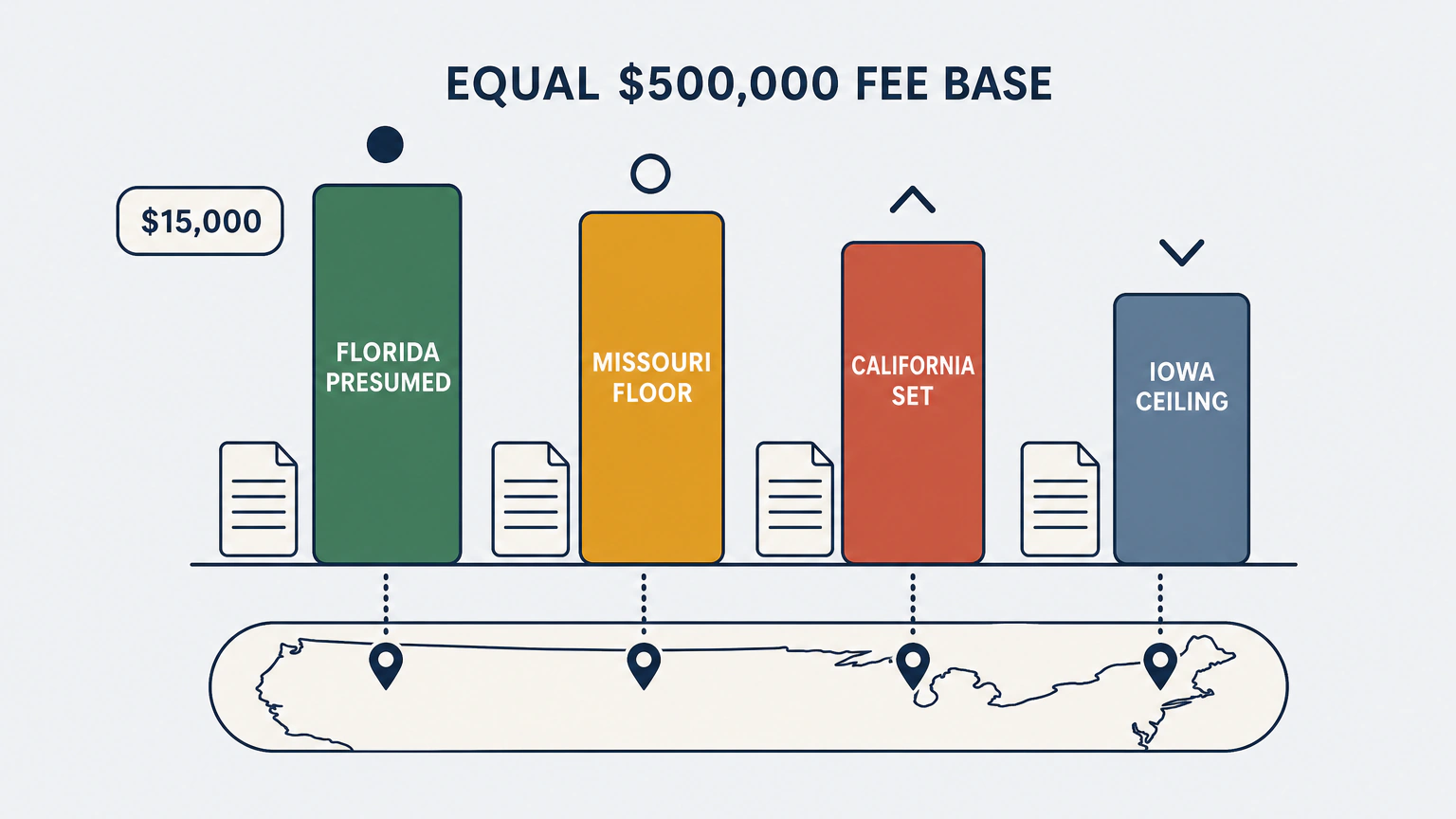
| Florida | $15,000 | Presumed reasonable; court may raise or lower it |
| Missouri | $14,050 | Statutory minimum; court may add |
| California | $13,000 | Statutory entitlement; paying more is void; the executor gets $13,000 too |
| Wyoming | $10,350 | Statutory; negotiable downward; the executor gets $10,350 too |
| Iowa | $10,120 | Statutory maximum; court may allow less |
| Texas | No statutory figure | Court reviews reasonableness |
Statutory Probate Fee Estimator
Probate fees are state law. Pick your state, enter the fee base that state's statute actually runs on, and read what the statute produces for a lawyer's ordinary services - and what kind of number that is.
The same $500,000 qualifying statutory fee base, run through four state schedules. Each state defines that base differently, so one identical mix of assets does not produce the same base everywhere.
- Florida$15,000
- Missouri$14,050
- California$13,000
- Iowa$10,120
On an equal base the answer still changes across state lines, and so does the kind of number it is: an entitlement, a presumption, a floor or a ceiling.
Inventory appraisal value plus gains over appraisal on sales plus receipts, less losses from appraisal on sales, "without reference to encumbrances or other obligations on estate property" (sections 10800(b) and 10810(b)).
These two schedules run on the gross or unencumbered value the statute names. Enter secured debts here to see that figure beside the equity behind it.
Attorney's ordinary fee
$15,000
What kind of number this is.
Executor's fee: .
Combined, paid from the estate:
This figure excludes extraordinary services, court filing fees, bond, publication, appraisal and any accountant.
This estimator covers seven states. For any other state the answer lives in three places: the state's current code, the probate rules of the county where the case is filed, and the fee agreement itself.
- Search your state's official code site for the probate chapter on compensation of personal representatives and attorneys. They are usually two separate sections, and a percentage in the personal representative section is not the lawyer's fee.
- Read the fee agreement against whatever you find, and ask which statute or court rule the number comes from.
Two states where the famous percentage is not the lawyer's
Texas: the 5% belongs to the executor
Tex. Est. Code § 352.002(a) gives the executor or administrator "a five percent commission on all amounts that the executor or administrator actually receives or pays out in cash." Subsection (b)(1) caps it in the aggregate at 5% of the estate's gross fair market value, and (b)(2) carves out three large categories: cash already in the decedent's bank or brokerage accounts at death, life insurance proceeds, and cash paid out to an heir or legatee as such.
The lawyer sits in a different section. Section 352.051 allows the representative "reasonable attorney's fees necessarily incurred in connection with the proceedings and management of the estate." No schedule, no tiers. If a Texas quote is built on 5%, ask which statute it comes from.
Oregon: the schedule in the statute is the personal representative's
ORS 116.173(3)(a) sets 7% of any sum up to $1,000, 4% above that to $10,000, 3% above that to $50,000 and 2% on everything over $50,000, plus, under (3)(b), 1% of property outside the court's jurisdiction but reportable for estate tax, excluding life insurance proceeds. On $500,000 of property subject to the court's jurisdiction that is $10,630, and all of it compensates the personal representative. Oregon sets no schedule for the attorney, so an Oregon quote reciting those tiers is quoting the wrong person's statute.
The costs that sit on top of the lawyer's fee
Extraordinary services
The statutes distinguish ordinary from extraordinary services, and extraordinary services may receive additional compensation. California § 10811 lets the court allow additional compensation for extraordinary services "in an amount the court determines is just and reasonable," and it expressly includes paralegal work done under attorney supervision. A contingency arrangement for extraordinary work needs a written agreement the court approves after a noticed hearing.
Florida § 733.6171(4) lists examples: will contests, tax proceedings, sales of real property, running the decedent's business, ancillary administration in another state. A will contest moves the matter into litigation and may require a separate engagement, so that is when you are also looking for civil litigation attorneys.
Court and administration costs
These are estate administration expenses separate from the lawyer's ordinary fee. California publishes the one hard number in this group: "Typically, the fee is $435.00" to file the Petition for Probate. The same guide warns that the costs of administration overall "are often well over $1,000.00 and can be much more."
The rest are categories rather than verified national numbers in this article: the bond premium if a bond is required, publication of notice, the appraiser or probate referee, certified copies, and the accountant if a final income tax return or an estate tax return is due. That last one sits entirely outside the attorney's fee and belongs with CPA firms.
If your state is not in the table
Seven states appear here because we read seven statutes end to end. We haven't estimated the other 43, guessed at them, or copied them out of somebody else's article, and we won't tell you how many states run a fee schedule, because we didn't count them.
What a reasonable-fee state actually reviews
Where no schedule applies, nobody hands you a number, so the fee agreement and the court's later review are the whole ballgame. The factors that keep recurring in these statutes and rules are the time and effort reasonably expended and the responsibility carried (Wyo. Stat. §§ 2-7-803(a), 2-7-804(a)), the size and complexity of the estate (Fla. Stat. § 733.6171(4)), and the local court's scrutiny of the itemization. Summit County, Ohio requires every fee application to carry itemized time records giving the date, the time expended, who did the work and the hourly rate.
How to find your own state's rule in about ten minutes
Search your state's official code site, not a law firm blog, for the probate chapter on compensation. Look for separate sections on compensation of the personal representative and compensation of the attorney. Reading only the first is how most people end up budgeting from the wrong statute.
Then check the probate court in the county where the case is filed, because county local rules may add attorney-fee procedures or presumptive guidelines. Ohio is the clearest example. Clark County's Probate Court Local Rule 71.1 treats 4% of the first $100,000, 3% of the next $100,000 and 2% above $200,000 as prima facie reasonable in a decedent's estate, while stating that the guidelines "shall not be considered either a minimum or maximum fee schedule." Summit County, in the same state, publishes no percentage at all.
Last, read your fee agreement against whatever you found, and treat any percentage in it as a claim to be traced back to a section number.
Before you sign the fee agreement
Seven questions to ask, and what a good answer sounds like
A good answer names a section number or plainly admits there isn't one. A vague answer is itself information.
- Is your fee set by our state's statute, or is it whatever we agree in this document?
- If a statute applies, is that number a floor, a ceiling, or your fixed entitlement?
- Is the fee computed on the gross inventory value, before subtracting the mortgage and other debts?
- What is your estimate of extraordinary services on this estate, and what would trigger them?
- Does the executor also intend to take a statutory fee out of the estate?
- Which costs are outside your fee entirely: filing, bond, publication, appraisal, accountant?
- When is the fee actually paid, and does it need a court order first?
Take five minutes first to check that the lawyer is licensed and in good standing in the state where the estate is being administered.
What should make you slow down
Slow down if: the agreement names a percentage but no statute. Ask which section it comes from, in writing.
Slow down if: you are asked to pay the full percentage up front in a state where the court must approve payment. Ask when the fee application will be filed.
Slow down if: the quote is computed on gross value and nobody mentions it. Ask for the same figure calculated on equity.
Slow down if: nobody has told you whether the executor is also taking a statutory fee. Ask for both numbers side by side, because they come out of the same estate.
Slow down if: the scope of "ordinary services" will not be put in writing. Ask for the list, and for what falls outside it.
Frequently asked questions
Who pays the probate lawyer's fee?
In California, fees may be paid from estate assets and are usually not paid until the end of the case. Wyoming requires a court order before either the personal representative or attorney is paid, and Summit County, Ohio generally defers attorney fees until the final account is ready. California filing costs may need to be advanced and later reimbursed.
Are probate attorney fees negotiable?
That depends on the jurisdiction and the fee agreement. Wyoming says so in the statute: § 2-7-804(d) permits the personal representative and the attorney to negotiate lower fees. Florida requires the lawyer to disclose in writing that the fee "is subject to negotiation." In California the schedule is an entitlement and § 10813 makes an agreement to pay more void.
What is the difference between the attorney's fee and the executor's fee?
They're separate payments to separate people from the same estate, usually under separate statutes. California gives both the identical schedule, so a $500,000 statutory fee base can produce two $13,000 fees. Florida sets the attorney's fee in § 733.6171 and the personal representative's in § 733.617, which presumes 3% of the first $1 million reasonable.
What percentage do probate lawyers take?
It depends what "take" means where you are. A percentage can be a fixed entitlement (California), a rebuttable presumption (Florida), a minimum the court builds on (Missouri), a maximum the court cannot exceed (Iowa), or the executor's commission rather than the lawyer's (Texas, Oregon). Outside the seven states covered here, check the applicable code and county rules.
Which states set probate attorney fees by statute?
Of the seven states we read, five set the lawyer's fee by statute: California, Florida, Missouri, Iowa and Wyoming. Texas and Oregon do not, and the schedules widely quoted for them belong to the executor. We didn't cover the other 43, so check your own code and your county probate court's rules.
What is included in the estate value the fee is based on?
The base depends on the statute. California and Iowa use probate-inventory values and do not deduct the cited debts first; Florida adds estate income, Missouri uses administered personal property plus court-ordered real-estate sale proceeds, and Wyoming and Oregon add other specified receipts or gains. Beneficiary-designated, joint-tenancy and living-trust property generally remain outside California formal probate.
When you're ready to talk to someone admitted in the state where the estate is being administered, start with the probate estate administration attorneys listed for your area, and bring those seven questions to the first call.