

On this page
- The short answer, and what the limit is really testing
- Most of what they owned probably never counted
- The limits in twelve states, and what each one measures
- California moved twice on the same day
- Land, cars and last wages are separate doors
- If the estate is over the line
- What you are promising when you sign
- Finding your own state's current number
- Frequently asked questions
The short answer, and what the limit is really testing
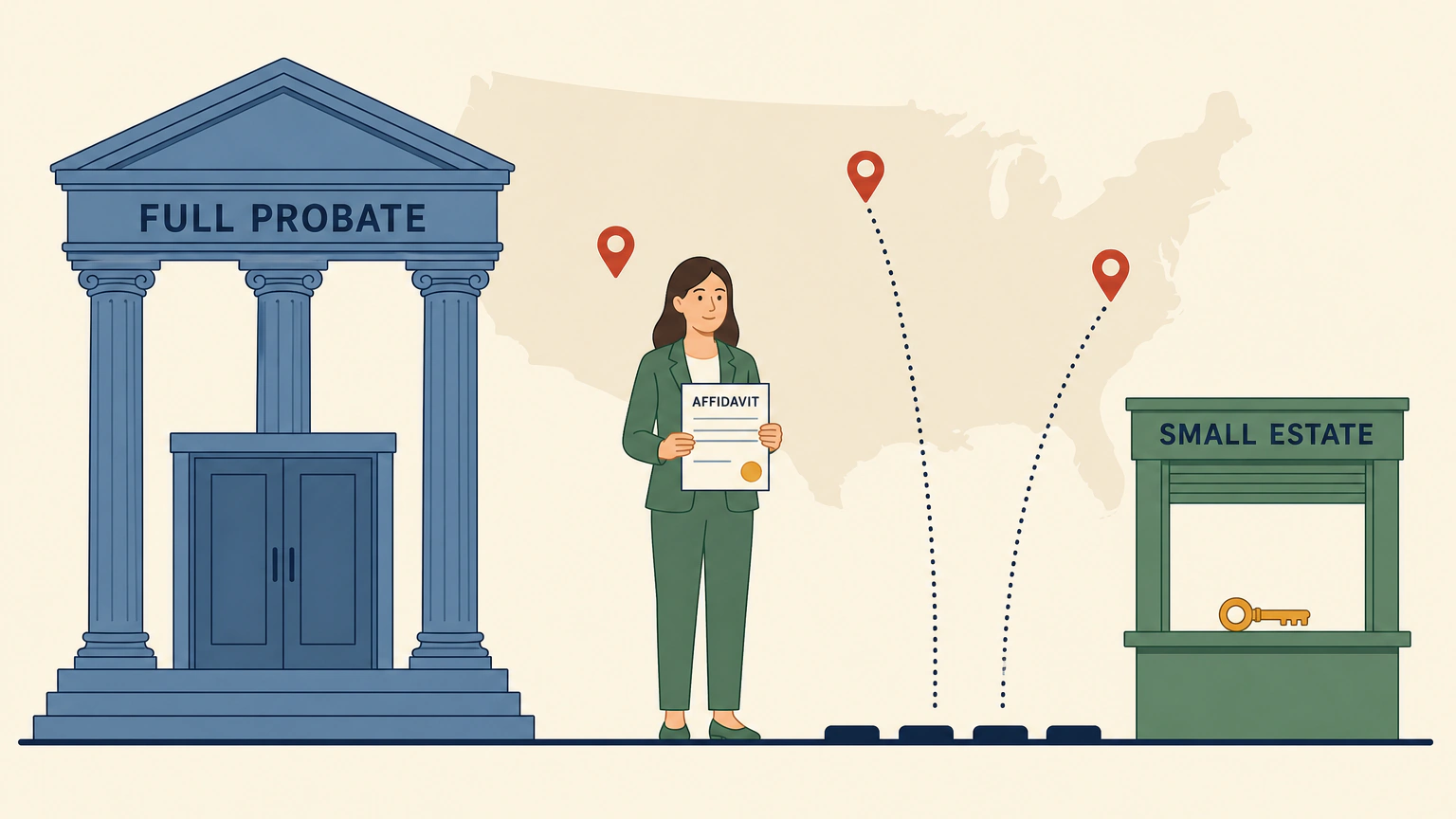
That letter from the bank is why most people land here. It asks for letters, which are court-issued documents naming someone to act for the estate, and it reads like the start of a long year in court. Often it isn't. Each of the twelve states below has a reduced procedure for qualifying estates, though the procedure may be an affidavit, a verified petition or a small-estate administration.
What the limit tests is the size of the probate estate, which means the property with nowhere else to go. That is rarely the same thing as what your mother or father was worth. Twelve states, four facts each: the number, the measuring rule, the waiting period and where the paper goes.
What signing the affidavit actually gets you
The paperwork creates authority to collect or distribute property, but the route depends on the state. Some affidavits go to the holder with proof of death; others must be filed with a clerk or approved by a judge. Court procedures and local representation rules vary.
What it reaches is personal property. Money in a bank account, the last paycheck, an uncashed check, shares held by a transfer agent, and in several states the car and the safe deposit box as well.
What it usually can't reach is land. Among the twelve, five affidavit routes can reach at least some real property: Arizona, California, Oregon, Missouri, and a qualifying Texas homestead.
Three things the dollar figure leaves out
Say your state's limit is $75,000 and your mother's accounts add up to $61,000. You still can't answer the question. Here's why.
The number doesn't tell you what counts toward it. Most of what she owned may drop out before you add a single thing up.
It doesn't tell you how the value gets measured. Some states subtract the mortgage and the car loan. Others measure the gross and take nothing off at all.
And it doesn't tell you when you're allowed to file. Nine of the twelve set an explicit wait in the route described here, from thirty days to six months. Florida, Maryland and Iowa state no wait in the section setting the headline limit.
Take those three in order and your answer usually appears on its own.
Most of what they owned probably never counted
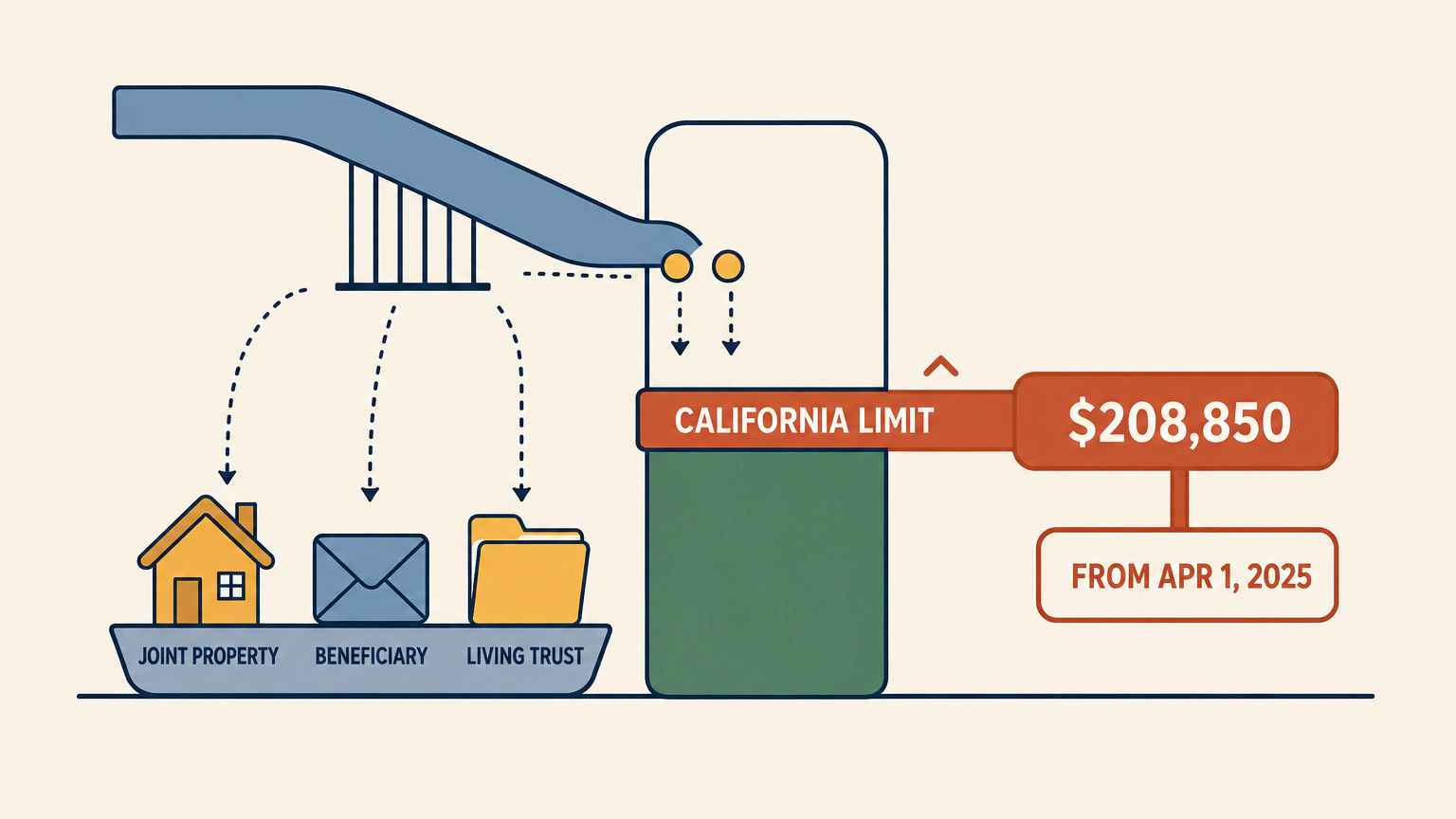
This is the correction that changes most readers' answers. The limit generally measures property subject to the state's estate procedure, not net worth. Jointly owned, beneficiary-designated or trust property often passes outside probate, but the exact exclusions come from state law.
The gap between those two numbers can be enormous. A house held in joint tenancy with a surviving spouse, a retirement account with a named beneficiary and a living trust can carry nearly everything a family owns. What's left for the affidavit might be one checking account and a final paycheck. On paper the estate may look like $600,000. For this purpose it may be $18,000, below every dollar threshold in the table, though the other eligibility rules still apply.
The property that leaves the estate before you start adding
California publishes the clearest version of this list, so we'll use it as the template. Probate Code section 13050 and the state's own self-help guide both spell out what comes out before you add anything up.
- Anything held in a living trust
- Any account or policy with a named beneficiary, including life insurance and retirement plans
- Property owned in joint tenancy with someone still living
- Community property passing to a surviving spouse or registered domestic partner
- Bank accounts with a right of survivorship
- Real property located in another state
- Cars, boats and mobile homes, which California leaves out of this count entirely
- Unpaid salary up to the amount the state sets aside
- Most government survivor benefits
- Anything already transferred by a transfer on death deed or registration
Two of those are California's own rules, not a national pattern. California drops cars, boats and mobile homes out of the count entirely, and it sets unpaid salary aside up to $20,875. We didn't read the other eleven states on either point, so check yours before you assume the car is free.
Everything else on that list is ordinary estate planning doing its job quietly. Joint tenancy, a beneficiary form, a transfer on death deed and a trust are what kept this estate out of court. If that's what you're looking at, it's worth asking estate planning attorneys what the same setup would cost for your own family, while the lesson is fresh.
Gross, net, or something in between
Here is where two families with identical facts get opposite answers, and it's the part of this subject nobody explains.
Three of the twelve measure the gross value and subtract nothing. California's own form uses the words "gross value," and the state's self-help guide is blunt about it: "You are not allowed to subtract the debts of the person who died." Oregon's statute says the value is used "without reduction for liens or other debts." Iowa measures the "gross value of the probate assets."
Five subtract liens and encumbrances, which in plain terms means the mortgage and the car loan come off the top: Washington, Arizona, Montana, Minnesota and South Carolina.
The last four each do something of their own. Missouri takes off liens, debt and encumbrances, the broadest rule of the twelve. Maryland subtracts debts of record secured by the property only to the extent insurance benefits are not payable to the lienholder or secured party. Florida removes property that's exempt from creditors. Texas leaves out the homestead and exempt property, then adds a second test on top: what's left has to be worth more than the estate's known debts.
Watch what that does to one family. Minnesota and Oregon both set the same $75,000 limit. Your father leaves $95,000 of personal property with a $30,000 loan secured against it. In Minnesota you subtract the loan, land at $65,000, and the affidavit works. In Oregon you count the whole $95,000, and it doesn't. Same money, same debt, same limit, opposite answer.
The limits in twelve states, and what each one measures
Read your row across, not down. The dollar amount on its own will mislead you. The measuring rule sitting beside it does half the work, and the filing route at the far end decides your afternoon.
| State | The limit, and what it covers | How the value is measured | Wait after death | Where the affidavit goes |
|---|---|---|---|---|
| California | $208,850 for deaths on or after April 1, 2025 | Gross value; debts and mortgages aren't subtracted, and section 13050 property comes out first | 40 days | Straight to the bank or other holder, no court filing |
| Texas | $75,000, excluding homestead and exempt property | Assets must also exceed known liabilities; intestate estates only; valued on the date of the affidavit | 30 days | Filed with the clerk for judicial approval; a qualifying homestead affidavit is also recorded in the county deed records |
| Florida | $150,000 for summary administration | Entire estate subject to Florida administration, less property exempt from creditors | None stated; the alternative route opens once the death is more than 2 years old | Petition to the probate court |
| Washington | $100,000 | Estate subject to probate, less liens and encumbrances; the spouse's community share is excluded | 40 days after death, and at least 10 days after written notice to other successors | Straight to the holder, no court filing |
| Arizona | $200,000 personal property, $300,000 real property | Personal property normally uses value at death, while real property uses the assessor's full cash value for that year; both use affidavit-date values after a qualifying closed administration; liens and encumbrances are subtracted | 30 days for personal property, 6 months for real property | Personal property direct; real property filed in superior court |
| Oregon | $75,000 personal property other than manufactured homes, and $200,000 combined real property and manufactured homes | Fair market value at death, or within 45 days before filing if death was more than a year earlier; no reduction for liens or other debts | 30 days | Filed with the probate court clerk |
| Minnesota | $75,000 | Entire probate estate wherever located, valued at the date of death, less liens and encumbrances; safe deposit contents included | 30 days | Straight to the holder, no court filing |
| Montana | $100,000 | Probate estate wherever located, less liens and encumbrances | 30 days | Straight to the holder, no court filing |
| Maryland | $50,000, or $100,000 if the spouse is the only heir or legatee | Fair market value at death, less recorded secured debts to the extent insurance benefits are not payable to the lienholder or secured party | None stated in this section | Filed with the register of wills |
| Missouri | $40,000 | Entire estate less liens, debt and encumbrances; a bond is required unless the court waives it | 30 days | Filed with the probate division; for real property, the affidavit and clerk's certificate also go to each county recorder of deeds |
| South Carolina | $45,000, raised from $25,000 in May 2025 | Entire probate estate wherever located, less liens and encumbrances | 30 days | Countersigned by the probate judge and filed with the court |
| Iowa | $200,000 | Gross value of the probate assets in Iowa | None stated in this section | Petition to the clerk, who issues letters |
Every figure above came off that state's own statute or its own official form. The other thirty-eight fall outside what we checked, and we'd rather say so than pad a table with numbers nobody has opened. If yours is one of them, the six-step routine at the end shows where to look for the current number.
The wait runs from thirty days to six months
Nine of the twelve set an explicit wait in the route described here. The trigger is usually the death date, but Washington also uses notice to other successors and Minnesota uses the safe deposit inventory date for that property.
Thirty days is the common answer. Texas, Arizona, Oregon, Minnesota, Montana, Missouri and South Carolina all use it. California and Washington both use forty.
Washington adds a separate condition people miss. At least ten days must have passed since you delivered or mailed written notice to the other successors. That condition can run during the forty-day period after death, so it doesn't necessarily create a fifty-day wait.
Six months is the outlier, and it shows up twice: Arizona's real property route, and California's affidavit for real property of small value.
Florida, Maryland and Iowa set no waiting period in the section that sets the threshold. Each of those routes still has its own filing requirements, so the clock simply isn't the thing standing in your way.
The bank, the clerk, or the judge
Where the paper goes decides whether you need a trip to the courthouse, and the twelve split three ways.
In California, Washington, Minnesota and Montana the affidavit goes straight to whoever holds the property. You file nothing with anyone. The bank pays, and the statute then protects it exactly as if it had dealt with a court-appointed representative.
In Texas and South Carolina a judge sees it first. Texas calls it approval, South Carolina calls it countersigning, and either way the form reaches the court before it reaches the bank.
Florida's $150,000 headline route is summary administration through court, though section 735.303 separately lets a defined family member use a sworn affidavit for up to $2,000 in qualifying accounts after six months. Iowa's clerk issues letters on a petition. Maryland calls its route small-estate administration and runs it through the register of wills.
Arizona and Oregon sit between the camps. Arizona hands personal property over directly and sends real property to court. Oregon files everything with the probate court clerk.
California moved twice on the same day
California is where the internet is most confidently wrong about this, and the reason is worth knowing even if you live somewhere else.
On April 1, 2025 two separate California limits changed at once. The affidavit for personal property went from $184,500 to $208,850. The court order for a primary residence went from $184,500 to $750,000. A 2024 law made that change, and it also narrowed that route to the person's main home. Those are two procedures under two different sets of statutes, so pages that treat them as one number get both of them wrong. That's how you end up reading that $750,000 is "scheduled" to arrive on a date now well over a year past.
Five California limits, and the date of death picks your column.
| What it covers | Died before Apr 1, 2022 | Apr 1, 2022 to Mar 31, 2025 | Died on or after Apr 1, 2025 |
|---|---|---|---|
| Affidavit to collect personal property, sections 13100 and 13101 | $166,250 | $184,500 | $208,850 |
| Court order determining succession to the primary residence, sections 13151 to 13154 | $166,250 | $184,500 | $750,000 |
| Affidavit for real property of small value, section 13200 | $55,425 | $61,500 | $69,625 |
| Set aside for a spouse and minor children, sections 6602 and 6609 | $85,900 | $95,325 | $107,900 |
| Unpaid salary left out of the total, section 13050(c) | $16,625 | $18,450 | $20,875 |
Where the current figure lives, and when it changes next
The same thing happens in any state that indexes its limit to inflation.
Open California's Probate Code section 13100 today and it still says $166,250, a figure that has been out of date since 2022. The statute isn't broken. It sets a base, then says the amount is adjusted "periodically in accordance with Section 890." Section 890 hands the arithmetic to a Judicial Council form.
That form is DE-300. It carries the live numbers, names the price index period behind them, rounds each result to the nearest $25, and says the next adjustment lands on April 1, 2028. On an indexed limit, the form is the current figure and the statute is only the starting point.
Even California's own self-help page trips over this. Its prose still narrates $184,500 while the table further down the same page gives $208,850. Neither is a typo. One was written before the adjustment and the other after. Read the form, not the summary.
Land, cars and last wages are separate doors
Three kinds of property carry their own rules, and reading only the headline limit can walk you past all three. Real property is often the biggest asset and can change the route. Cars have their own shortcut in several states. California and Arizona each give final compensation a separate affidavit route with a smaller headline amount.
When an affidavit can reach real property
Start from the default. Most small estate affidavits reach personal property only, and the house is out.
Five of the twelve open an affidavit door to at least some real property, and every one is built differently.
Arizona has a real property affidavit for land with an assessor's full cash value up to $300,000 after liens. The normal valuation year is the year of death, but an affidavit filed after a qualifying closed administration uses the affidavit year. You wait six months, file with the superior court in the proper county, and swear that funeral costs, last illness costs and all unsecured debts are paid.
Oregon counts real property and manufactured homes together inside its simple-estate affidavit, up to $200,000, alongside up to $75,000 of other personal property. Missouri's $40,000 net-estate route covers personal property, real property or both; the affidavit and clerk's certificate must also be recorded in each county where the land sits. Texas can transfer the decedent's homestead when it is the estate's only real property, with the affidavit recorded in that county's deed records.
California runs two separate routes. The affidavit for real property of small value tops out at $69,625, and you have to attach an inventory and appraisal by a court-appointed probate referee. The court order for a primary residence reaches $750,000, and that one is a petition to a judge, not a form you hand across a counter.
Real property is where these shortcuts become most state-specific, and a deed recorded wrong can be expensive to undo. If the house is the reason you're reading this, that's where real estate attorneys and probate practice start to overlap.
The vehicle, the safe deposit box and the final paycheck
These three are usually the exact things sitting in front of you on the kitchen table, and each one has a shortcut of its own.
The car. Arizona's Motor Vehicle Division retitles a vehicle on the same affidavit you'd use for a bank account. Minnesota's motor vehicle registrar issues a new certificate of title on its version. Washington reaches wider still. Its statute makes any agency that issues certificates of ownership reissue one. California solves it from the other end and leaves cars, boats and mobile homes out of the count entirely, so the car can't push you over the line.
The safe deposit box. Minnesota names it outright, and there the thirty-day clock starts when someone files an inventory of the contents, not when the person dies. The company can refuse to open the box if it has heard an objection from anyone, or if the key has gone missing.
The final paycheck. In California a surviving spouse can collect up to $20,875 net of unpaid salary or other compensation on a separate affidavit, and section 13050 excludes up to the same amount from the main count. That dollar cap does not apply to the surviving spouse of a qualifying firefighter or peace officer. Arizona has a separate affidavit for up to $5,000 in wages, but section 14-3971 does not say that payment comes out of the $200,000 personal-property calculation.
If the estate is over the line
There's no rounding here and no discretion. A $76,000 estate in a $75,000 state is a $76,000 estate, and the bank will say no.
What comes next is usually not the year in court you're picturing. Most states run a middle tier: a simplified or summary administration that goes through the court but skips most of the supervision. Florida's summary administration is exactly that. Arizona and South Carolina both have summary procedures for estates that clear their own costs and family allowances. Ask for the middle tier by name, because nobody will offer it unprompted.
If you do hire someone, our own cost profiles for probate attorneys put the national average at $4,080, with most engagements landing between $3,060 and $5,100. That's our aggregate across 615 cost profiles, not a market survey. Treat it as a yardstick, not a quote. We've written separately about what a probate lawyer actually charges and why the percentage states work differently. Before you sign an engagement letter, check they are licensed in that state, because probate is usually opened where the person was domiciled, and real property in another state can require another proceeding there.
Some situations need a lawyer whatever the number says. A will somebody is disputing. Siblings who disagree about who gets what. Property in two states. A business. Debts larger than the assets. We're not your lawyer, and an estate with a fight in it or land in two states deserves one before you sign anything.
What you are promising when you sign
The form is short, and that's exactly what makes it easy to sign too fast. These routes use sworn or verified statements, and what you're promising goes well past the dollar figure. The required statements vary. Washington requires estate debts, including funeral and burial expenses, to be paid or provided for. Arizona and California impose different payment conditions on different property routes.
Before you sign: signing puts you on the hook, and how far depends on your state. In California you become personally liable for the person's unsecured debts, capped at the property's fair market value when you handed the form over, after the statutory deductions for liens, encumbrances and certain payments. Missouri caps your liability at the value of what you received and usually wants a bond. In Washington, Montana, Minnesota, South Carolina and Texas you're answerable to a personal representative appointed later, and to anyone with a better claim than yours. Oregon treats you as a fiduciary. If a creditor turns up six months from now, the bank is protected and you're the one holding the bill. That isn't a reason to avoid the affidavit. It's a reason to find out what was owed before you sign, and to keep every receipt for what you pay out of the money you collect.
Three habits protect you, and none takes long. Find out what was owed, which usually means opening the mail and calling the last hospital. Keep receipts for anything you pay out of what you collect. Tell the other heirs in writing what you're claiming, which Washington requires outright and which is worth doing everywhere else.
Finding your own state's current number
Your state may be one of the thirty-eight we didn't open, and this is where you finish the job yourself. These six steps are what we'd do, and they come straight from what worked and what wasted our time on the twelve.
The order matters more than it looks. Start on your own state judiciary's self-help site, not in a search engine. Form vendors dominate the results for this phrase, and plenty of them are still quoting figures from three years ago.
- Search your state judiciary's self help site for small estate affidavit, summary administration, or collection of personal property by affidavit
- Open the official form and note its revision date; if the statute indexes the amount, also find the official published adjustment rather than relying on the base figure alone
- Find the statute number printed on the form, then read that section
- Check which date and valuation source control, since Arizona and Oregon have later-date exceptions and Texas uses the affidavit date
- Read the section's own words on liens and debts, because that single clause decides whether you clear the limit
- Check whether the form goes to the holder of the property or has to be filed with and approved by a court
Two things are worth a second look before you trust any figure you find. First, the date it took effect. South Carolina's limit was $25,000 until May 2025 and is $45,000 now, California's moved twice inside three years, and Florida's summary-administration cap doubled to $150,000 on July 1, 2026. Second, which date and valuation source control. California, Minnesota and Maryland use the death date. Arizona normally does too, but has a later closed-administration exception and uses the assessor's full cash value for realty. Oregon uses the death date unless the death was more than a year earlier, while Texas uses the affidavit date.
Then check the official form's proof-of-death requirement before ordering copies. Many routes require a certified death record, but the exact paperwork varies by state and sometimes by court. If your situation turns out to sit outside probate entirely, you can browse attorneys by service and start from the right category instead.
Frequently asked questions
Does a small estate affidavit have to be filed with the court?
It depends on your state. California, Washington, Minnesota and Montana have direct holder routes. Texas and South Carolina require judicial approval or countersignature. Arizona sends personal property directly but real property to superior court, while Oregon files with the probate clerk. Florida, Iowa and Maryland use court administration for the headline limits, though Florida separately allows a narrow $2,000 bank-account affidavit after six months.
Who can file a small estate affidavit?
The successor, which each state defines in its own words. Broadly that's the person entitled to inherit the property, either under a will or under the state's rules for dying without one. South Carolina goes wider and expressly counts anyone who paid the funeral bill. Oregon lets a personal representative named in the will file, and bars anyone with a felony conviction.
Can you use a small estate affidavit if there is a will?
Sometimes, and the split is sharp. Texas limits its small estate affidavit to people who died without a will, so a will shuts that door completely. Oregon's criteria expressly cover an estate with a will, including specific gifts made in it. California's affidavit works either way. Read your own state's section before you assume, because a will disqualifies you in one state and changes nothing in the next.
Does the house count toward the small estate limit?
It can. Whether a house counts toward the threshold and whether an affidavit can transfer it are separate questions. Joint tenancy or a trust may remove it from probate, but sole-name realty may still count even where the personal-property affidavit cannot transfer it. Among the twelve, Arizona, California, Oregon, Missouri and a qualifying Texas homestead have affidavit routes that can reach at least some real property.
What happens if the estate is a little over the limit?
Nothing bends. There's no rounding and no discretion on the threshold, so a $76,000 estate in a $75,000 state has to take another route. That route is often a simplified or summary administration rather than full probate, which is faster and cheaper than the process most people imagine. Ask your probate clerk what the next tier down is called in your state.
Can a bank refuse a small estate affidavit?
Yes, and some common reasons are fixable. The waiting period may not have run, the proof of death may be incomplete, or the form may belong to another state. A pending administration or appointed personal representative blocks many routes, but not every one: California permits the representative's written consent, and Arizona can reopen its affidavit route after a qualifying discharge or closing. Check the state's exact rule before returning with corrected paperwork.
How long after a death can you use a small estate affidavit?
Thirty days applies to the personal-property routes in Texas, Arizona, Oregon, Minnesota, Montana, Missouri and South Carolina. California requires forty days. Washington requires forty days after death and at least ten days after notice to other successors, but those periods may overlap. Arizona's real-property affidavit needs six months. Florida, Maryland and Iowa state no wait in the headline threshold section, while Florida's separate $2,000 bank-account affidavit waits six months.