

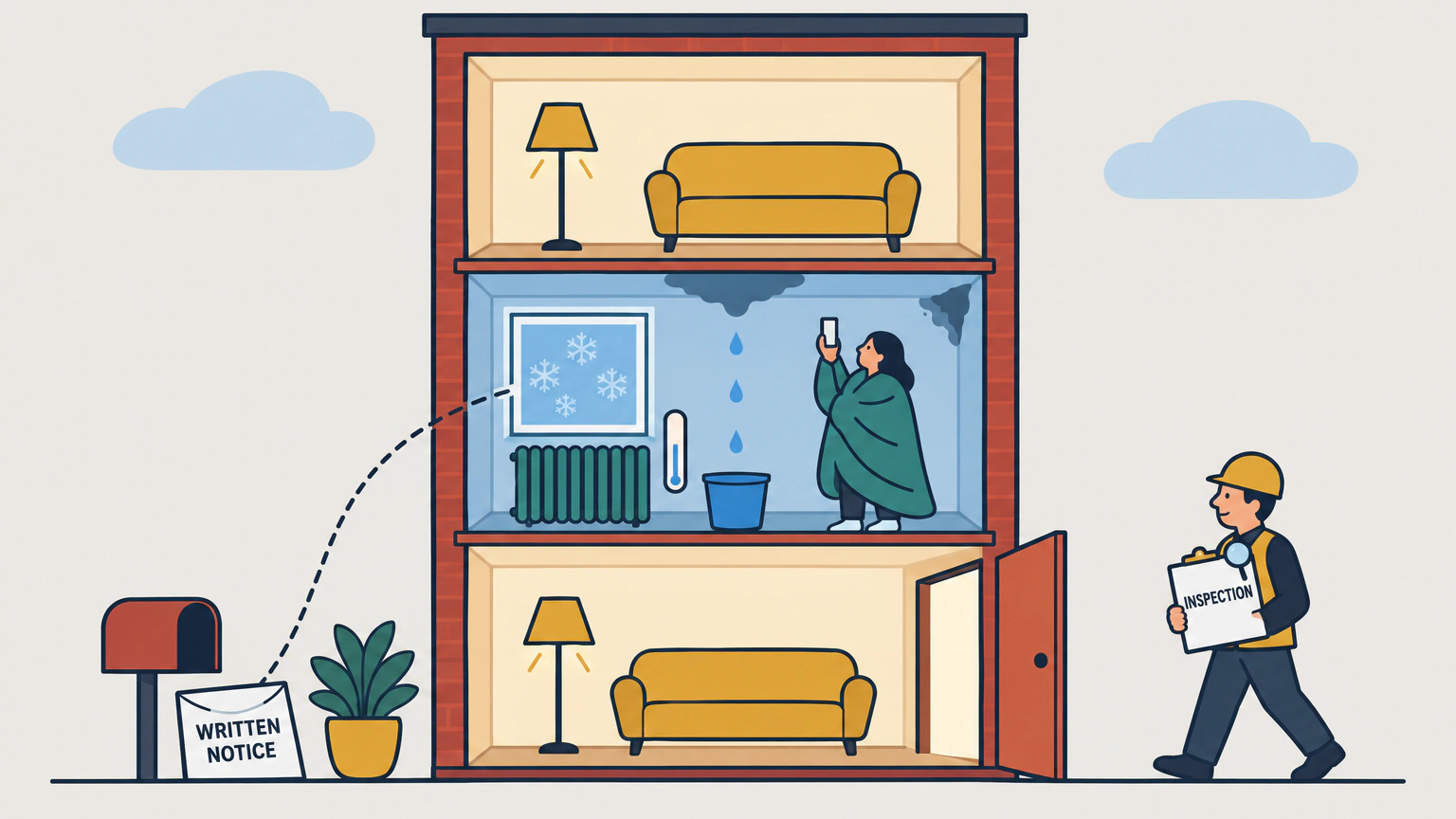
Yes, you can sue your landlord over unsafe living conditions. But in the states we checked, the lawsuit is usually the last step, not the first. Put the problem in writing. Get a housing inspector to see it and write it up. Use only the self-help your state allows. Then sue in small claims for the rent and money you lost, or call an injury lawyer if someone got hurt. Those records can support your case and help you show that an eviction or rent increase was retaliation.
On this page
Yes, you can sue, but the lawsuit usually comes last
Start with what winning looks like, because state law spells it out.
Texas lists it plainly. A tenant who wins a repair case can get an order to fix the problem and a rent cut running from the first repair notice. Add a civil penalty of one month's rent plus $500, your actual damages, and attorney's fees (though not for a personal injury claim).
California has an inspector-based remedy for serious conditions you didn't cause. After official notice and 35 days without repairs, the landlord can't demand rent if the delay has no good cause. A landlord who demands it anyway owes your actual damages plus $100 to $5,000 in special damages, and the winner's attorney's fees.
Maryland's 2024 warranty law lets a court award damages, cut the rent, or end the lease and order relocation expenses, and a tenant who wins relief can recover fees.
Every one of those remedies depends on steps you take before you file, which is why those steps come first.
Two kinds of lawsuit you may have
The same leak can produce two different cases, and they run on different rules.
The rent case: you paid for a home that wasn't livable
New York's statute puts the landlord's promise in plain words. The landlord warrants that the home is "fit for human habitation" and that its occupants "shall not be subjected to any conditions which would be dangerous, hazardous or detrimental to their life, health or safety." A lease clause waiving that promise is void. Lawyers call it the warranty of habitability.
The money is the gap between the rent you paid and what the place was worth with the problem. Texas cuts the rent "in proportion to the reduced rental value," starting from your first repair notice. California says its inspector-notice claim can go to small claims court.
The injury case: when the condition hurt you
A fall on a broken stair, a burn, an illness from mold: that can support a negligence claim as well as a rent dispute. California's general rule makes everyone answer for injury caused by a "want of ordinary care or skill in the management of his or her property."
Your written notice matters twice here. It's usually the best evidence that the landlord knew. And the clock is short: two years in four of our eight states, three in the other four (Table B).
So if someone in your home was hurt, call a lawyer early. Suing an apartment complex for negligence lives on this branch.
Four things to do before you file
Notice, inspection, records, then a remedy. Each step does legal work, and skipping one can cost you the next.
Put it in writing, the way your state counts it
Notice starts many repair clocks, though some states also count oral or actual notice. The rules differ a little from state to state.
Texas. Give notice to the person or place where you normally pay rent. If the landlord doesn't act within a reasonable time, send a second written notice. One notice is enough if the first went by certified mail with a return receipt requested, registered mail or another tracked mail service. The law presumes seven days is a reasonable time to repair. You must also be current on rent when each notice goes out.
Maryland. Send a list of the defects by certified mail, or rely on actual notice or a government violation notice. Taking more than 30 days after receiving notice to fix it is presumed unreasonable.
Florida. If you might hold back rent, the notice has to say so, and seven days have to pass first.
Washington. The notice names the property, the owner if you know who it is, and the problem. Unless circumstances are beyond the landlord's control, it starts three clocks for the landlord to begin repairs: 24 hours for lost heat, water or electricity, 72 hours for a dead fridge, stove or major plumbing fixture, and 10 days for everything else.
Keep a copy of everything you send.
Get an inspector to see it
Code enforcement or the health department turns your word into an official record. In several states, that record is also what opens a remedy.
In California, the 35-day clock runs from service of the official notice, complete when it enters the mail. If the problem is still there after 35 days, the landlord can't demand rent.
Massachusetts lets you fix the problem and take the cost off your rent, known as repair and deduct, only after the board of health, a code agency or a court certifies the violation. After written notice, the owner has 5 days to start repairs or sign a repair contract and 14 days to substantially finish. A shorter official deadline takes priority.
Washington makes you ask the local government for an inspection before you can pay rent into escrow, held by a neutral third party instead of the landlord. It has to inspect and decide whether the conditions qualify within 5 days of receiving your request.
In Texas, for broken heat or cooling and most other problems, repair and deduct needs a local official's written notice to the landlord first.
In New York City, call 311. The city's housing agency, HPD, lets tenants file anonymously, though then the inspector picks an apartment at random to try to inspect. Write down the complaint number the day you call.
Keep the records a judge believes
Dated, specific, boring records beat a strong feeling every time. Open the file the day the problem starts.
Before you file:
- A copy of every written notice, with the date you sent it and how (certified mail receipt, tracking number or email).
- Photos and video of the problem, dated, taken again each time it changes or comes back.
- A temperature log if the heat is out: time, inside reading, outside reading, every day it happens.
- The inspector's report or violation notice, and the complaint or case number.
- Receipts for anything the problem cost you: space heaters, hotel nights, ruined belongings, a repair you paid for.
- Medical records and bills if anyone in the home got sick or hurt.
- Every text, email and voicemail from the landlord or manager about the problem.
What your state lets you do before court
Find your row before you spend a dollar or skip a payment. Where a cell says no, treat it as a hard stop, even if a friend in another state did exactly that.
Table A. What your state lets you do before court
| State | Fix it and deduct the cost? | Hold back rent? | Retaliation protection |
|---|---|---|---|
| California | Yes, up to one month's rent, no more than twice in 12 months (Civ. Code § 1942) | A substantial habitability breach can support withholding after notice and reasonable repair time. The inspector route has a 35-day wait and other conditions (Civ. Code § 1942.4). If sued, the judge can set a reduced rent (CCP § 1174.2) | 180-day rule from the latest qualifying event, if you're current on rent, once in 12 months. Broader retaliation protection also applies (Civ. Code § 1942.5) |
| Texas | Yes, for listed conditions: up to one month's rent or $500, whichever is greater, per month. Subsidized homes use fair market rent (Prop. Code § 92.0561) | No. Withholding can cost you damages, plus a penalty after a written warning (Prop. Code § 92.058) | 6 months after your repair notice or code complaint (Prop. Code § 92.331) |
| Florida | No repair-and-deduct right in the statute (Fla. Stat. ch. 83) | For material building-code or basic maintenance violations, after 7 days' written notice of intent to withhold. An eviction case requires court deposits (§ 83.60) | No fixed window. You must show retaliation was the main reason (§ 83.64) |
| New York | In "extenuating circumstances," per the state Attorney General | Withholding risks a nonpayment suit, where habitability is a defense. A stay under RPAPL § 755 requires court deposits | 1 year presumption after a protected complaint, except owner-occupied homes with fewer than four units (RPL § 223-b) |
| Washington | Yes. Hired pro: up to two months' rent a year. Your own work: up to one month's rent a year (RCW 59.18.100) | Escrow for certified dangerous conditions you can't fix through repair and deduct. Both remedies require current rent and agreed utilities (RCW 59.18.080, .115) | 90 days presumption, with exceptions including rent arrears and other lease breaches (RCW 59.18.250) |
| Arizona | Minor defects: under $300 or half a month's rent, whichever is greater, licensed contractor (A.R.S. § 33-1363) | No general right. Lost heat or water: buy it and deduct, or move out temporarily rent-free (A.R.S. § 33-1364) | 6 months presumption after a complaint (A.R.S. § 33-1381) |
| Maryland | Not in §§ 8-211 or 8-212. Repair money comes through a court order | Yes. Court rent escrow (§ 8-211) or withhold and raise the defects when sued (§ 8-212) | Up to 6 months after your complaint (Real Prop. § 8-208.1) |
| Massachusetts | Yes, once an inspector or court certifies it: up to four months' rent in 12 months (G.L. c. 111, § 127L) | As a defense or counterclaim, if the landlord knew before you fell behind (G.L. c. 239, § 8A) | 6 months presumption after a protected complaint, except nonpayment notices (G.L. c. 186, § 18) |
Read from each state's statute, plus the New York Attorney General's tenant guidance for the repair column. Cities can add rules, so check yours too.
Fixing it yourself and deducting the bill
The caps are the easy part. The conditions are where tenants get caught.
California allows it twice in 12 months at most, and waiting 30 days after your notice is presumed long enough.
Texas covers only listed conditions. Sewage or flooding inside the home can be fixed right after your notice of intent to repair. Lost water gets 3 days. Bad heat or cooling gets 3 days, but only once an official has notified the landlord in writing. Anything else gets 7 days, with that same official notice. Since a 2025 rewrite, the work must be done by "an independent company, contractor, or repairman," licensed if your city requires it. Unless the landlord agrees, that rules out you and your immediate family. The bill and receipt go to the landlord with the rest of the rent.
Washington's higher limit is for a licensed or qualified pro, after you've given the landlord a good-faith estimate. Your own work is allowed only inside your unit, on jobs that don't need a license.
Arizona's version covers minor defects only: 10 days' written notice, a licensed contractor, and an itemized statement and lien waiver before you deduct. Massachusetts waits for certification, then allows up to four months' rent.
Then there are the two that say no, or rarely. Florida's statute has no repair-and-deduct right at all. New York's Attorney General describes it in "extenuating circumstances." Its example is a landlord who willfully ignores a broken door lock, where the tenant may hire a locksmith and deduct the cost.
Holding back rent is where tenants get evicted
This is the decision that turns a repair complaint into an eviction case. It's unfair that the risk lands on you, but it does, so slow down here. Withholding rent depends on state law, including court decisions, and every route has conditions.
Florida allows it for a material breach of the landlord's building-code or basic maintenance duties. Your written notice must identify the problem and say you're withholding, then seven days must pass. If the landlord sues for possession, you must pay the rent into the court registry, or ask the court to set the amount, within five days of being served, not counting weekends and legal holidays. Miss that and you lose every defense except payment.
Florida also has a trap for cold apartments. Its statewide duty to keep heat working in winter can't be raised to fight an eviction. Only a local housing-code violation can carry that defense. So get the violation on record, ideally as an inspector's citation, before you hold back a dollar over heat.
Texas's repair law doesn't let you simply stop paying rent. A tenant who does it can owe the landlord's damages, and after a written warning, a bad-faith penalty of one month's rent plus $500.
New York lets you withhold over a habitability breach, but the landlord can sue for nonpayment. A stay under its repair law requires a court deposit. Maryland offers court rent escrow, or holding the rent and raising the defects when the landlord sues. For monthly or longer tenancies, three possession judgments for unpaid rent in the past year bar escrow relief. Weekly tenancies have a different threshold. Washington allows escrow only after certification. Massachusetts lets you raise the conditions only if the landlord knew about them before you fell behind.
Red flag: Before you hold back a dollar. Check three things first. Your state has to allow it, and Table A shows that several don't. Your notice has to say what your state requires, in the way it requires. Keep the money ready. Florida eviction cases, New York repair-law stays and Maryland rent-escrow cases can require court deposits. Miss any one and nonpayment becomes the case.
Lose a nonpayment case and you've lost an eviction case. Here's what an eviction filing does to your record.
The retaliation shield, and how long it lasts
Retaliation means a landlord punishing you for complaining, with an eviction notice, a rent hike or a cut in services. These states protect you in two different ways.
Four use a presumption. If the landlord acts soon after your complaint, the law assumes it's payback and makes the landlord prove otherwise. The window is a year in New York, 90 days in Washington, and six months in Arizona and Massachusetts.
California and Texas bar retaliation, but landlords can still act for lawful reasons. California's 180-day rule runs from the latest qualifying event if you're current on rent, once in 12 months. Texas's rule runs six months.
Maryland's state rule covers retaliation within six months of a protected action. Local rules can give you more protection. Florida sets no window at all.
What it can pay: in Massachusetts, one to three months' rent or your actual damages if higher, plus attorney's fees. Maryland allows up to three months' rent plus fees. California adds up to $2,000 in punitive damages per retaliatory act, on top of actual damages, where the landlord acted with fraud, oppression or malice.
No heat this winter? Here's how the rules treat it
Heat is where the state rules split hardest, and the cold months are here.
New York City's heat season runs October 1 to May 31. From 6 a.m. to 10 p.m., the inside has to reach 68°F whenever it's below 55°F outside. Overnight it has to be at least 62°F, whatever the weather. Hot water is due all year at 120°F.
Washington gives the landlord 24 hours to start fixing lost heat. Arizona offers these remedies when a landlord deliberately or negligently fails to supply heat. Give notice first. You can buy reasonable amounts of heat and deduct the cost. Or you can move to substitute housing and owe no rent while the heat is out. If that costs more than your rent, you can recover the extra, up to 25% of the rent you were excused from paying.
Maryland lists lack of heat among the defects serious enough for rent escrow. California counts heating that works as part of a livable home.
Texas is slower. Repair and deduct for heat needs a local official's written notice to the landlord. The three days run from your notice of intent to repair.
Florida requires working heat in winter in apartment buildings, unless the lease says otherwise in writing. But only a local code violation can back a defense to eviction there.
Start the temperature log tonight. We'd call the inspector the first cold night, not the fifth.
Filing the lawsuit
Where you file depends on how much you're asking for. An injury claim runs on its own clock.
Table B. Where you file, and how long you have
| State | Small claims limit | Usual injury lawsuit deadline |
|---|---|---|
| California | $12,500 for an individual (CCP § 116.221) | 2 years (CCP § 335.1) |
| Texas | Justice court, up to $20,000 in a repair case (Prop. Code § 92.0563) | 2 years (CPRC § 16.003) |
| Florida | $8,000 (Fla. Sm. Cl. R. 7.010) | 2 years for negligence (§ 95.11) |
| New York | $10,000 in New York City Civil Court | 3 years (CPLR § 214) |
| Washington | $10,000 for an individual (RCW 12.40.010) | 3 years (RCW 4.16.080) |
| Arizona | $5,000 (A.R.S. § 22-503) | 2 years (A.R.S. § 12-542) |
| Maryland | $5,000 (Cts. & Jud. Proc. § 4-405) | 3 years (Cts. & Jud. Proc. § 5-101) |
| Massachusetts | $7,000 (G.L. c. 218, § 21) | 3 years (G.L. c. 260, § 2A) |
Deadlines usually run from the injury. Elsewhere in New York, small claims limits are lower.
Small claims for the rent and repair money
Small claims is where most rent cases belong, and Table B has the caps.
It's cheap. California charges $30 to file a claim up to $1,500, $50 up to $5,000, and $75 above that, if you've filed 12 or fewer small claims in the state in the past year.
It can be fast. A Texas justice court must hear a repair suit between the 6th and 10th day after the landlord is served, and it can award up to $20,000, repair orders included.
Two limits are worth knowing. Arizona's small claims division can't order repairs, because it can't grant injunctive relief (an order to do something). And in New York City, repair cases go to the Housing Part of Civil Court instead.
Moved out, and the real fight is over the deposit? Our guide to getting your security deposit back covers the penalties there.
Injury cases need a lawyer early
The clock may already be running. Injury deadlines depend on when the claim accrues, with exceptions for some claims. Early matters for a second reason. Evidence fades. Medical records, photos and the landlord's own repair logs are easier to pin down while the injury is recent.
If an injury lawyer offers a contingent fee, meaning a percentage of what you recover, the ABA's model rule says that deal belongs in a writing you sign. It has to state the percentage and whether expenses come out before or after the fee is calculated. Read that line before signing. Our list of personal injury attorneys is a good place to start.
What a tenant's lawyer costs, and when the landlord pays
Our landlord-tenant lawyers page doesn't put one price on a repair fight. Our planning estimates there, drawn from published US provider prices rather than quotes, put a residential lease review at about $150 to $400. For a deposit or repair dispute, we tell you to get a quote. Ask for the lease review, a demand letter and a lawsuit to be priced separately.
Several states shift fees to the landlord when you win: California, Texas (not for the injury part), Maryland, and the retaliation laws in New York, Washington and Massachusetts. Some cut both ways. California's inspector-notice law and Washington's retaliation law award fees to whichever side prevails, so a weak case can leave you paying the landlord's lawyer. Above the small claims limit, run those numbers with civil litigation attorneys before you file.
We're not your lawyer, and a fight over your home deserves one: if you're weighing whether to hold back rent, talk to a landlord-tenant lawyer or your local legal aid office first.
Frequently asked questions
Can I sue my landlord for emotional distress?
Sometimes. Emotional distress can be a separate claim, depending on your state's rules and the landlord's conduct. The amount a court awards turns on your state's case law and how badly the landlord behaved. The statutes also set damages. California awards $100 to $5,000 when a landlord illegally demands rent under its inspector-notice rule, which has a 35-day wait and other conditions. Massachusetts allows one to three months' rent for retaliation, or actual damages if higher. Ask a lawyer before you build a case on distress alone.
Can I sue my landlord after I move out?
Yes. Moving out doesn't erase what you lost while you lived there. The usual injury deadlines are two years in California, Texas, Florida and Arizona, and three in New York, Washington, Maryland and Massachusetts. Claims for rent you overpaid can run on a different clock in some states, so check yours before you wait. Keep your notices and photos when you move.
How much does it cost to sue an apartment complex?
In small claims, mostly the filing fee. California charges $30, $50 or $75 depending on the amount, if you've filed 12 or fewer small claims in the state in the past year. Small claims courts are built for people without lawyers. Massachusetts' statute calls its version "simple, informal and inexpensive." An injury case costs more to run, but injury lawyers can take it on a contingent fee set out in a signed agreement.
Can I stop paying rent until my landlord fixes things?
Only where your state allows it, and only its way. In Texas, withholding can cost you the landlord's damages and a penalty. Florida allows it for material building-code or basic maintenance violations after seven days' written notice of your intent to withhold. An eviction case also requires court deposits. Washington routes it through escrow, and Maryland offers court escrow or withholding with the defects as your defense. Read your row in Table A before you skip a payment. Once rent goes unpaid, you may have to prove the repair problem to defend an eviction.
Can my landlord evict me for complaining about repairs?
Not as payback. Several states have special rules after a protected complaint, either presuming retaliation or banning it while allowing lawful action. Coverage and exceptions vary. The window runs a year in New York, 180 days in California, six months in Texas, Arizona and Massachusetts, and 90 days in Washington. Florida sets no window. Being behind on rent weakens the protection in several states, so stay current while you complain.
Can I break my lease if my apartment is unsafe?
Often, after written notice and a chance to fix. In Florida, this covers a material breach of basic maintenance duties or the lease. Your notice must give seven days and say you'll end the lease. Arizona allows five days for a problem that materially affects health and safety. California and Texas let you leave and stop owing rent once the repair rules are met. Put your intent in the notice itself.
Your next step
Today, write the notice and send it the way your state counts it. This week, call code enforcement, or 311 in New York City, and get an inspector in. Before you make any decision about rent, read your row in Table A. When you're ready for help, start with our landlord-tenant lawyers, and before you sign anything, check that the lawyer is licensed.