

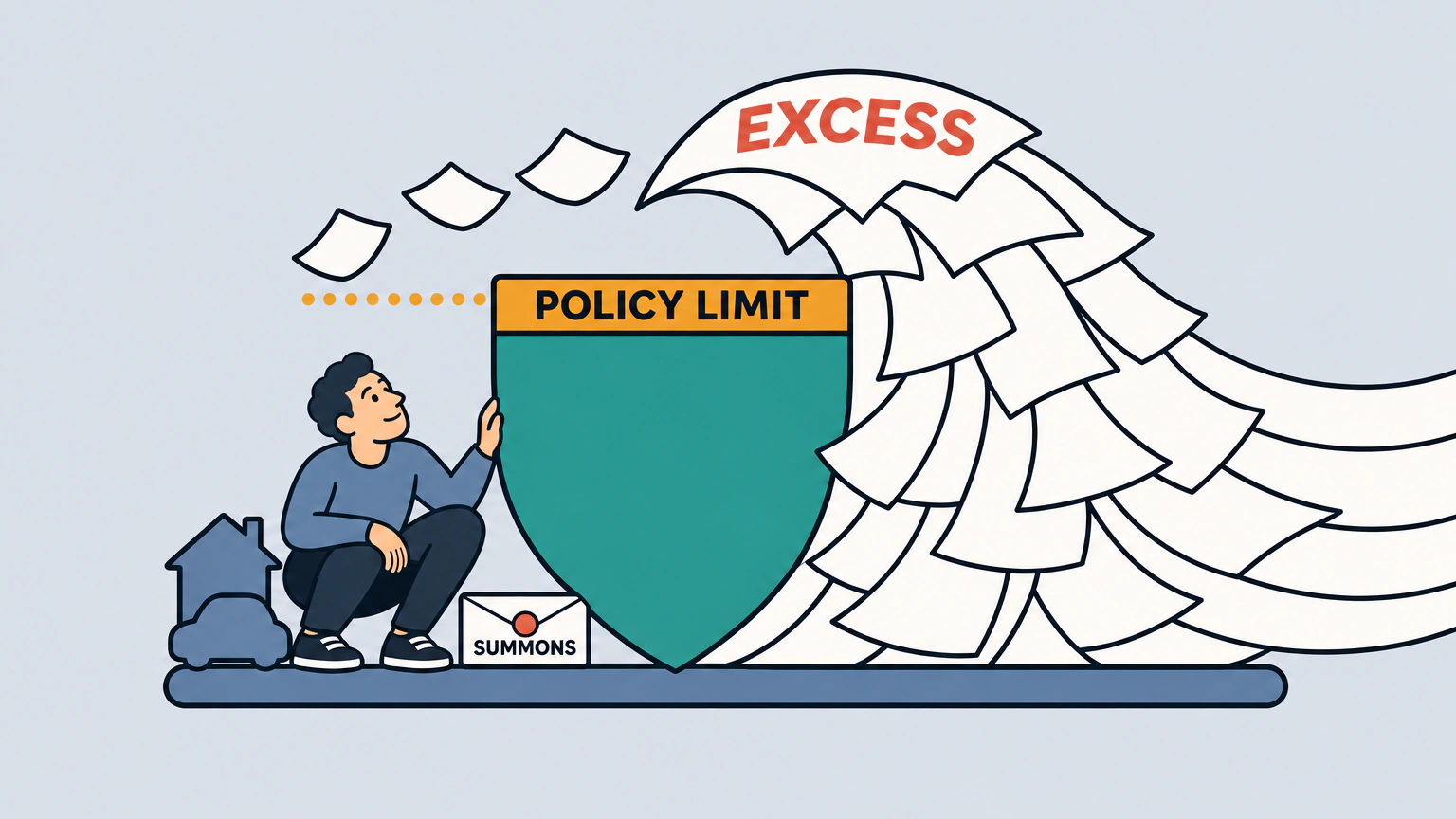
If you've been served after a crash, send the papers to your auto insurer today. Your policy almost certainly obliges it to hire and pay a lawyer for you, and to pay any judgment up to your liability limit. Only the part of a judgment above that limit is yours to pay. Even then, federal and state law protect much of your paycheck, your Social Security, your workplace retirement plan and, depending on your state, your home.
The next week matters more than the next year. Two things turn a manageable suit into a dangerous one: a missed deadline and a policy nobody read.
On this page
- The first week after you're served
- What your insurance company owes you, and what it doesn't
- When your own money is on the line
- What a judgment can reach, and what stays yours
- An unpaid crash judgment can cost you your license
- Don't move money or property now
- Can bankruptcy wipe out a car accident judgment?
- When to hire your own lawyer, and what it costs
- Questions people ask when they've been sued after a crash
The first week after you're served
You have days, not months. Most of the work is paperwork you can start tonight, at the kitchen table.
Your first week after being served
- Send the summons and complaint to your auto insurer today, in writing, with your claim number.
- Write down the response deadline printed on the summons.
- Ask the insurer to confirm in writing that it will defend you, and who your lawyer is.
- Ask that lawyer for a copy of your answer once it's filed.
- Forward every settlement demand letter to the insurer the day it arrives.
- Give the lawyer every policy you hold, including any umbrella policy.
- Leave your house, car and accounts exactly where they are.
Send the papers to your insurer today
The papers came to you because the lawsuit names you, the driver. That's normal. It doesn't mean your insurer is out of the picture, but it can't defend a case it doesn't know about.
A standard Texas personal auto policy form shows the kind of promise you've probably made. Anyone seeking coverage must "Cooperate with us in the investigation, settlement or defense of any claim or suit" and must "Promptly send us copies of any notices or legal papers received in connection with the accident or loss." It also warns: "If we show that your failure to provide notice prejudices our defense, there is no liability coverage under the policy."
So send everything in writing. Include your claim number, a copy of every page you were handed, and something that proves when you sent it, like a saved email or a certified mail receipt. If someone else owned the car, or you were driving for work, send a copy to that insurer as well.
Your own policy's wording is what counts. You'll find it on your declarations page and in the policy booklet.
Find your answer deadline, then make sure someone meets it
The summons tells you the deadline, and it's short. In California, a summons must direct you to file a written response "within 30 days after summons is served." It must also warn that ignoring it "could result in garnishment of wages, taking of money or property, or other relief." In federal court, an answer is due "within 21 days after being served with the summons and complaint." Other states set their own windows, so read yours off the summons itself.
The insurer's lawyer normally files the answer. Don't just assume it happened, though. A default is entered against you, not against the insurer, so ask the lawyer for a copy of the filed answer before the deadline passes. Our guide to debt lawsuits explains how an answer and a default judgment work if you want the mechanics.
What your insurance company owes you, and what it doesn't
Your policy is a contract with two sides. Knowing the insurer's side tells you when you can relax and when you should start to worry.
The lawyer the insurer hires is your lawyer, on its budget
The same Texas form spells out the insurer's side. It "will settle or defend, as we consider appropriate, any claim or suit asking for these damages." It adds: "In addition to our limit of liability, we will pay all defense costs we incur." Then comes the catch: "Our duty to settle or defend ends when our limit of liability for this coverage has been exhausted."
Put plainly, the lawyer's bills don't eat into your coverage, so a $30,000 limit is still worth $30,000 after months of defense work. The insurer decides whether to settle, and when. And once it has paid out the full limit, it can stop defending you.
In the lawsuit itself, the lawyer your insurer hired represents you. The insurer pays the bills and controls settlement. Keep that lawyer's number somewhere you'll find it, and answer every request quickly. Don't discuss the crash with the other driver, their insurer or their lawyer, and don't post about it.
Two kinds of letter can change this arrangement.
If a reservation of rights letter arrives
A reservation of rights letter says the insurer will defend you for now but keeps the right to deny coverage later. It might claim the crash was intentional, for example, or that the driver wasn't covered. That's where your interests and the insurer's can split, because the lawyer the insurer picked may be shaping the same facts that decide the coverage fight.
California puts the answer in a statute. When a conflict of interest creates a duty to provide independent counsel, "the insurer shall provide independent counsel to represent the insured," unless you waive that right in writing. A conflict "may exist" when the insurer reserves its rights on an issue the defense lawyer could steer. One line surprises people, though: "No conflict of interest shall be deemed to exist ... solely because an insured is sued for an amount in excess of the insurance policy limits." Being sued for more than your coverage isn't enough by itself.
Other states set their own rules. If you're holding this letter, have your own lawyer read it. A flat denial of coverage is worse still: you're defending yourself, and that's the moment to hire one.
When the other side offers to settle inside your limits
This is the letter that matters most when your limits are low. An offer to settle for no more than your policy limit protects you, because a settlement inside the limit leaves nothing for you to pay.
California regulates these offers closely, which tells you how much rides on them. A "time-limited demand" is an offer, made before any lawsuit is filed, to settle a claim "within the insurer's limit of liability insurance." It must be in writing. It must give at least 30 days to accept if it's sent by email, fax or certified mail, or 33 days by ordinary mail. And it must contain "A clear and unequivocal offer to settle all claims within policy limits, including the satisfaction of all liens," plus a complete release of everyone the insurer covers. That means you.
Why the fuss? The statute calls any amount above your total coverage "extracontractual damages," and it expects a later lawsuit against the insurer over that excess. A demand that doesn't substantially comply can't count as a reasonable offer within limits in that suit, but only when the person making it has a lawyer.
Forward every demand letter to the insurer the day it arrives. If the demand is within your limits, ask the insurer in writing to accept it, and keep a copy. That last step is our advice, not a rule. We'd take it every time.
When your own money is on the line
Being sued for a car accident becomes your personal problem in three ways. The first is a verdict bigger than your liability limit. The insurer pays up to the limit, and the rest is a judgment against you.
The second is no coverage at all: no policy, a lapsed one, a driver the policy excludes, or an insurer that denies coverage. The third is a claim the policy itself excludes. The Texas form, for instance, gives no liability coverage to a person "Who intentionally causes bodily injury or property damage," and none for a car carrying people for a fee (car pools aside).
Minimum limits show how low that ceiling can sit. In California, a policy issued or renewed on or after January 1, 2025 must carry at least $30,000 for one person's injuries, $60,000 when two or more people are hurt in one accident, and $15,000 for property damage. Texas requires $30,000, $60,000 and $25,000. A serious injury claim can be worth more than a minimum policy pays, and the difference is the driver's.
Now the part that should let you breathe. Injury lawyers size a case by the insurance available, and they rarely chase a driver's personal assets. If the person suing you is a friend or relative who rode with you, the suit is usually their way to reach your insurance, not a verdict on you as a person.
Lawyers on that side also hunt for an umbrella or excess policy sitting above the auto policy, and sometimes they learn about one only after suit is filed. So give your defense lawyer every policy you hold, umbrella included. If a judgment does land above the limit, the next question is the one you came with: what can they take?
What a judgment can reach, and what stays yours
A judgment lets the person who won collect from what you earn and what you own, by garnishing wages or taking money and property. But the law fences off a lot. Federal rules protect part of every paycheck, all of your Social Security and the benefits in most private-employer pension plans. Your state adds its own list on top.
What a judgment can reach, and what stays yours
| What you own | What's protected | Source |
|---|---|---|
| Your paycheck (federal floor) | A creditor can take no more than the lesser of 25% of weekly disposable earnings or the amount above $217.50, which is 30 times the $7.25 federal minimum wage. | 15 U.S.C. § 1673(a); 29 U.S.C. § 206(a)(1)(C) |
| Your paycheck in Texas | All current wages, except for court-ordered child support or spousal maintenance. | Tex. Const. art. XVI, § 28, and Tex. Prop. Code § 42.001(b)(1) |
| Social Security benefits | All of them. They can't be levied, attached or garnished. | 42 U.S.C. § 407(a) |
| An employer pension plan covered by ERISA | Plan benefits "may not be assigned or alienated". | 29 U.S.C. § 1056(d)(1) |
| A home in Texas | The homestead itself, with no dollar cap: up to 10 acres in town, or 100 rural acres for a single adult and 200 for a family. | Tex. Prop. Code §§ 41.001(a), 41.002 |
| A home in California | Equity up to the greater of $300,000 or the county's median single-family sale price capped at $600,000, both adjusted yearly for inflation. | Cal. Code Civ. Proc. § 704.730 |
Protection for homes, cars and bank accounts is set state by state. The Texas and California rows are examples, not the rule where you live.
Here's the federal paycheck rule with real numbers. It works on "disposable earnings," the pay left after "the deduction from those earnings of any amounts required by law to be withheld." Someone with $250 a week of disposable earnings can be garnished no more than $32.50. Someone with $800 can lose up to $200. Anyone at $217.50 a week or less keeps every dollar.
States can protect more, and federal law says so. It leaves alone any state law "prohibiting garnishments or providing for more limited garnishment." Texas is the sharpest example. It protects current wages completely, except for court-ordered child support or spousal maintenance. A bankruptcy or debt lawyer in your state can tell you what's protected where you live, and our credit card lawsuit guide covers what a judgment lets a collector reach step by step.
An unpaid crash judgment can cost you your license
This is the consequence few people see coming. In all six states we read in full, a driver who doesn't pay a crash judgment can lose their license under the state's financial responsibility law (the rules that make drivers show they can pay for damage they cause). Unlike garnishment, it doesn't depend on what you own. A driver with nothing to seize can still lose the right to drive.
Six states and how long they wait
The clock starts with the judgment: 15 days in New York, 60 in Texas and 30 in the other four. In five of the six, the person you owe (the judgment creditor) sets things moving, not the court on its own. California's court clerk acts "upon the request of a judgment creditor," and Virginia's Code has the DMV act "Upon the application of any judgment creditor." Florida, Texas and Washington work the same way. New York's statute says only that the commissioner acts on an "authenticated report."
Six states that suspend a license over an unpaid crash judgment
| State | How long the judgment can go unpaid first | What's suspended | Which judgments count | Statute |
|---|---|---|---|---|
| California | 30 days | Your privilege to drive | Injury or death in any amount, or property damage over $1,000, from driving on a California highway | Veh. Code §§ 16370, 16251 |
| Florida | 30 days, then the court clerk forwards it at the creditor's written request | License and registration | Injury, death or property damage from owning, maintaining or using a motor vehicle | Fla. Stat. §§ 324.111, 324.121, 324.021(10) |
| New York | 15 days | License, registrations and plates | Injury or death in any amount, or property damage over $1,000, from a motor vehicle | Veh. & Traf. Law § 332(a), (b) |
| Texas | 60 days, after which the clerk sends it to the state at the creditor's request | License and vehicle registrations | Judgments reported under the Motor Vehicle Safety Responsibility Act | Transp. Code §§ 601.331, 601.332 |
| Virginia | 30 days | License, registrations and plates | Motor vehicle accident judgments that reach the DMV within 10 years | Code §§ 46.2-417, 46.2-418 |
| Washington | 30 days | License, for 10 years at first and extendable another 10 | Injury, death or property damage from a vehicle's ownership, maintenance or use, if the judgment's first page says the damages fall under the financial responsibility law | RCW 46.29.270, 46.29.310, 46.29.330 |
These are the six states we read in full. Search your own DMV's site for 'unsatisfied judgment' to find your state's rule.
Texas adds one mercy: a driver suspended this way "is eligible for an occupational driver's license."
Getting the license back without paying in full
If you can't pay the judgment in full, the six states between them offer five other routes. Nearly all of them come with one extra step, proof of insurance going forward. California, for one, won't lift the suspension until you've filed it.
- Court-ordered installments. Ask the court that entered the judgment to let you pay over time, then file proof of insurance. California, Virginia, Washington and Texas's Motor Vehicle Safety Responsibility Act all restore the license, or never suspend it, while you keep up. Miss a payment and the suspension comes back.
- The creditor's written consent. Florida, Texas and Washington may let you keep driving if the person you owe agrees in writing, again with proof of insurance.
- Proof that your insurer owed it. Florida's statute won't suspend you if an insurer "was obligated to pay the judgment but failed to do so through no fault of the judgment debtor." Texas, Virginia and Washington have their own versions. New York relieves a driver whose policy was in force at the time of the crash and paid the judgment to the extent its law requires.
- Paying the state's minimum amount. California treats a judgment as satisfied for this purpose once $15,000 is credited for one person's injuries, $30,000 for several people, or $5,000 for property damage. That's lower than California's current policy minimums, and it's the set that counts here. Virginia uses $50,000, $100,000 and $25,000 for policies effective on or after January 1, 2025.
- Bankruptcy. Virginia counts a judgment "discharged in bankruptcy" as satisfied. Texas says a discharge frees you from these rules, apart from insurance requirements that arise afterward. Federal law protects drivers in every state, as the bankruptcy section below explains.
Washington's Department of Licensing says the suspension runs 10 years at first and can be extended another 10 on the court's notice.
Don't move money or property now
After a crash, someone will suggest putting the house in your spouse's name, forming an LLC, or "gifting" your savings to a parent until this blows over. That's advice a court can undo.
California's Uniform Voidable Transactions Act shows how. A transfer can be undone when it was made "With actual intent to hinder, delay, or defraud any creditor of the debtor," and that holds "whether the creditor's claim arose before or after the transfer was made." One of the signs a court may weigh is "Whether before the transfer was made or obligation was incurred, the debtor had been sued or threatened with suit."
A crash claim counts as a claim before anyone wins anything. The statute's definition covers a right to payment "whether or not the right is reduced to judgment, liquidated, unliquidated." In plain terms, the debt exists in the law's eyes even before a court puts a number on it.
So the time to buy an umbrella policy or restructure your assets was before the crash. For the next one, it still is. Right now, leave your property where it is, and tell your lawyer exactly what you own.
Can bankruptcy wipe out a car accident judgment?
Usually, yes. A Chapter 7 discharge wipes out the debts you owed when you filed, except the ones on the Bankruptcy Code's list of exceptions. A judgment for ordinary negligence (carelessness, like rolling through a stop sign while distracted) isn't on that list.
Two exceptions matter here. A debt "for death or personal injury caused by the debtor's operation of a motor vehicle, vessel, or aircraft if such operation was unlawful because the debtor was intoxicated from using alcohol, a drug, or another substance" survives. It covers death and injury to people, not damage to property. A debt "for willful and malicious injury by the debtor to another entity or to the property of another entity" survives too, but not automatically. The person you owe has to ask the bankruptcy court to keep it, and win.
Chapter 13, the repayment-plan chapter, has its own list for people who finish their plan. It keeps the drunk and drugged driving exception. In place of the willful-and-malicious one, it carves out damages from a civil case for "willful or malicious injury by the debtor that caused personal injury to an individual or the death of an individual."
Then there's your license. Federal law says a state "may not deny, revoke, suspend, or refuse to renew a license" solely because you haven't paid a debt that's dischargeable in your case. The Supreme Court settled this for crash debts in 1971, in Perez v. Campbell. It struck down an Arizona law that kept a discharged driver's license suspended until the crash judgment was paid.
Bankruptcy carries its own costs, and there are limits on how often you can file. A bankruptcy lawyer can tell you whether it makes sense for you.
When to hire your own lawyer, and what it costs
For many drivers, the lawyer the insurer hired is enough. These five situations call for one of your own:
- The claim is clearly worth more than your limits.
- You've received a reservation of rights letter or a denial of coverage.
- You had no insurance.
- You were hurt too and want to bring your own claim.
- The crash involved alcohol or drugs. If you were intoxicated, that can also mean a criminal case, plus the bankruptcy exception above.
For the defense, look for a lawyer who defends civil lawsuits. Our civil litigation page prices "Business or contract dispute representation" at $300 to $550 per attorney hour. The row is written for business disputes, but it's our closest price for hiring your own defense counsel, and its note fits you: "An advance retainer is a deposit against bills, not the price of the entire lawsuit."
If you were hurt in the crash too, your own claim works differently. A car accident lawyer usually takes it on contingency, and our car wreck lawyers page puts an accepted injury claim at about 33% to 40% of the total recovery, with no attorney fee up front or without a recovery. Whoever you hire, check the lawyer's license before you sign anything.
We're not your lawyer, and a lawsuit with your name on it deserves one who has read your policy and your state's rules.
Questions people ask when they've been sued after a crash
Can I be sued for a car accident if I have insurance?
Yes. Insurance doesn't stop anyone from suing you, and the injured person usually names the driver, not the insurer. What insurance changes is who handles the case. A standard Texas policy form says the insurer "will settle or defend, as we consider appropriate, any claim or suit" for covered damages. Your part is sending it the papers right away and cooperating with the lawyer it hires.
What happens if I'm sued for more than my insurance covers?
The insurer pays up to your limit, and anything above it becomes a judgment against you. The person who won can collect that only from what isn't protected, and federal law shields part of your pay, all of your Social Security and most private-employer pension benefits. Your best protection comes earlier, in a settlement offer within your limits. Make sure the insurer sees every one.
Can they take my house after a car accident lawsuit?
It depends on your state's homestead law. Texas protects the homestead itself with no dollar cap, up to 10 acres in town, or 100 rural acres for a single adult and 200 for a family. California protects equity up to the greater of $300,000 or the county's median single-family sale price, capped at $600,000, and both figures adjust for inflation every year. Other states set their own rules.
What happens if I'm sued for a car accident and have no insurance?
You defend the case yourself or hire a lawyer, and any judgment is yours to pay. Federal and state exemptions still protect part of your pay and some of your property. In states such as California, New York and Texas, an unpaid crash judgment can also suspend your license until you pay, set up court-ordered installments where the state allows them, or discharge the debt in bankruptcy.
Can an unpaid car accident judgment suspend my driver's license?
Yes, in some states. Of the six we read, New York acts after 15 days unpaid, California, Florida, Virginia and Washington after 30, and Texas after 60. Depending on the state, a court order to pay in installments, the creditor's written consent, proof that your insurer owed the judgment, or a bankruptcy discharge can stop the suspension or end it.
Should I hire my own lawyer if my insurer already gave me one?
Not always. If the claim fits inside your limits and there's no fight over coverage, the lawyer your insurer hired is usually enough. Hire your own when a reservation of rights letter arrives, when the claim is bigger than your limits, or when you had no coverage. If you were hurt too, a car accident lawyer can bring your own claim.