

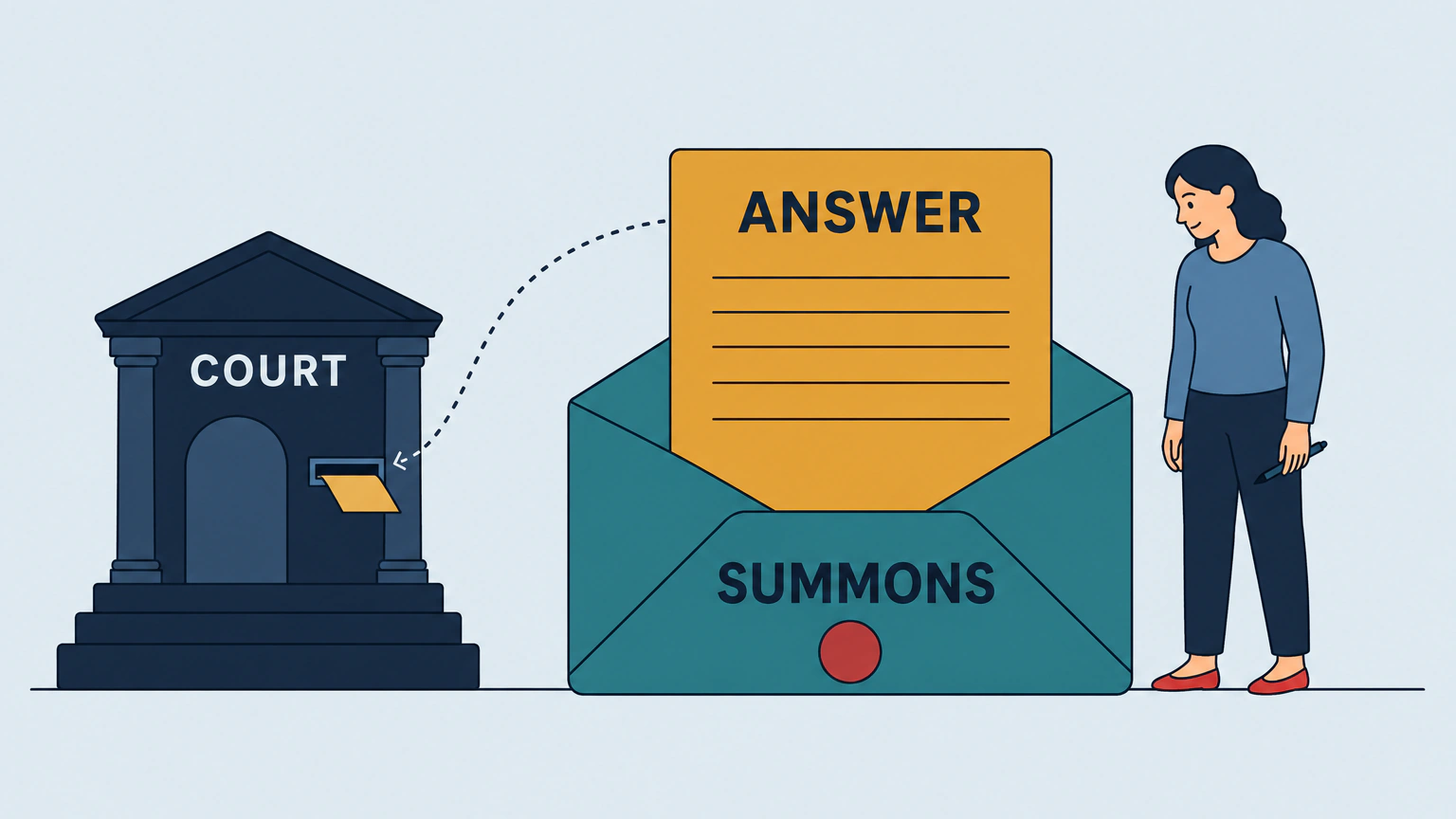
Don't ignore the papers. The case moves forward whether you take part or not, and your summons tells you how and when to respond. Responding as the papers require prevents a default for not responding, and it forces the collector to prove the debt. It also saves defenses you may otherwise lose, including the argument that the debt is too old to sue on.
We're an editorial team, not your lawyer. What follows is how these cases work in general, and only an attorney licensed in your state can tell you what your own papers require.
On this page
- The date on your papers is the only date that matters
- What happens if you never reply
- What filing an Answer actually does
- The other clock, the one that was running before you were served
- When a debt collector cannot sue on a time-barred debt
- Whether to hire someone, and what it costs
- Your first week, in order
- Questions people ask after they are served
The date on your papers is the only date that matters
Two dates can show up on what you were handed, and people mix them up all the time. One is a court date. The other is your response deadline, and that's the one deciding whether you still have a case at all. It isn't a national number. The required response and its trigger can change with the court and with how you were served. Use the instructions on your own papers, not a number a website quotes.
What you were handed, and which page carries the deadline
You got two documents doing two different jobs.
The summons is the court's notice. It names the court, names you, and tells you how long you have to respond. California's law spells out exactly what has to appear on one, down to a boldface legend across the top reading "Notice! You have been sued. The court may decide against you without your being heard unless you respond within 30 days."
The complaint is the other one, and it's the collector's version of events: who they say owes the money, how much, and why. It's a claim. Nothing in it has been tested by anyone yet, and a number printed in it isn't a number a court has agreed with.
Pro tip: Photograph both documents and the envelope the moment they reach you, and keep the envelope. Write down the date, the time, the place, and who put the papers in your hand. How and when you were served can become an issue of its own later on, and by then nobody remembers.
How much the window varies, in the three states we could check
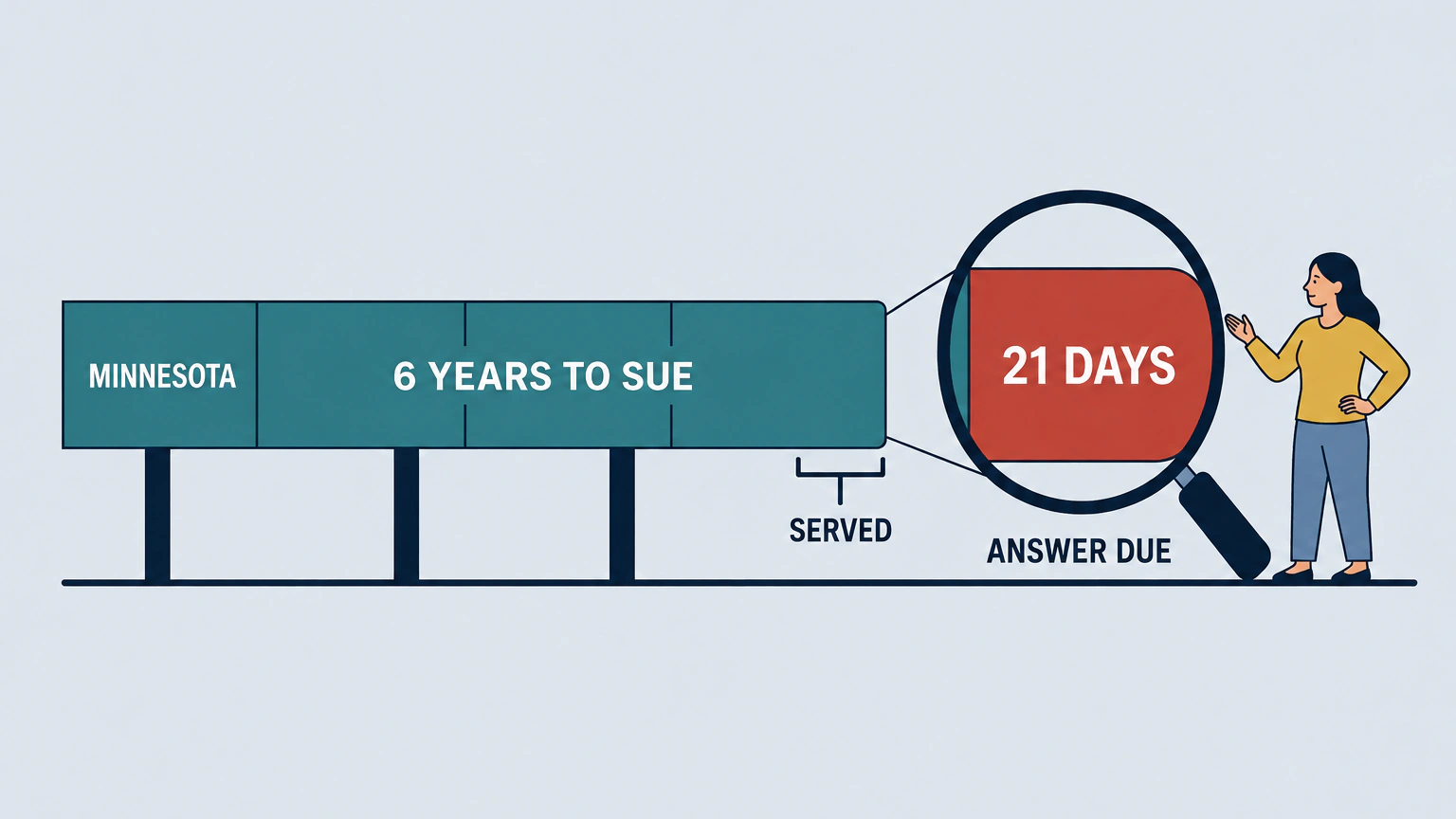
California's summons has to direct you to file a written response within 30 days of being served. New York gives 20 days when the papers are handed to you in person, and 30 days when they arrive by several of the other permitted routes. Minnesota gives 21 days from service.
Three states, three numbers, and New York's changes inside its own borders depending on how you were served. We wanted to hand you all fifty. Several state court rule books wouldn't open to us at all, and a guessed deadline in a matter like this one is worse than no deadline.
So read your own summons. If the wording confuses you, phone the clerk of the court named at the top and ask where to find that court's response instructions.
What counts as responding, and what does not
Calling the collector isn't responding. Sending a payment isn't responding. Refusing the envelope definitely isn't responding, and the FTC says so in as many words: you can't stop things by refusing to accept delivery, and "the case can go ahead without you."
Your papers may require a written Answer, a court appearance, or both. A motion or notice of appearance may also count in some courts or change the Answer deadline. Follow the filing and service instructions you were given, because the sequence varies by court.
If your response requires a filing fee, ask whether the court will waive it. California's court self-help guide lists $225 to $450 to file an Answer there and tells people who can't cover it to ask for a fee waiver.
What happens if you never reply
Silence doesn't buy time. It buys a decision.
Nobody at the courthouse pauses to build your defense for you. If you don't respond or appear as required, the plaintiff may win by default. What comes out the other end is a judgment with your name on it and a set of collection powers attached.
You can lose without arguing your case
A default judgment is what a court may enter when one side doesn't respond or appear as required. Your side isn't heard, and the plaintiff may win without an adversarial hearing on the merits.
It's also the ordinary outcome, which is worth knowing if you're feeling singled out. Pew's study of state court dockets found that over the past decade, in the jurisdictions where data existed, courts resolved more than 70 percent of debt collection lawsuits by default judgment for the plaintiff. Read that number for what it measures. It says how few people reply. It says nothing about how strong those cases were.
The volume behind it is real. Texas is the one state where Pew had comprehensive statewide figures, and there debt claims more than doubled between 2014 and 2018, reaching 30 percent of the entire civil caseload.
What a judgment lets a collector reach
A judgment isn't the end of the paperwork. It's the start of the collecting, and the FTC's summary of what comes next is short and unpleasant. The collector may be able to garnish your wages. It may be able to take money out of your bank account, or put a lien on your property, including your home. The court can also be asked to add collection costs, interest, and the collector's own attorney's fees on top of the balance.
Wages have a federal floor under them. Ordinary garnishment is capped at whichever is less: 25 percent of your disposable earnings for that week, or the amount by which those earnings exceed thirty times the federal minimum hourly wage. That's the federal minimum protection, not the ceiling. Plenty of states shelter more, and some money can't be touched at all.
What filing an Answer actually does
A lawsuit is something that happens to you. When your papers call for an Answer, that document is the first move that's yours.
It isn't a letter or a plea. It's a formal response to the complaint, and it does two jobs you can hold in your head at once.
It puts the proving back on the person suing you
California's courts put it in a single sentence: "Filing an Answer to the Complaint forces the other side to prove their case with evidence." Before your Answer, the complaint's version stands unchallenged. After it, somebody has to back it up.
That matters most when the plaintiff is a debt buyer rather than the bank you originally dealt with. Debt buyers purchase portfolios of defaulted accounts, sometimes several owners down the chain. To win, the buyer has to prove that you owe the amount claimed and that it has the legal right to collect. Account records and the assignment trail can be central to that proof, but they don't always travel with each sale. The FTC says the same: a collector must prove that you owe the debt, the amount is accurate, and it has the legal right to collect.
It saves the defenses that silence throws away
Courts don't treat every omitted defense the same way. A limitations defense is one you shouldn't leave out.
Federal Rule 8(c)(1) says a party "must affirmatively state any avoidance or affirmative defense," and it names payment and the statute of limitations. Minnesota Rule 8.03 names both as well, and requires a party to plead them affirmatively. Other courts have their own rules, so check how your court requires you to raise them.
So here is the sentence to carry out of all this. "The debt is too old" only helps if you raise it in the response your court requires. Don't assume the judge will raise a limitations defense for you.
The other clock, the one that was running before you were served
There are two clocks in this case, and they run at wildly different speeds. Yours is the short one, counted in days, and your court papers name what starts it. The collector's is the long one, counted in years, and it had been running since long before anyone knocked. If that long clock ran out before the case was filed, you may hold a complete defense to the whole thing.
What a limitations period does, and what it does not do
A limitations period is a deadline on suing, not an eraser.
When it runs out, the debt itself doesn't disappear. Depending on state law, a collector may still call or write about it. The account can also remain on your credit report for as long as credit reporting rules allow. What runs out is the legal window to sue on the debt.
The clock generally starts when the claim accrues, which on a credit card usually traces back to a missed payment. A later payment can change the date in some states. The law that applies may be your own state's or the one named in the card agreement. That law and its courts decide whether the claim fits a written contract, an open account, or another category. The table compares statutory categories, not a legal conclusion about your account.
Eleven states, and the test each one applies
| State | Written-contract period | Other contract or account period | Statute |
|---|---|---|---|
| Arizona | 6 years | 6 years; the statute names a credit card expressly | A.R.S. § 12-548(A)(1), (2) |
| California | 4 years | 4 years for a book account or account stated; 2 years for another contract not based on a writing | Code Civ. Proc. §§ 337(a), (b), 339(1) |
| Florida | 5 years | 4 years, including store accounts | Fla. Stat. § 95.11(2)(b), (3)(j) |
| Iowa | 10 years | 5 years | Iowa Code § 614.1(5)(a), (4) |
| Minnesota | 6 years | 6 years; the statute covers express and implied obligations alike | Minn. Stat. § 541.05 subd. 1(1) |
| Montana | 6 years | 5 years for a contract, account or promise not in writing | Mont. Code Ann. § 27-2-202(1), (2) |
| Nevada | 6 years | 4 years for an open account or a store account | NRS 11.190(1)(b), (2)(a) to (c) |
| New York | 3 years | 3 years; the statute generally covers consumer credit transactions but lists exceptions | CPLR § 214-i |
| Oregon | 6 years | 6 years; the statute covers express and implied contracts alike | ORS 12.080(1) |
| Virginia | 5 years if signed | 3 years if the writing is unsigned or there is no writing | Va. Code § 8.01-246(A)(2), (A)(4) |
| Washington | 6 years | 6 years for an account receivable | RCW 4.16.040(1), (2) |
Six of those eleven can use different periods for a written agreement and another type of account, and in Iowa the gap is five years wide. The other five land on the same number across the table. So the written-versus-other question changes the possible period in more than half the states here.
Two rows deserve a second look. Arizona is the only one whose cited statute expressly names credit-card debt. New York is the shortest in the set at three years, and its consumer-credit rule generally applies no matter how the account was documented. The statute does spell out exceptions, though.
If your state is missing, look it up rather than guess. Start with the state's official limitations law, then check whether the card agreement names another state's law. Read every contract and account category that might fit, because courts don't classify credit-card claims the same way everywhere.
Whether a payment restarts the clock, and when it cannot
Here's where a small gesture can cost you years.
In some states a payment made while the clock is still running restarts it from the date of that payment. Washington sets it out in plain statutory words. A payment made before the limitation period expires restarts the period from the most recent payment, and "any payment on the contract made after the limitation period has expired shall not restart, revive, or extend the limitation period." That second half is the newer part, added by the legislature in 2019.
New York goes further. Under its consumer credit rule, once the period has expired, "any subsequent payment toward, written or oral affirmation of or other activity on the debt does not revive or extend the limitations period." Not a payment, not a phone call where you agree the money is owed, not a signature.
Your own state may follow either pattern, or neither. Where the applicable law lets a payment restart the clock, even a small amount may give the collector more time to sue.
Red flag: A caller offers to settle an old account for one small payment today, and wants it taken over the phone right now. In some states a payment made while the clock is still running restarts the whole period from that date. Find out which law applies and where that clock stands before you pay anything. Get any settlement in writing first. If you're unsure who you're talking to, here's how to tell a real practitioner from a sales pitch.
When a debt collector cannot sue on a time-barred debt
So far the limitations period has been a shield. For a debt collector covered by the FDCPA, it's also a rule the plaintiff has to obey.
Federal regulation bars that collector from filing suit on a time-barred debt.
The federal rule that bans it
Regulation F is the Consumer Financial Protection Bureau's rulebook for debt collectors. Its section 1006.26 gets the job done in one line: "A debt collector must not bring or threaten to bring a legal action against a consumer to collect a time-barred debt." The same section defines a time-barred debt as one "for which the applicable statute of limitations has expired." A single carve-out is written into the paragraph, for proofs of claim filed in a bankruptcy proceeding.
Two things to be careful about. The rule binds debt collectors as the FDCPA defines them. That broadly covers a business whose main work is collecting debts, or one collecting on an account owed to somebody else. A bank suing on its own account, in its own name, usually sits outside it. And whether a debt is "time-barred" depends on the limitations period that applicable law supplies, which may be the law named in your card agreement.
Why a lawyer may take the case with nothing up front
The FDCPA includes a fee-shifting remedy when a consumer brings a successful action.
In a successful FDCPA action, a consumer can recover actual damages and additional damages the court may allow up to $1,000. That same consumer can also recover "the costs of the action, together with a reasonable attorney's fee as determined by the court." That fee provision is one reason an attorney may consider a case without payment up front. Ask what you would owe if the claim doesn't succeed or the award doesn't cover the full fee.
Now the honest other half. The same provision lets a court award fees against a consumer who brings a claim in bad faith and to harass. You have one year from the violation to file an FDCPA claim. It's a real remedy with real limits, not a lottery ticket. If your facts point that way, start with consumer protection attorneys.
Whether to hire someone, and what it costs
You may be able to respond without a lawyer, depending on the court and how tangled the facts are. How much is at stake matters too.
Three routes, and who each one fits
Do it yourself with the court's instructions. Some courts publish an Answer form for contract cases. California's is form PLD-C-010, and its self-help pages walk you through filling it in. This route may fit a straightforward case, but first check whether your papers require a form, an appearance, or both.
Free help. Legal aid offices may work for free or at a reduced fee, and court self-help centers can explain local forms and procedure. Eligibility and available services vary, so call before you assume you're out.
A paid attorney. Start with creditor and debtor attorneys, or with civil litigation attorneys if the fight is going to be over the facts rather than the calendar. Before you sign anything, check that the lawyer is licensed and in good standing.
One figure for perspective. Looking at debt collection lawsuits from 2010 to 2019, Pew found fewer than 10 percent of defendants had counsel, against nearly all plaintiffs. The ones who did were likelier to win outright, or to reach a settlement they had actually agreed to. Going in alone is normal. It also shows up in the results.
What paying for a defense looks like
We publish cost profiles for the categories in our directory, and creditor, debtor and bankruptcy work is one of them. Across 770 of those profiles the average comes to $1,030, with a typical range of $927 to $1,391. Take that for what it is: our own collected data for an entire category of legal work, not a quote for defending one collection suit.
You may be offered a flat fee for a defined response, an hourly rate for contested work, or an arrangement tied to a possible FDCPA fee award. Find out what you'd owe if the court doesn't award the full fee.
Ask four questions before you sign. What exactly does that number cover? What happens if the case goes past the Answer? Who pays the filing fee? And would you take this on the fee-shifting provision if my facts support it?
Your first week, in order
Eight things to do between today and the deadline printed on your papers. Work down the list in order, because each one feeds the next, and the first two take about ten minutes together.
- Find the date on the summons and write it on the front of the envelope.
- Check the caption for who is suing you: the original bank, or a debt buyer.
- Note the last date you paid anything on this account, from memory or a statement.
- Check which state's law applies and which contract or account period fits the claim.
- Follow the summons, and ask the clerk where to find the court's response form or appearance instructions.
- State your defenses in the response your court requires, including the limitations defense if it applies.
- Complete every required filing, service, and appearance step by the deadline on your papers.
- Ask the clerk about a fee waiver if the filing fee is a problem.
Sometimes the lawsuit is the smaller half of the problem. If a garnishment is already running, or a mortgage is sliding out of reach, browse every service category and start where the trouble sits.
Questions people ask after they are served
What happens if you ignore the lawsuit and hope it goes away?
It doesn't go away, and refusing the envelope doesn't stop it. As the FTC puts it, the case can go ahead without you. The court can rule without hearing your side, and the collector may win by default if you don't respond or appear as required. Pew found courts resolving more than 70 percent of debt collection lawsuits that way over the past decade in the places where the data existed. A default judgment carries the same collection powers as any other.
Can a debt collector garnish your wages for credit card debt?
Not until it has a judgment. Once it does, wage garnishment is one of the tools available in most states. Federal law then caps the ordinary bite at whichever is less: 25 percent of your disposable earnings for that week, or the amount by which those earnings exceed thirty times the federal minimum hourly wage. That's a floor, not a ceiling. Several states protect considerably more of a paycheck.
Can they take money out of Social Security, or take my car?
Social Security is protected by statute. Federal law says money paid under it isn't subject to "execution, levy, attachment, garnishment, or other legal process." Banks automatically protect the lesser of recent federal benefit deposits or the balance in the account when they review a garnishment order. A car is a different question, decided by your state's exemption list, which sets how much equity in a vehicle a creditor can't touch. Those lists vary enormously, so check yours.
Do I have to go to court, or is filing the Answer enough?
An Answer is only one step. If your papers require an appearance, you still need to go. California's courts warn that a lawsuit is a long process, possibly a year, done mostly on paper and reaching a courtroom only at the end. Expect mail from both the court and the plaintiff, and answer it. As that guide puts it, if you respond and then ignore your next steps, you can still lose and end up owing more.
The debt is years old. Does that end it on its own?
No. An expired limitations period doesn't end a filed case by itself. Federal Rule 8 lists it as an affirmative defense, and Minnesota's civil rules do the same. Your court may require you to raise it in an Answer, at a hearing, or through another permitted response. The age of the debt can decide the case, but only if you bring it up the way your court requires.
Can I still settle after I have been sued?
Yes. The FTC notes that responding or showing up may help you settle, because some collectors would rather deal than run a long and expensive lawsuit. Respond first as your papers require, so the deadline doesn't pass while you talk. Then get every term in writing before any money moves, including what happens to the case itself.