

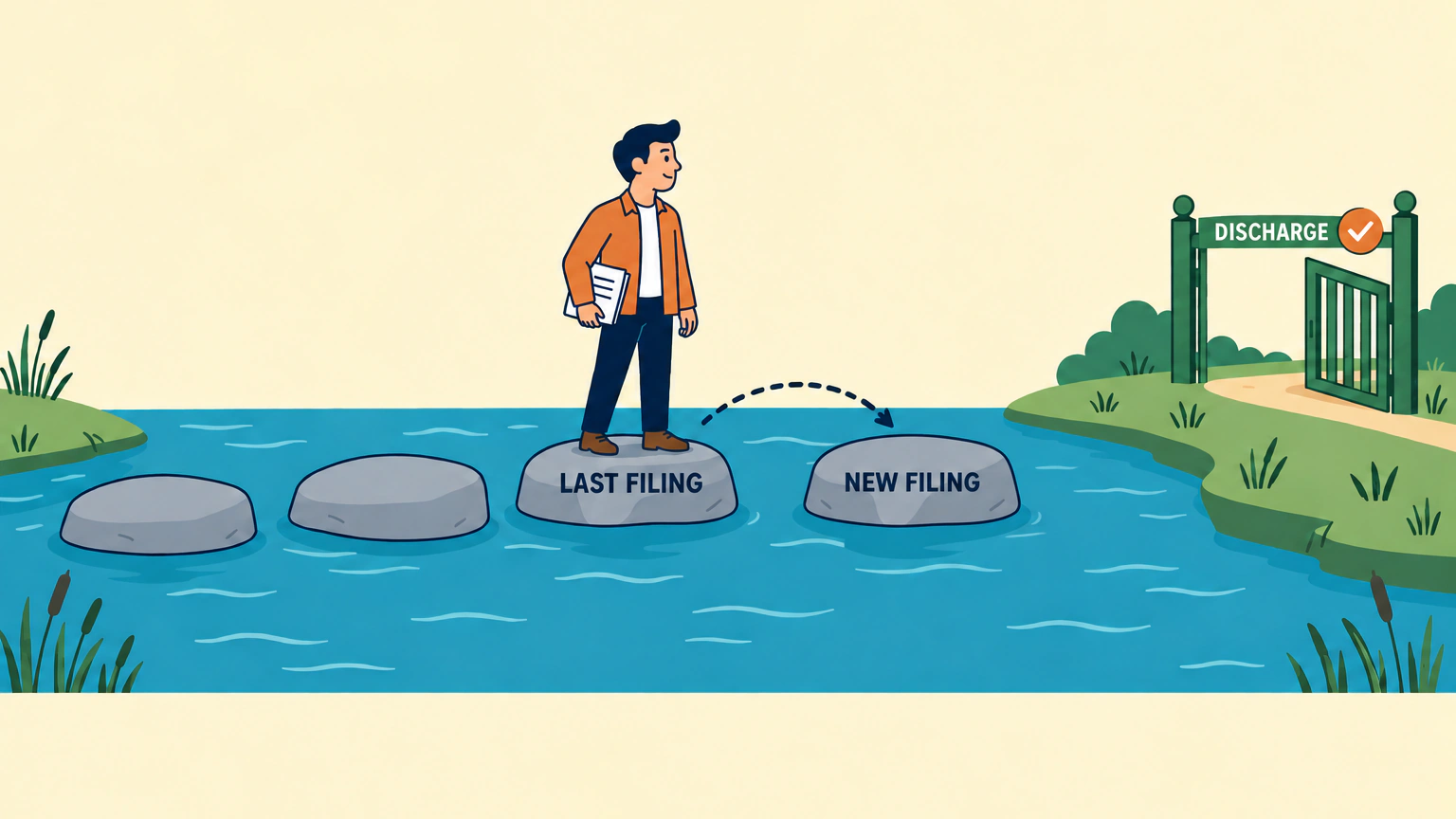
Usually. The law sets no lifetime cap, but some dismissals block a new case for 180 days. It also limits how often you get a discharge, the court order that wipes out debt. The wait between discharges runs from your old case's filing date to your new one: 8 years between Chapter 7 cases, 6 from a Chapter 13 to a Chapter 7, 4 from a Chapter 7 to a Chapter 13, and 2 between Chapter 13s. If your last case was dismissed instead, that wait doesn't apply. A one-year rule can also end some or all of your automatic stay after 30 days.
A second bankruptcy isn't a moral failure. The law expects it and sets rules for it. Here's which clock you're on, how to count it, and where to find the dates.
On this page
- How your last case ended decides which clock you're on
- The discharge clock: 2, 4, 6 or 8 years
- Still inside the 8 years? Here's what you can file now
- If your last case was dismissed, two other clocks start
- If your discharge was denied for misconduct, a new Chapter 7 won't clear those debts
- How to find the dates that decide your wait
- What filing again costs, and when a lawyer earns the fee
- Questions people ask about filing bankruptcy again
How your last case ended decides which clock you're on
A bankruptcy case ends one of three ways, and each ending sets up something different for your next case.
A discharge determines which waiting period applies. The clock starts on the day that earlier case was filed, whether it was a Chapter 7 or a Chapter 13 payment plan.
A dismissal means the case closed without wiping out any debt. It starts no waiting period, because the Bankruptcy Code's waits only follow a discharge the court granted. It can start two other things: a 180-day bar on filing, and a one-year rule that weakens your automatic stay, the freeze on collection that begins the moment you file.
A denied discharge is the third ending. No discharge was granted, so no wait starts. If the court refused one for misconduct, those old debts can follow you into a later Chapter 7. A denial for filing too soon works differently.
Between them, those endings can start three clocks.
Three clocks at a glance
| Clock | What starts it | How long it runs | What it costs you | The rule |
|---|---|---|---|---|
| The discharge wait | An earlier case that ended in a discharge. The clock starts on that case's filing date | 2, 4, 6 or 8 years, depending on the two chapters | A discharge in the new case. You can still file. | 11 U.S.C. §§ 727(a)(8) and (9), 1328(f) |
| The 180-day bar | A dismissal for willfully disobeying court orders or failing to appear, or a dismissal you asked for after a creditor moved to lift the stay | 180 days | The right to file any new case | 11 U.S.C. § 109(g) |
| The one-year look-back | A case of yours that was open in the past year and ended in a dismissal | One year back from the new filing date | Some or all of the automatic stay: 30 days after one such case, none after two or more, unless a judge acts in time | 11 U.S.C. § 362(c)(3) and (4) |
Most people who have filed before are on the first clock, so start there.
The discharge clock: 2, 4, 6 or 8 years
Your wait depends on two things: the chapter of the case that gave you a discharge, and the chapter you plan to file now.
Count from your old filing date, not your discharge date
Each wait runs from the day your earlier case was filed to the day you file the new one. Ask how often you can file Chapter 7 and get a discharge, and the statute answers in those terms. It blocks a second one when the first came "in a case commenced within 8 years before the date of the filing of the petition." The Chapter 13 waits look back from "the date of the order for relief," and in a case you file yourself, that's the day you filed.
How long you wait for another discharge
| Your earlier case ended in a discharge under | Your new case | Wait, counted between the two filing dates | Exception | The rule |
|---|---|---|---|---|
| Chapter 7 or 11 | Chapter 7 | 8 years | None | 11 U.S.C. § 727(a)(8) |
| Chapter 12 or 13 | Chapter 7 | 6 years | No wait if your plan paid 100% of allowed unsecured claims, or at least 70% under a plan proposed in good faith that was your best effort | 11 U.S.C. § 727(a)(9) |
| Chapter 7, 11 or 12 | Chapter 13 | 4 years | None | 11 U.S.C. § 1328(f)(1) |
| Chapter 13 | Chapter 13 | 2 years | None | 11 U.S.C. § 1328(f)(2) |
Two examples show how the dates fall.
- You filed Chapter 7 on June 3, 2019, and got your discharge that September. A new Chapter 7 discharge needs 8 years from June 3, 2019, which brings you to June 3, 2027. A Chapter 13 discharge needed 4 years, so that door opened on June 3, 2023.
- You filed Chapter 13 on March 10, 2021, and finished a five-year plan in 2026. The Chapter 7 wait is 6 years from March 10, 2021, so it ends on March 10, 2027, about a year after that Chapter 13 discharge.
The second example is the one people miss. A Chapter 13 plan uses up much of its own waiting period while you're still paying into it. Counting from the discharge date won't hurt your case. It just makes you wait longer than the law asks.
One correction. At least one guide prints 4 years between two Chapter 13 cases. The statute says 2.
Filing on the anniversary itself is a gray area
Some guides say a filing on the anniversary date itself qualifies. One bankruptcy judge described that same boundary three different ways in a single opinion.
In a 2009 case from eastern Washington, a man had filed Chapter 7 on January 18, 2002, and received a discharge. He filed again on January 27, 2009, seven years later and without a lawyer. The U.S. Trustee, the Justice Department official who monitors the bankruptcy system, asked the court to withhold the discharge. The court did, and closed the case with the debts still owed. The denial, the judge wrote, "does not imply any wrongdoing on the part of a debtor, but is merely the result of calculating dates."
Then came the dates. A discharge would be available "in a second case commenced after January 19, 2010." A few lines later, the man could file "by January 18, 2010" and receive one. And his pending case failed because it was "commenced prior to January 18, 2010."
We'd pick a filing date a few days past the anniversary, and ask a lawyer how your own court counts. Get the day wrong and you've paid the filing fee and sat through the counseling for a case that wipes out nothing.
After a Chapter 13, the wait can drop to zero
Only the 6-year wait has an exception, and it comes in two versions.
If your earlier Chapter 13 plan paid 100 percent of the allowed unsecured claims, there's no wait before a Chapter 7 discharge. Unsecured claims are debts with no collateral behind them, like credit cards and medical bills. "Allowed" means the court accepted them for payment.
If the plan paid at least 70 percent, there's no wait either, but two more things have to be true. The plan was "proposed by the debtor in good faith," and it was your "best effort." A court makes that judgment about your old case. It isn't a box you tick.
The numbers live in the payment records from your Chapter 13 trustee. A lawyer can check them against the claims filed in the case.
Still inside the 8 years? Here's what you can file now
Yes, you can file Chapter 7 before 8 years are up. The court will take the case and let it run. It just ends without a discharge. The judge in that Washington case said so directly: "It is not illegal to commence the second case." For most people, though, that's a filing fee spent without clearing debt.
Two other routes do something.
The first is a Chapter 13 with a discharge. It opens once 4 years have passed since your Chapter 7 was filed, and the plan usually runs three to five years.
The second is a Chapter 13 filed sooner, which lawyers sometimes call a "Chapter 20." It gives you no discharge, and it still does two useful things. Your automatic stay arrives at full strength, because your last case ended in a discharge and the one-year rule only counts dismissals. (Another case of yours dismissed in the past year would change that.) And the plan can cure a mortgage default: you catch up the missed payments over time while keeping up the regular ones. That cure stays open until the house "is sold at a foreclosure sale."
Say you filed Chapter 7 on June 3, 2019. In 2026, a Chapter 13 with a discharge has been open to you since 2023. A Chapter 7 discharge has to wait until June 2027.
One more route sits outside bankruptcy. If a collection lawsuit is what's pushing you toward a second filing, answering it may protect you better than a case with no discharge. Start with defending the lawsuit itself.
If your last case was dismissed, two other clocks start
A dismissal doesn't start the discharge wait, and by default it doesn't count against a later filing. How long after a dismissal you can refile comes down to two other rules. Check both first.
The 180-day bar on filing at all
The Bankruptcy Code shuts you out completely for 180 days in two situations.
The first is a case the court dismissed for your "willful failure" to follow its orders or to appear. Willful means on purpose. Missing a deadline by mistake is different from ignoring the court.
The second is a case you asked the court to dismiss after a creditor had filed a request for relief from the stay. In plain terms, the mortgage company asked the judge for permission to foreclose, and then you dropped your own case.
File during those 180 days anyway and the court can dismiss the new case. In the meantime, the stay won't stop a lender from enforcing its lien on your home.
And 180 days is only the default. A judge who dismisses a case "for cause" can attach a longer bar, so read the dismissal order itself and not just the docket entry. It's on the list of things to pull from your old case.
The one-year look-back that shrinks your protection
Some guides say any bankruptcy in the past year shrinks your automatic stay. The statute is narrower. It counts a case of yours that "was pending within the preceding 1-year period but was dismissed." A case that ended in a discharge doesn't count. Neither does a Chapter 7 dismissed under the means test, the income test for Chapter 7, and refiled under a different chapter.
What a dismissal in the past year does to your automatic stay
| Cases of yours dismissed in the year before the new filing | Your automatic stay | Your deadline | What you have to prove | The rule |
|---|---|---|---|---|
| None (a case that ended in a discharge doesn't count) | Starts in full the moment you file | None | Nothing | 11 U.S.C. § 362(a), (c)(3) |
| One | Some or all of the stay ends on day 30, depending on how your court reads the rule | A judge must finish a hearing on your motion to extend before day 30 | That the new case was filed in good faith as to the creditors you want held back | 11 U.S.C. § 362(c)(3) |
| Two or more | Doesn't start at all | Ask within 30 days of filing. Protection begins only when the judge signs the order | Good faith, and the law presumes you lack it until you prove otherwise by clear and convincing evidence | 11 U.S.C. § 362(c)(4) |
After one dismissal, the stay ends on day 30 as to you and property outside the bankruptcy estate unless a judge extends it. Courts disagree about whether estate property stays protected. The extension has to come "after notice and a hearing completed before the expiration of the 30-day period." So the motion goes in with your petition, not in week three.
At that hearing you have to show the new case was filed in good faith. The law starts out presuming it wasn't if your last case was dismissed because you skipped required papers with no good excuse, didn't give a creditor the protection the court ordered, or didn't keep up with a confirmed plan. The same goes if nothing substantial has changed in your finances or your life since that dismissal and there's no other reason to think this case will succeed. Overcoming that presumption takes "clear and convincing evidence."
With two or more dismissals in the year, you file with no stay at all. You have 30 days to ask for one, and the protection starts only once the judge's order is entered. Until then, the bankruptcy stops neither a sale nor a garnishment.
This is a hearing-in-30-days problem. It's the best reason we know to call bankruptcy attorneys before you file instead of after.
Filing again to stop a foreclosure sale
If a sale date is what's driving you, those stay rules decide whether a new filing stops the sale at all.
One more rule follows the house and not the person. A lender can ask the court to find that your filing was "part of a scheme to delay, hinder, or defraud creditors" involving either "multiple bankruptcy filings affecting such real property" or a transfer of the property without the lender's consent or the court's approval. If the judge agrees and the order is recorded under state law, it binds any bankruptcy case affecting that property filed within the next 2 years.
That means one more emergency filing can leave the house outside the protection of any case for two years. You can ask a later court to lift the order for changed circumstances or good cause.
The deadlines that count backward from a sale date are in our guide on how to stop a foreclosure. If your sale is already on the calendar, foreclosure lawyers are the people to call this week.
Check for a case someone else filed in your name. The U.S. Trustee Program warns that some foreclosure "rescue" operators take a homeowner's money and then file a bankruptcy case in the homeowner's name, sometimes without the homeowner knowing. If you don't take part in it, the judge dismisses it. You can still have a bankruptcy on your credit record for years. Before you file your own, check McVCIS for any case you didn't file, tell your lawyer about it, and report the operator to your local U.S. Trustee office.
If one of those operators took your money, consumer protection attorneys can tell you whether you can get it back.
If your discharge was denied for misconduct, a new Chapter 7 won't clear those debts
Most people filing again will never need this rule.
A court can deny a discharge for misconduct in the case: hiding or transferring property, destroying records, lying under oath, failing to explain where assets went, or refusing to obey a court order. You can also sign a waiver that gives the discharge up. Either way, every debt that "was or could have been listed" in that case is shut out of a later Chapter 7 discharge.
The trap is easy to miss because no waiting period applies. No discharge was granted, so no clock started. You can file a new Chapter 7 next year, and those old debts will still be there when it ends.
Two things fall outside the rule. A denial for filing too soon isn't misconduct, which is why that Washington judge could call it a matter of calculating dates. And debts you took on after the old case aren't touched.
There's one narrow exit. The discharge for finishing a Chapter 13 plan has its own, shorter list of debts it can't reach, and this kind isn't on it. The court still has to find that you filed the case and proposed the plan in good faith. After a denial for misconduct, expect a judge to look hard at that, so take this route only with a lawyer.
How to find the dates that decide your wait
Most people filing a second time don't remember the day they filed the first, and it's the one number every rule here runs on. There are three ways to get it, cheapest first.
Call the courts' free Multi-Court Voice Case Information System (McVCIS) at (866) 222-8029 from a touch-tone phone. Search by name, Social Security number or case number, and it reads out the case filing date, the chapter, the discharge date if there is one, and the case status.
Or look up the docket on PACER, the federal courts' online records system. It charges $0.10 a page, never more than $3 for one document, and sends no bill unless you run up more than $30 in a quarter.
Or dig out your own papers. The court's notice of your case, usually Official Form 309A in Chapter 7, prints the "Date case filed." If your case was converted from one chapter to another, the notice shows both dates, and the original filing date is the one that counts.
Before you file again, get these from your old case
- The date each earlier case was filed, and its case number.
- The chapter each case was filed under, and whether it was later converted. A converted case keeps its original filing date.
- Whether a discharge was entered, and the order that says so (Official Form 318 in Chapter 7, Form 3180W in Chapter 13).
- For any dismissed case, the date of the dismissal order and the reason written in it.
- Whether a creditor had asked the court to lift the stay before you asked to dismiss.
- Any order in the old case that gave a creditor relief from the stay on your home.
- The date on your new credit counseling certificate. It has to fall within the 180 days before you file.
What filing again costs, and when a lawyer earns the fee
Every new case means the court's fees again. Chapter 7 costs $338: a $245 filing fee, a $78 administrative fee and a $15 trustee fee. Chapter 13 costs $313, which is $235 plus the same $78.
You can ask to pay in up to four installments, all within 120 days of filing, and a judge can stretch the last one to 180 days. In Chapter 7 the court can waive the fee if your household income is below 150 percent of the poverty line and you can't manage installments.
The courses repeat too. You need a new credit counseling briefing within the 180 days before you file, and the financial management course again before any discharge.
However long it's been between bankruptcies, we think a lawyer earns the fee on a second filing in four places: picking a filing date near an anniversary, getting a motion to extend the stay heard inside 30 days, reading a dismissal order for a longer bar, and making the 70 percent case.
We're not your lawyer, and a second filing is exactly where one date or one line in a dismissal order changes the answer. Have a bankruptcy lawyer read your old case before you file.
So find your old filing date first. Then take it to one of the bankruptcy attorneys near you, and check that the lawyer is licensed before you sign anything. Deadline pressure is when that step gets skipped.
Questions people ask about filing bankruptcy again
How many times can you file bankruptcy in a lifetime?
There's no lifetime cap for Chapter 7 or Chapter 13. What stops serial filing in practice is everything around the discharge: the 2 to 8 year waits, the 180-day bar after certain dismissals, the shrinking automatic stay, and a judge's power to attach a longer bar to a dismissal for cause.
Is the waiting period different in my state?
No. Bankruptcy is federal law, and the Constitution gives Congress the power to pass "uniform Laws on the subject of Bankruptcies throughout the United States." So the waits are the same in Ohio, California or Florida. What your state changes is which property you can keep, and that's usually set by where you lived for the 730 days before you file.
Can you file bankruptcy twice in a year?
Sometimes. If the first case was dismissed, part or all of the automatic stay ends after 30 days unless a judge extends it after a hearing completed within that window. After two or more dismissals in a year, a new case gets no stay until a judge orders one. Some dismissals bar any new filing for 180 days.
Can you file Chapter 7 right after a Chapter 13 is dismissed?
Often, yes. A dismissed Chapter 13 gave you no discharge, so the 6-year wait never started. Check two things first. If the dismissal was for willfully ignoring court orders, or you asked for it after a creditor moved to lift the stay, you're barred for 180 days. If it happened within the past year, part or all of your new stay ends after 30 days unless a judge extends it.
How soon can you file Chapter 13 after Chapter 7?
You can file as soon as your Chapter 7 is over, but a Chapter 13 discharge has to wait until 4 years after your Chapter 7 was filed. Some people file sooner on purpose, a move sometimes called Chapter 20, to stop a foreclosure sale and catch up the mortgage through a plan. A Chapter 7 that ended in a discharge doesn't shrink your automatic stay.
Will a second bankruptcy show up on your credit report?
Yes, and both cases can show at once. Federal law lets a credit report carry a bankruptcy for up to 10 years from the filing date. Experian says the credit bureaus keep a Chapter 13 for seven years from filing and a Chapter 7 for up to 10. So a second Chapter 7 filed eight years after the first can overlap it for about two years.