

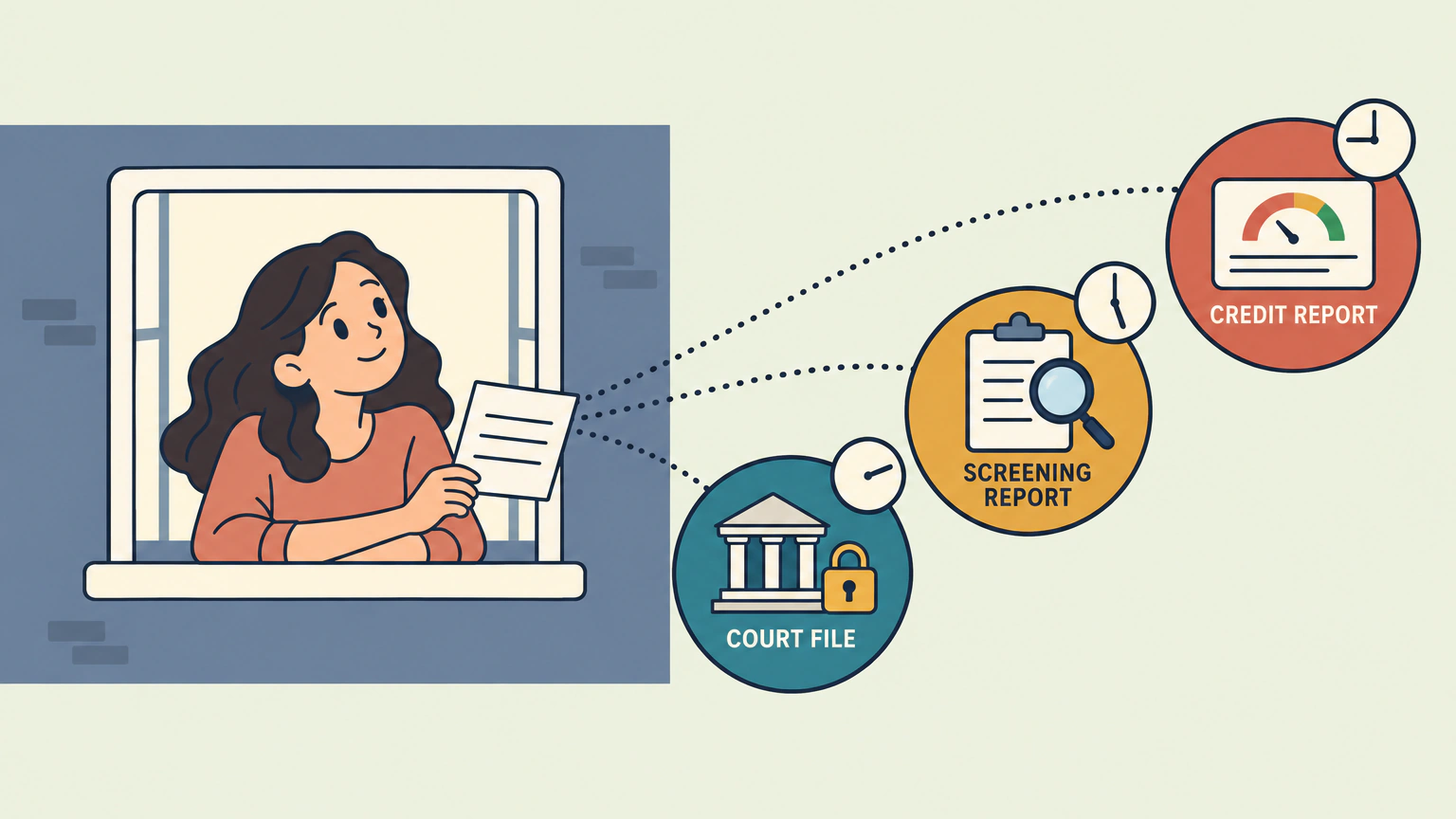
A tenant screening company can usually report an eviction case for seven years from the date it was entered. Your credit report doesn't list the eviction itself, only rent that went to collections, and that drops off about seven years after you fell behind. The court file runs on its own clock. It stays public unless your state has a law that seals or masks it.
Three records. Three clocks. Each one runs differently, and there's something you can do about any of them.
On this page
- An eviction leaves three records, and each keeps its own time
- The court file stays public until a state law closes it
- Tenant screening reports: usually seven years
- Your credit report never shows the eviction, but it can show the rent
- What to do before your next rental application
- Questions people ask about eviction records
An eviction leaves three records, and each keeps its own time
Three sets of organizations hold a piece of what happened to you, and they keep separate files.
The court where your landlord filed keeps the case file. That's the original record of the suit, and screening companies can copy from it.
Tenant screening companies keep a second version. Landlords pay them to pull reports on applicants, and those reports can draw from court records, credit data and old addresses.
The three nationwide credit bureaus keep a third file. It tracks money you borrowed and money you owe, not what happened in housing court.
So "how long do evictions stay on your record" has three answers, and they don't line up. There's a harder piece too: a record can exist even when your landlord lost. The filing is what creates the case, not the outcome, so an eviction suit that was dismissed a week later still left a file behind with your name on it.
Start with the court file. It's the one that can outlast the other two.
| Record | Who keeps it | How long it can follow you | The rule |
|---|---|---|---|
| The court case file | The court where your landlord filed | Open to the public unless your state's law seals, masks or expunges it | Your state's eviction record law, if it has one |
| Your tenant screening report | Screening companies that landlords pay to check applicants | Usually 7 years from the date the case or judgment was entered, or longer if the governing statute of limitations runs longer, and 10 years for a bankruptcy | 15 U.S.C. § 1681c(a)(1), (a)(2) |
| Your credit report | The three nationwide credit bureaus | The eviction isn't listed. Rent sent to collections can stay about 7 years from when you first fell behind | 15 U.S.C. § 1681c(a)(4), (c)(1); Experian |
The court file stays public until a state law closes it
The day your landlord filed, the case got a number and a docket, and unless a state law says otherwise that docket is public. Anyone can walk into the clerk's office and look it up. Screening companies can copy those court records into reports landlords order.
States that have done something about this use different words for it. Sealed. Masked. Suppressed. Shielded. Expunged. Each one is a real statutory term somewhere, and the effect you care about is close to the same: the case drops out of public view. Who can still see it differs quite a bit. In California, for one, someone who gives the clerk the names of at least one plaintiff and one defendant plus the property address can still get access.
While you're looking at the docket, check that the court has the outcome right. The FTC tells tenants to do exactly that, and to ask the court to correct records that look wrong or incomplete, then ask the former landlord to send the court updated information. A wrong outcome in the file is fixable. It gets much harder once a screening company has copied it.
Where the file closes on its own
Eight of the eleven jurisdictions we checked close some eviction files with nobody asking. They fall into three groups.
California and Colorado start out of general public view. From the day the complaint is filed, access is limited, and the file opens only if the landlord wins. In California that means a win against every defendant within 60 days of filing, or a win at trial after that. In Colorado it means a court order giving the landlord possession. California's restriction applies to limited civil case records, which is the track most eviction suits use.
Arizona, Maryland, Nevada and Virginia close some files after an ending that didn't hand the landlord the home. A dismissal is the clearest example.
The District of Columbia and Minnesota go furthest. Both close the file three years on, even in a case the landlord won outright. Three years is a long time when you need a place in March. It's still a finish line, and three of the eleven we read don't draw one at all.
| Jurisdiction | Closes on its own | You can ask the court | The law |
|---|---|---|---|
| Arizona | When the case is dismissed before judgment or the tenant wins. The court can't sell or release the sealed file as part of a records transfer to a third party | When you and your landlord file a written agreement to set aside the eviction and seal the file | A.R.S. § 33-1379 |
| California | From the day of filing, access is limited. The file opens to the public only if the landlord wins against every defendant within 60 days, or wins at a trial after that | When both sides agree to keep the file closed | Cal. Civ. Proc. Code § 1161.2 |
| Colorado | From the day of filing, the file is suppressed. It becomes public only if the court grants the landlord possession | When both sides agree to keep it suppressed after a possession order | Colo. Rev. Stat. § 13-40-110.5 |
| District of Columbia | 30 days after a case ends without a possession judgment for the landlord, or 3 years after a case the landlord won | At any time for a listed reason, such as unpaid rent of $600 or less, subsidized housing, or a settlement that left you in your home | D.C. Code § 42-3505.09 |
| Maryland, failure to pay rent cases | Within 60 days after the case ends, if the landlord didn't get a judgment of possession | When the landlord won possession but you paid what was owed to keep your home and 12 months have passed, or the court finds good cause | Md. Code, Real Prop. § 8-503 |
| Massachusetts | It doesn't | By petition. If all your prior eviction records are sealed, you may answer "no record" on Massachusetts housing or credit applications | Mass. Gen. Laws ch. 239, § 16 |
| Minnesota | The court expunges it without a motion if you won, the case was dismissed, both sides agreed, or 3 years after the eviction was ordered | When you settled and kept the settlement's terms, or when expunging is clearly in the interests of justice | Minn. Stat. § 484.014 |
| Nevada, summary eviction cases | When the court dismisses the case, 10 judicial days after it denies the eviction, or 31 days after your tenant's affidavit if the landlord files no complaint within 30 days | When both sides agree in writing, or on your motion if the eviction should be set aside or sealing serves the interests of justice | Nev. Rev. Stat. § 40.2545 |
| Oregon | It doesn't | The court must seal on your motion, with no filing fee, if you won or the case was dismissed in your favor, if you kept a stipulated agreement and paid what you owed, or if 5 years have passed since an eviction judgment you paid off | Or. Rev. Stat. § 105.163 |
| Virginia, general district court | 30 days after a dismissal, or 6 months after a nonsuit, if no order of possession was entered | When you won at trial; the court then expunges on your petition without a hearing. Dismissed or nonsuited cases filed before July 1, 2024 can be cleared by petition | Va. Code § 8.01-130.01 |
| Washington | It doesn't seal eviction files | When the case lacked a basis in fact or law, your tenancy was reinstated, or there's other good cause, the court may order limited dissemination. Screening companies then can't report the case | Rev. Code Wash. § 59.18.367 |
Where you have to ask the court
Massachusetts, Oregon and Washington move only when someone files something. Massachusetts takes a petition. Oregon's court must seal on your motion, and it can't charge you a filing fee for it. Washington calls its version limited dissemination. The eight that close files on their own have motion routes too, for the cases their own rule misses, so "my state seals these" and "I have nothing to file" aren't the same sentence.
So what does closing a file actually buy you? That depends on the state, and the differences are worth knowing before you spend money on a motion. Nevada treats a sealed case as though it never happened. Arizona bars the court from selling or releasing a sealed file in a records transfer to a third party. In Massachusetts, if all your prior eviction records are sealed, you can answer "no record" on a housing or credit application in that state. Washington's order reaches past the courthouse: a screening company can't report a case covered by a limited dissemination order. And in the District of Columbia, a tenant can sue a housing provider that turns them down on an eviction record it knows is sealed.
We're not your lawyer, and whether your case qualifies can turn on a detail in the court file. If your state makes you ask, a landlord-tenant lawyer or your local legal aid office can tell you where you stand. Before you hire anyone, check that the lawyer is licensed.
If your state isn't on the list
We read the statute in eleven jurisdictions, and those eleven are all we can speak for. If yours isn't one of them, we don't know what your state does, and we'd rather say so than guess on your behalf.
Three ways to find out, roughly in the order that works fastest.
Call the clerk of the court where the case was filed and ask whether eviction records can be sealed or masked in that state, and on what terms.
Search your state judiciary's own site for its self-help or self-represented litigant pages. Several states publish a plain-English page on exactly this, with the form attached.
Then call your local legal aid office. One short call can tell you whether there's anything worth filing.
Whatever your state does with the court file, the federal limits on what a screening company or a credit bureau can report apply to you either way.
Tenant screening reports: usually seven years
This is one report landlords may read. You apply, they order a screening report, and a company you've never heard of can send back your court history, a credit summary and a recommendation.
Federal law caps how far back that report can reach, and the FTC puts it in plain words: "most civil lawsuits and judgments, including housing court cases, and arrest records can't be included in a report after seven years." Bankruptcies get ten. Criminal convictions have no time limit at all.
Accuracy is the other half of it, and that includes how the case ended. A screening report that shows a filing but not the dismissal that followed is wrong, not merely unflattering. The FTC lists that exact problem, "incomplete information, such as how civil or criminal cases or eviction actions were resolved", among the errors tenants find most often, and it's one you can force the company to investigate.
When the seven years starts, and when it runs longer
The clock starts on the date the case or judgment was entered, not the day you paid. Paying a judgment in year six doesn't move it.
Then comes the exception, and it's written into the statute itself. Civil suits and judgments come off the report after seven years "or until the governing statute of limitations has expired, whichever is the longer period." A money judgment has its own life span under state law, and renewal can let a judgment outlive the seven years even when the eviction case behind it doesn't.
We don't list those periods state by state, because they vary and because renewal changes the answer for one person and not the next. Ask the clerk in the county where the judgment was entered how long a judgment lasts there, and whether yours has been renewed.
One more figure worth holding on to: a bankruptcy case can be reported for ten years.
How to see your own screening file for free
You don't have to wait for a landlord to tell you what's in your file. Federal law gives you two ways in, and neither costs a cent.
Once every twelve months, each nationwide tenant screening company has to hand over your own file if you ask for it. One small rule makes that workable: the company has to accept the request by toll-free phone, and publish the number.
If a landlord turns you down because of a report, you're owed a notice, and that notice has to name the company that supplied it.
From the date of that notice you have 60 days to ask the company for a free copy of the report.
Found something wrong? Dispute it. The company generally has 30 days to investigate, free of charge, and it has to tell you in writing what it found. If you send relevant information during that period, federal law can add up to 15 days. If it still won't correct a sealed or plainly wrong entry, a consumer protection attorney can help you challenge the reporting company.
Your credit report never shows the eviction, but it can show the rent
Ask how long an eviction stays on your credit and the answer that comes back is usually "seven years". The number is right. The thing it's attached to isn't. Experian is blunt about its own files: "Evictions are public records, but they don't appear on your credit reports. The only public records that are part of your credit reports are bankruptcy filings." So no, evictions don't show up on credit reports in the way people expect.
What can land there is the money. If you moved out owing rent, late fees or damage charges, and the landlord handed that balance to a collection agency, the collection account can appear. It's an ordinary debt entry at that point, and it can pull on your scores.
Its clock is the odd one, and worth understanding. Federal law lets a collection account stay about seven years, and those seven years begin 180 days after the missed payment that led to the collection, not on the day a collector bought the debt. Experian describes the same thing as up to seven years from the date your payment was past due. Either way, paying the balance won't restart the clock and won't shorten it.
If that balance includes move-out charges taken out of what you left on deposit, it's worth checking the arithmetic before you accept it. You may be able to contest charges taken from your deposit, and a charge you successfully dispute is one that shouldn't be sitting in collections at all.
What to do before your next rental application
You can't speed up a federal clock. What you can do is make sure every record about you tells the truth. A wrong entry can lose you an apartment just as surely as a right one can. Start at the courthouse, since the screening companies copy from there, and work outward.
- Look up your case in the court's records and make sure the outcome is right: dismissed, settled, or a judgment, and for how much. If it's wrong, the FTC suggests asking the court to correct it, and asking your former landlord in writing to help.
- If your state is one of the eleven jurisdictions whose law we read, check whether your case already meets a rule that closes it on its own, and ask the clerk whether that has happened yet.
- Ask the nationwide tenant screening companies for your free annual file. Each one has to take requests through a toll-free number.
- If a landlord turns you down because of a report, ask that company for your free copy within 60 days of the notice. The notice has to name the company.
- Dispute anything that's wrong: a case that belongs to someone else, a dismissal shown as an eviction, a case your state has sealed, or anything older than the law allows. The company generally has 30 days to look into it, with up to 15 more days if you send relevant information during that period.
- Pull your free credit reports at AnnualCreditReport.com and look for a collection account tied to old rent or move-out charges.
Red flag: Disputing a wrong entry costs nothing. You don't need a paid removal service to fix a wrong entry. Federal law makes a screening company reinvestigate your dispute free of charge, and the FTC's advice on credit reports is blunt: "You don't have to buy anything or pay to fix errors."
Two different lawyers can help with the two halves of this problem. A landlord-tenant lawyer can help with a motion to close a court file when your state won't close it for you. A consumer protection attorney can challenge a screening company that keeps reporting something it shouldn't. If your next application is weeks out, make the free calls first, and save the lawyer for the record that won't move on its own.
Questions people ask about eviction records
Does a dismissed eviction stay on your record?
Yes, the filing itself is a court record, and it can reach a screening report even though the landlord didn't win a possession judgment. What the report can't do is leave out how the case ended, and the FTC names that as an error you can dispute. Some states close dismissed files on their own. Arizona seals them, Minnesota expunges them, and Nevada seals summary eviction cases. Virginia expunges general district court cases 30 days after dismissal if no possession order was entered.
If you pay off an eviction, does it come off your record?
No. Paying doesn't erase the court file, and it doesn't restart or shorten any federal clock. A collection account's seven years count from when you first fell behind, and a judgment's from the day it was entered. Paying can still matter for sealing, though. Oregon requires payment of any money award for its judgment and settlement routes. One of Maryland's routes for a tenant who lost turns on paying what was owed to keep the home.
Can landlords see an eviction after seven years?
Not through a screening report, as a rule, unless the statute of limitations on a judgment runs longer than that. But the federal limit binds the reporting company, not the courthouse. If your state hasn't closed the file, anyone willing to search the court's own records can still find the case, and some landlords do exactly that before they sign anyone.
Does an eviction show up on a background check for a job?
It can. An employment background check is a consumer report under the same federal law, so the same seven-year limit applies, with one exception: the limit drops away for a job expected to pay $75,000 a year or more. And an eviction is a civil case, not a criminal charge, so it never shows up as a conviction.
Does bankruptcy clear an eviction?
No. A discharge can wipe out your personal liability on a money judgment, but nothing in it closes the eviction file, so whether that file closes still depends on your state's rules. The screening report clock doesn't change either. And the bankruptcy adds a record of its own, reportable for ten years. If old rent debt is the real problem, a bankruptcy attorney can price the trade for you.
What does a sealed eviction mean?
It means the court stops showing the file to the public, though you and the other party usually still can. What sealing buys you differs by state. Nevada treats the case as if it never happened. Arizona bars records transfers of the sealed file to third parties. Massachusetts lets you answer "no record" on a housing or credit application there if all your prior eviction records are sealed. A screening report still showing a sealed case is an error.
Do evictions from other states show up?
They can. Nationwide tenant screening companies keep files across state lines, and the seven-year federal limit is the same wherever you apply. What changes when you move is the court file. Its sealing rules come from the state where your landlord filed, not from the state you're moving to, so crossing a border doesn't put the case behind you.