


Take it in the order that decides your case: whether a rule has been broken, then what that's worth, then how to collect.
One thing first. This is general information about state law, not legal advice, and plenty of cities add deposit rules on top of the state's. Check yours, or call a licensed attorney or legal aid, before you act.
On this page
- First: has your landlord actually missed the deadline?
- What your landlord is allowed to keep
- "Double damages" is not one rule: it is at least four
- Deadlines that are yours, not your landlord's
- The demand letter that actually works
- Small claims, and whether a lawyer changes the math
- If your state is not in the table
- Frequently asked questions
First: has your landlord actually missed the deadline?
Most people get here angry and early, and early is the part that matters. Send a demand letter before the clock has run and you've told your landlord you don't know the rule. There is no single federal security-deposit deadline for ordinary private rentals; specialized federal programs and local law can add rules. Across the eight state statutes we read, the deadlines run from 21 days to 45.
When the clock actually starts
The trigger isn't the day you stopped paying rent, and it isn't the day your landlord got around to inspecting. Each state names its own starting event, which is why a 21-day rule and a 30-day rule aren't really on the same scale.
California counts 21 calendar days from the day the tenant vacates (Cal. Civ. Code § 1950.5(h)(1)). Washington's 30 days take two events, termination of the rental agreement and vacation of the premises (RCW 59.18.280(1)(a)). Oregon's 31 days run from termination plus delivery of possession (ORS 90.300(12)). Maryland's 45 start at the end of the tenancy (Md. Real Prop. § 8-203(e)(1)).
Find your own starting event, write the date down, and count forward. That one date decides almost everything else.
The forwarding-address myth, and the two states where it's real
Other guides tell you the clock doesn't start until your landlord has a written forwarding address from you. Of the eight states we read, that's true in two.
Texas is explicit: a landlord "is not obligated to return a tenant's security deposit or give the tenant a written description of damages and charges until the tenant gives the landlord a written statement of the tenant's forwarding address" (Tex. Prop. Code § 92.107(a)). The same section says you don't forfeit the refund by failing to send one. Minnesota runs its three weeks after termination of the tenancy and after receipt of your mailing address (Minn. Stat. § 504B.178, subd. 3).
In California, Washington, Missouri, Maryland, Oregon and Florida, the address is not a statutory trigger. Send it in writing anyway. It costs a stamp and it removes your landlord's most convenient excuse.
What your landlord is allowed to keep
This is where tenants lose cases they could have won. Across these laws, unpaid rent and tenant-caused damage beyond ordinary wear are common lawful deductions, subject to the lease and the proof each statute requires. Demand money back over a charge that's actually fair and you hand your landlord the high ground.
Normal wear and tear vs. damage
Seven of these eight deposit statutes expressly bar deductions for ordinary or normal wear; Florida's deposit section instead governs claims against the deposit without supplying a wear-and-tear list. None supplies a ready-made list of examples. Carpet worn thin down a hallway usually points toward wear; a burn or pet stain usually points toward damage. Small nail holes may be wear, while larger holes or drywall damage may be chargeable depending on the facts and lease.
Washington is the most explicit about turnover work. No part of a deposit may be withheld "for wear resulting from ordinary use of the premises," and none may go to carpet cleaning "unless the landlord documents wear to the carpet that is beyond wear resulting from ordinary use" (RCW 59.18.280(1)(c)). Missouri allows a carpet-cleaning charge only where the lease warned you that you might be liable for it, and then requires a receipt for the actual cost within thirty days of the end of the tenancy (Mo. Rev. Stat. § 535.300.4).
The itemized statement, and why its absence is the whole case
In most of these states the landlord's duty isn't just returning money. It's accounting for it, and skipping that step is what turns a slow refund into a penalty.
In Texas, a landlord who in bad faith fails to give a written description and itemized list "forfeits the right to withhold any portion of the security deposit or to bring suit against the tenant for damages to the premises," and owes your attorney's fees (Tex. Prop. Code § 92.109(b)). In Oregon, withholding without a written accounting supports double recovery on its own, with no bad faith to prove (ORS 90.300(16)(a)). For a standard Maryland move-out, a landlord who doesn't mail the damages list and itemized costs inside 45 days "forfeits the right to withhold any part of the security deposit for damages" (Md. Real Prop. § 8-203(g)); subsection (h) uses a different demand-and-address procedure after specified evictions or abandonment.
If your check arrived with no itemized statement attached, that gap may be worth more than the deduction you meant to argue about.
"Double damages" is not one rule: it is at least four
Ask what a landlord owes for keeping your money and you get eight different answers from eight statutes.
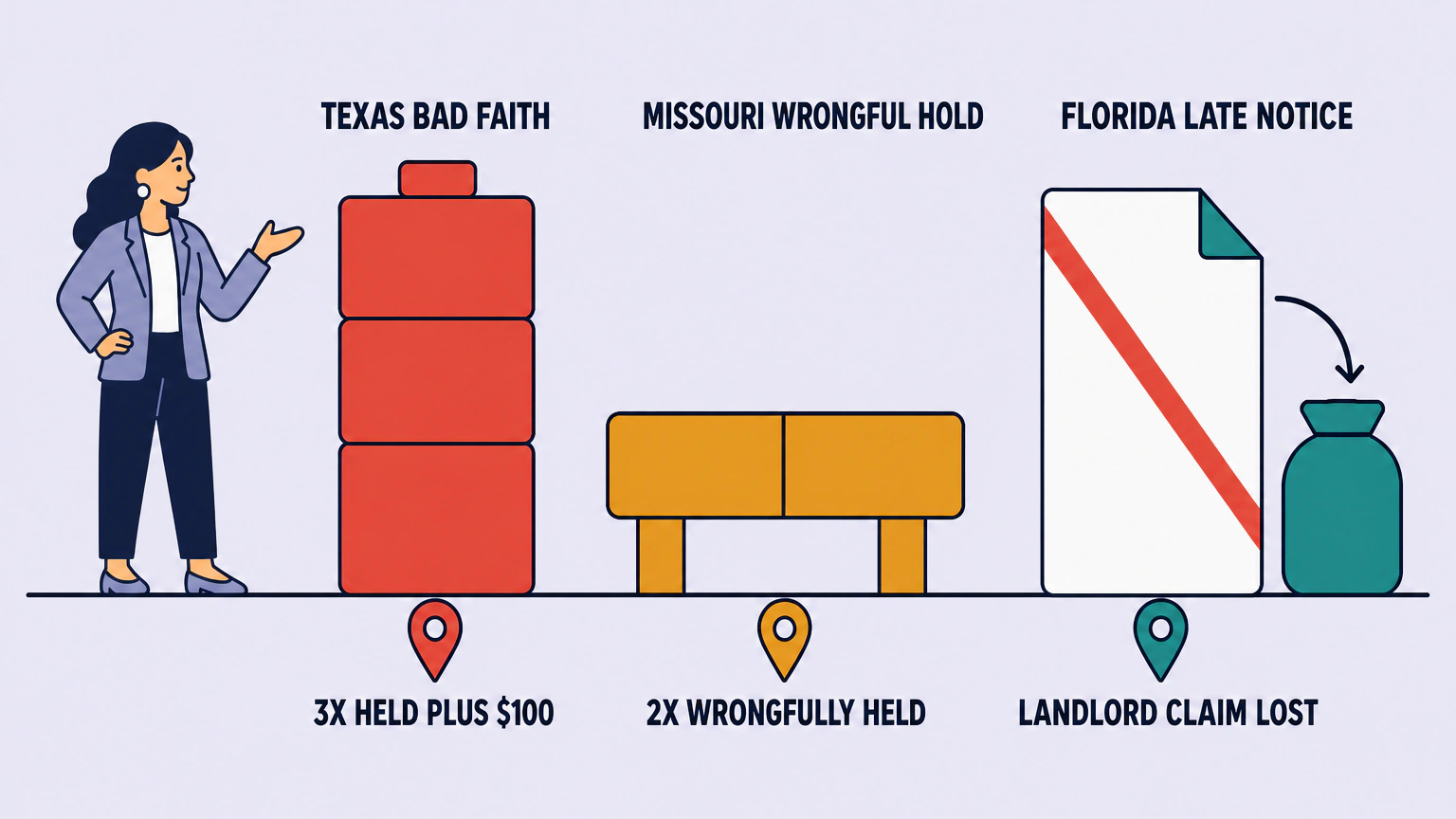
Four things vary independently. The multiplier: none, double, triple, or a flat cash cap. The base it applies to: sometimes the whole deposit, sometimes only the portion wrongfully withheld. The trigger: sometimes a missed deadline alone, sometimes bad faith you have to prove. And whether fees shift. The table covers ordinary residential move-outs; abandonment, eviction, subsidized housing, and local law can change a trigger or remedy.
| State | Deadline to return or itemize | Multiplier | What it applies to | What you must show | Fees shift? |
|---|---|---|---|---|---|
| California (Civ. Code § 1950.5) | 21 calendar days after you vacate | Up to 2×, discretionary, plus actual damages | Whole deposit | Bad faith | Not in this section |
| Florida (Fla. Stat. § 83.49) | From termination of the agreement: 15 days to return it all, 30 to send a claim notice by certified mail or agreed email | None | Nothing to multiply | A late 30-day notice; the claim against the deposit is then forfeited | Yes, prevailing party |
| Maryland (Real Prop. § 8-203) | Standard end of tenancy: 45 days; subsection (h) changes the trigger after specified eviction or abandonment | Up to 3× | Withheld amount | Landlord acted "without a reasonable basis" | Yes, to the tenant |
| Minnesota (§ 504B.178) | 3 weeks after termination, and after the landlord has your address | Penalty equal to the withheld amount, plus up to $500 punitive | Withheld portion; the $500 is a flat cap | Nothing for the penalty; bad faith for the $500, presumed if the deadline slipped | Not in this section |
| Missouri (§ 535.300) | 30 days after the tenancy terminates | 2× | Amount wrongfully withheld | Wrongful withholding; no state-of-mind test | Not in this section |
| Oregon (ORS 90.300) | 31 days after termination and you hand back possession | 2× | Amount withheld | No written accounting, or bad faith | Not in this section |
| Texas (Prop. Code §§ 92.103, 92.109) | 30 days after you surrender, once you've given a written forwarding address | 3×, plus a flat $100 | Portion wrongfully withheld | Bad faith, presumed after day 30 | Yes, to the tenant |
| Washington (RCW 59.18.280) | 30 days after the agreement ends and you vacate | Liability for the full deposit, then up to 2× on top, discretionary | Whole deposit | Missed statement or refund unless a statutory exception applies; intentional refusal for the 2× | Yes, prevailing party |
These eight were read directly against their statutes. The numbers and triggers do not transfer. If your state is not listed, use its current statute rather than extrapolating from this table.
Two tenants, same $1,200 deposit, same $1,200 wrongfully kept. If a Texas landlord retained all $1,200 in bad faith, § 92.109(a) sets liability at $100 plus three times $1,200 plus reasonable fees. Missouri sets damages at twice the amount wrongfully withheld. California allows actual damages plus statutory damages of up to twice the security only for bad faith, and the judge may award less or none. The number to chase isn't the deposit. It's whatever your state attaches to it.
The states where the deadline itself decides it
Florida is the cleanest case. A landlord who misses the 30-day window to send a claim notice by certified mail or an email authorized under § 83.505 "forfeits the right to impose a claim upon the security deposit and may not seek a setoff against the deposit" (Fla. Stat. § 83.49(3)(a)). There is no deposit multiplier in that statute. Read the rest of the sentence, though: your landlord can still sue you separately for damages after returning the deposit.
Texas doesn't void the claim, it moves the burden. Once the tenant has given a written forwarding address, missing the 30th day after surrender creates the presumption that the landlord acted in bad faith (Tex. Prop. Code §§ 92.107, 92.109(d)). Minnesota does the same, with an escape hatch: retention "shall be presumed to be in bad faith" unless the landlord returns the deposit within two weeks after you file suit (Minn. Stat. § 504B.178, subd. 7).
A presumption isn't a technicality. It flips who has to prove what.
The states where you still have to prove something
California wants bad faith and leaves the amount to the judge: statutory damages "of up to twice the amount of the security, in addition to actual damages" (Cal. Civ. Code § 1950.5(m)). One thing runs in your favor there. The landlord carries the burden of proving the deductions were reasonable.
Missouri sits at the opposite pole. Wrongful withholding alone gets you "twice the amount wrongfully withheld" (Mo. Rev. Stat. § 535.300.6), with no state of mind in the text to argue about.
Washington splits the difference. Miss the 30-day statement and the landlord is "liable to the tenant for the full amount of the deposit" and is barred from arguing the deductions unless the landlord proves the section's circumstances-beyond-control or abandonment exception. The doubling is separate: it needs "intentional refusal," and the court awards it only if it chooses to (RCW 59.18.280(2)).
Which side of that line you're on decides how much proof you need to gather.
Deadlines that are yours, not your landlord's
Nearly every guide treats deadlines as something landlords miss. Two of these states put important procedure deadlines on the tenant too. Missing one can let the landlord deduct before a dispute or cost the right to attend an inspection, even when it does not erase every later claim.
Florida gives you 15 days to object in writing once your landlord sends notice of intent to claim. If you miss it, the landlord may deduct the claim, but that does not waive your right to sue later (§ 83.49(3)(a)–(b)). Florida adds a second rule: unless the written rental agreement provides otherwise, moving out early without seven days' written notice relieves the landlord of the duty to send the claim notice, but it does not waive your right to the deposit (§ 83.49(5)).
Maryland's clock starts before you've moved. To keep the right to be present when your landlord inspects, mail certified notice at least 15 days beforehand: that you intend to move, the date you're moving, and where you're going (Md. Real Prop. § 8-203(f)(1)).
Deadlines that belong to you: Florida, you have 15 days to object in writing before the landlord may deduct the claim, but a missed objection does not erase a later lawsuit. Maryland, mail certified notice at least 15 days before you move to keep your right to attend the inspection. Everywhere, check your own statute for a tenant-side clock before you assume every deadline is your landlord's.
The demand letter that actually works
Most of these disputes end here rather than in a courtroom. A landlord who opens a dated letter citing a statute section reads it differently than an angry email, and not because of the tone. The section number tells them you know what they're exposed to.
Several of these statutes turn on dates you have to be able to prove. Send the letter certified, ask for the return receipt, and keep a copy of everything.
- Your full name, the rental address, and your unit number.
- The date your tenancy ended and the date you handed back the keys.
- The forwarding address you gave and the date you gave it, in writing, if you have proof.
- The original deposit amount, and the amount that has not been returned.
- Your state's statutory deadline, cited by section number, and the date it expired.
- Whether you received an itemized statement, and if so, which specific deductions you dispute and why.
- The amount you are demanding, and a reasonable deadline to pay it that still leaves you time before any filing deadline.
- A single plain sentence stating that you will file in small claims court if it is not resolved by that date.
- Send it by certified mail with return receipt requested, and keep a copy of the letter and the receipt.
Small claims, and whether a lawyer changes the math
Often, no. Small claims procedures are designed for self-represented cases, but limits and lawyer rules vary by state. In California a natural person can sue for up to $12,500, or another plaintiff for up to $6,250, and the deposit statute permits a small-claims action when the damages claimed fit the court's limit (Cal. Civ. Code § 1950.5(o); Code Civ. Proc. §§ 116.220–116.221).
Then there's the arithmetic. Engagements with landlord tenant lawyers on this platform average $1,479, with a typical range of $1,122 to $2,652 across the 806 cost profiles we hold. That's our own aggregate rather than a market survey. Against a one-month deposit dispute, those figures can make self-representation the economic choice, but fee shifting and case complexity can change that math.
The exception: fee-shifting states
Four of the eight provide fee shifting, but not in the same direction. Texas awards a tenant's reasonable attorney's fees on top of $100 and triple the withheld portion (Tex. Prop. Code § 92.109(a)). Maryland attaches reasonable fees to its treble claim (Md. Real Prop. § 8-203(e)(4)). Both run one way, toward the tenant.
Florida and Washington are different. Each awards costs and a reasonable fee to the prevailing party (Fla. Stat. § 83.49(3)(c); RCW 59.18.280(2)). Lose there and you're the one paying your landlord's lawyer.
When it is not a small-claims matter at all
Some situations outgrow the small claims window. The sum you're chasing sits above your state's ceiling. Your landlord is withholding across a whole building or layering illegal fees onto the deductions, which is a pattern rather than a one-off, and that belongs with consumer protection attorneys. Or retaliation is tangled up in the deposit, which needs civil litigation attorneys who can plead more than one claim. Whoever you call, spend five minutes first to check that the attorney is licensed and in good standing.
If your state is not in the table
We read eight statutes and did not treat them as a 50-state survey. If your state is not listed, do not assume its deadline, itemization duty, or remedy matches one of these rows.
Three steps get you to your own rule. Search your legislature's own site for "security deposit" in the state code, and read the section rather than somebody's summary of it. Next, the attorney general's consumer pages, because that office will say plainly when there's no rule on a point. Then call local legal aid, who handle this all day.
Two things not to rely on: a national blog's summary of your state, and any chart with no statute number beside the cell.
Frequently asked questions
How long does my landlord have to return my security deposit?
It depends on the law and housing program that cover your rental; there is no single general federal deadline for ordinary private rentals. Across the eight state statutes we read, the deadlines run from 21 calendar days in California to 45 in Maryland, and each starts from a different event: vacating, termination of the tenancy, or termination plus handing back possession. Find your state's row, then match the number to its starting event.
Do I have to give my landlord a forwarding address before the clock starts?
Among the eight states in this table, it is a statutory condition in two: Texas, where the landlord is not obligated to return anything until you give a written forwarding address, and Minnesota, where the clock runs after receipt of your mailing address. Send it in writing anyway. It removes an avoidable dispute about where notice or payment should go.
Can my landlord charge me for cleaning or repainting?
Seven of these eight deposit statutes expressly stop deductions at ordinary or normal wear; Florida's deposit section does not supply that list. Washington bans carpet-cleaning charges unless the landlord documents wear beyond ordinary use. Missouri allows one only if your lease warned you, and requires a receipt within thirty days. Extraordinary cleaning and genuine damage are different.
What actually counts as normal wear and tear?
Wear is deterioration from ordinary use; damage points to negligence, accident, abuse, or another charge the lease and law allow. Faded paint, small nail holes, or thinned carpet may be wear, while burns, pet stains, larger wall damage, or broken appliances may support a charge depending on the facts. These statutes do not supply a universal example list, which is why move-out photos matter.
Can I really sue for double or triple my deposit?
Sometimes, and four things decide it: the multiplier your state sets, what it applies to, what you have to prove, and whether fees shift. The multiplier often attaches only to the portion wrongfully withheld rather than the whole deposit, which can leave a triple state paying less than a double one.
Do I need a lawyer to sue my landlord over a deposit?
Often not, but check your state's small-claims limit and representation rules. For a one-month deposit, the math may favor self-representation: engagements in this category average $1,479 on our platform. Fee shifting can change that calculation. Texas and Maryland provide tenant-facing fees under the cited claims; Florida and Washington award fees to the prevailing party, so that risk cuts both ways.
Your state decides what a missed deadline costs your landlord. The date the clock started, and whether an itemized statement ever arrived, are what you build the case on. If you rented in one of these eight, you know which structure you're arguing under and roughly what it's worth. If you didn't, you know what to go and read. And if the amount or the mess has outgrown a small claims form, browse verified providers by service or go straight to landlord tenant lawyers.