

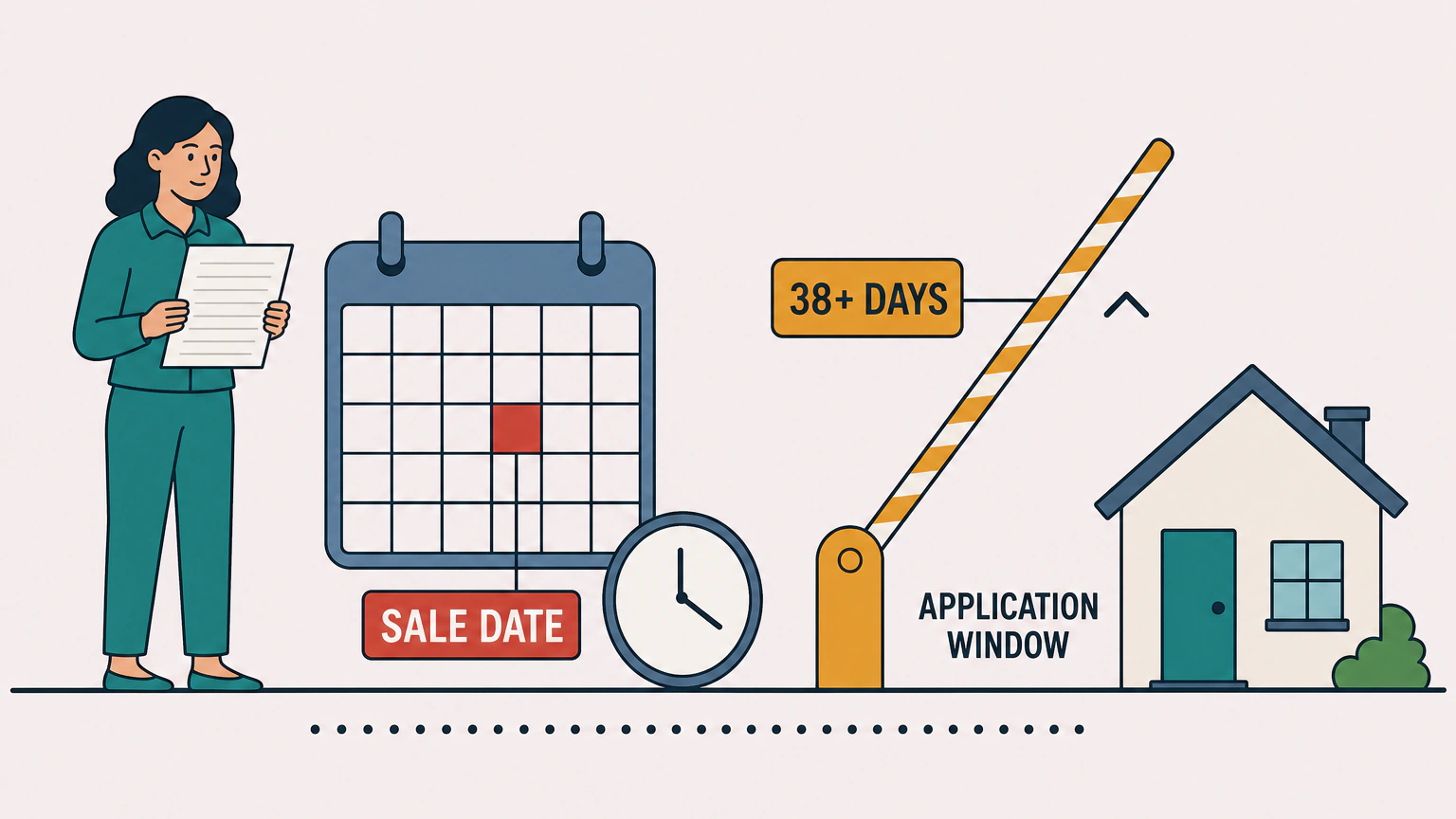
Almost every guide to how to stop foreclosure opens with "you have to be 120 days past due before your lender can file." That's your servicer's starting line, not your finish line. Once a sale is on the calendar, every rule that protects you counts backward from that date: 90 days, 45 days, 37 days. So the first move isn't to pick an option. It's to find the sale date and count.
On this page
Find your sale date first, then count backward
Everything keys off one number: the days between today and your sale date. Nobody wants to do that subtraction, and it still has to come before you weigh a single option.
Where the sale date appears on your paperwork
In a non-judicial foreclosure nobody files a court case, and the date lives in a recorded notice of trustee's sale or notice of sale. Texas requires that notice at least 21 days before the sale (Tex. Prop. Code 51.002(b)).
In a judicial foreclosure the date comes from the court, in the judgment or order of sale. Maryland homeowners are served with an order to docket or complaint to foreclose. If no sale is scheduled yet, do not relax.
Why "120 days" is the wrong number to plan around
A servicer may not make the first notice or filing unless your loan is more than 120 days delinquent (12 CFR 1024.41(f)(1)(i)). Two exceptions sit beside that rule: your violation of a due-on-sale clause, and a servicer joining a lienholder's action.
That bounds when trouble may start, not what you can do once it has. Other limits matter. These rules cover only a mortgage on your principal residence (1024.30(c)(2)), and a small servicer, including one that together with its affiliates services 5,000 or fewer mortgage loans all owned by it or an affiliate, is exempt from most of them (1024.30(b)(1), 1026.41(e)(4)(ii)(A)), though it still cannot foreclose before day 120 or while you perform under an agreed option (1024.41(j)).
What your servicer already owed you before any of this
Long before a sale date exists, your servicer owes you contact: good faith efforts at live contact by the 36th day of delinquency, and a written early intervention notice by the 45th day carrying the toll-free HUD counselor number (12 CFR 1024.39(a), (b)(1), (b)(2)(v)). Modified duties apply in bankruptcy and after some written requests to stop contact ((c), (d)).
If those never arrived, write down what you did and didn't receive, with dates, for your counselor or attorney.
Have this in front of you before you call anyone:
- Your most recent mortgage statement.
- Every notice you received, with its postmark if you kept the envelope.
- The sale date, written at the top of the page in large numbers.
- Today's date, and the days between the two.
- Your last two pay stubs, or other proof of income.
- A written account of what changed: job loss, illness, divorce, a payment shock.
- The name of your servicer, who you pay, and who is not always the lender.
The federal clock: what has to happen, and by when
Once a sale is scheduled, Regulation X (12 CFR Part 1024) cares less about how far behind you are than about how many days remain. The count runs from the date your complete application is received (1024.41(b)(3)).
| Days before your sale date | What the rule requires | Citation |
|---|---|---|
| 90+ days | Appeal right on a modification denial; at least 14 days to accept or reject an offer | 12 CFR 1024.41(h)(1), (e)(1) |
| 45+ days | Servicer must check the application for completeness and write to you within 5 business days | 12 CFR 1024.41(b)(2)(i) |
| More than 37 days | Servicer must evaluate a complete application within 30 days | 12 CFR 1024.41(c)(1) |
| More than 37 days | Servicer may not move for judgment or order of sale, or conduct the sale | 12 CFR 1024.41(g) |
| 14 days after an offer | Deadline to file your appeal | 12 CFR 1024.41(h)(2) |
| 30 days after your appeal | Servicer's decision due, from different personnel | 12 CFR 1024.41(h)(3)-(4) |
| Before any sale is set | No first notice or filing until more than 120 days delinquent | 12 CFR 1024.41(f)(1) |
| Day 36 / Day 45 of delinquency | Live-contact attempt / written early intervention notice | 12 CFR 1024.39(a), (b)(1) |
The 37-day line that freezes a sale
Submit a complete loss mitigation application after the first notice or filing but more than 37 days before the sale, and your servicer may not move for a foreclosure judgment or order of sale, or conduct the sale (12 CFR 1024.41(g)).
The freeze holds until one of exactly three things happens. The servicer writes to tell you that you are ineligible for every option, and the appeal process is unavailable, unused or exhausted. You reject every option offered. Or you fail to perform under an agreement you accepted.
Pushing a foreclosure forward while reviewing an application is called dual tracking, and this is what makes it unlawful inside the line. Under the general rule, the comparison is strict: 37 days away does not qualify, 38 does.
The 45-day line that forces a written answer
If your servicer receives an application 45 days or more before the sale, it must promptly review it for completeness and tell you in writing whether it is complete. That answer is due within 5 days, not counting legal public holidays, Saturdays and Sundays. If something is missing, the notice has to list it, along with a reasonable date to send it by (12 CFR 1024.41(b)(2)(i), (ii)).
That's the regulation's most practical lever: it turns "we are still reviewing" into a dated written list. The clock starts on receipt, complete or not.
The 90-day line that buys you an appeal
A complete application arriving 90 days or more before the sale, or before the foreclosure was referred at all, carries the right to appeal a denial of any trial or permanent loan modification (12 CFR 1024.41(h)(1)). You get 14 days to appeal, counted from the servicer's written determination under (c)(1)(ii). The answer is due within 30 days, and it has to come from someone other than the people who made the first decision ((h)(2)-(4)).
At 90 days or more you also get at least 14 days to accept or reject an offer. Inside 90 but more than 37, that shrinks to 7 ((e)(1)).
What "complete" actually means, and why it decides everything
Complete means the servicer has everything it requires to evaluate your options, and it must use reasonable diligence to get there (12 CFR 1024.41(b)(1)).
Protections attach as of the date the complete application is received, not the date you first sent something ((b)(3)).
Pro tip: send it so you can prove you sent it.
Every one of these protections turns on a date. Use a method that produces a receipt, keep the confirmation, and write the date on your own copy.
Foreclosure Clock Check
Enter your scheduled sale date to see which federal protections are still open today.
Six states are covered in detail. Choose Another state to see the federal rules only.
Enter your sale date above, or tell us that no sale has been scheduled.
How the timing windows layer around a sale date
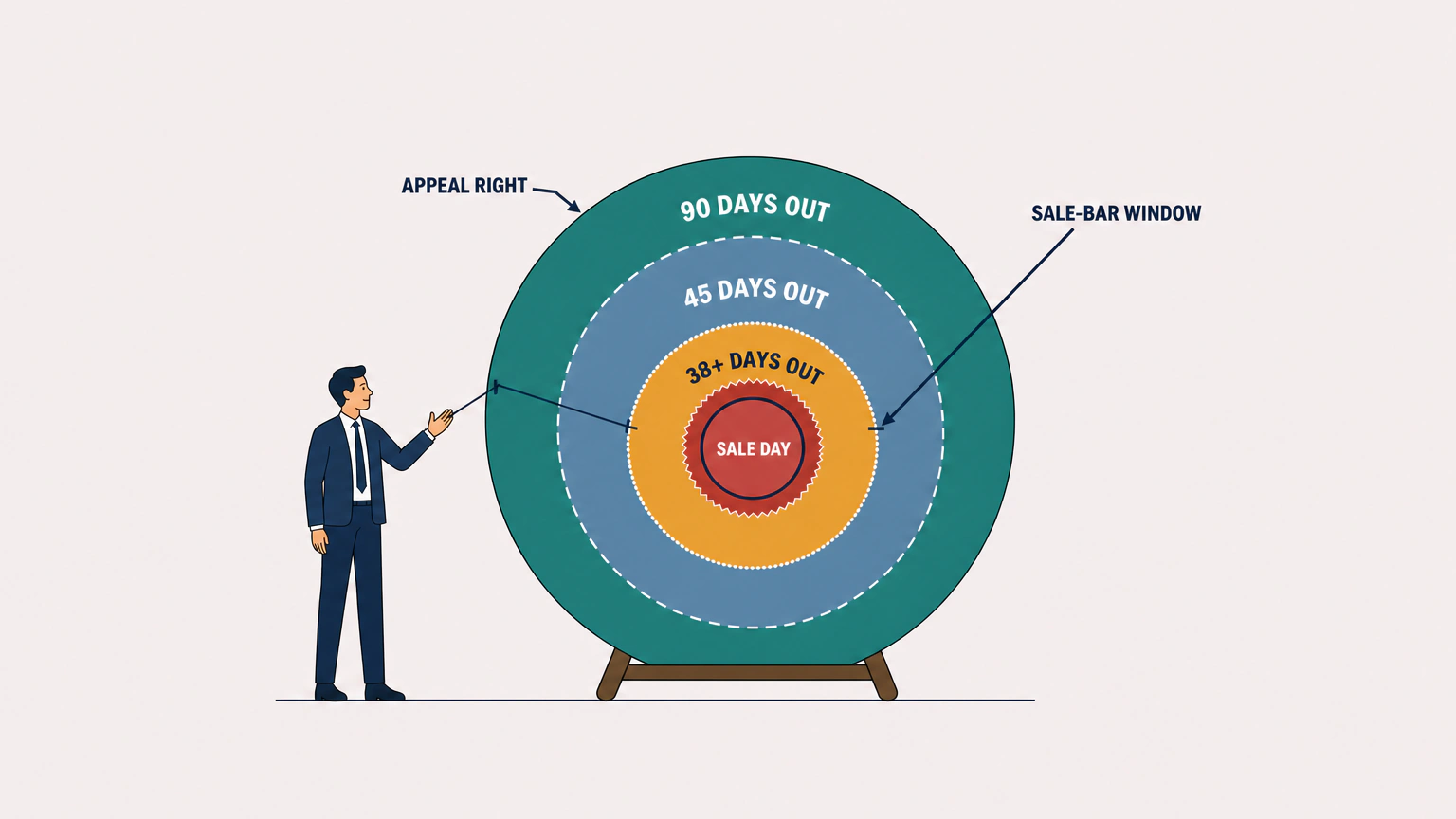
Ordinary federal timing windows are layered around the sale date, and they close in as the date gets nearer. A date on its own does not make a protection apply: each window depends on Regulation X coverage, and the 90-day and more-than-37-day protections also depend on a complete application.
- 90 DAYS OUTAPPEAL RIGHTA complete loss mitigation application received 90 or more days before the sale carries the right to appeal a denial of a loan modification, and at least 14 days to accept or reject an offer.12 CFR 1024.41(h)(1), (e)(1)
- 45 DAYS OUTCOMPLETENESS NOTICEAt 45 or more days before the sale, the servicer must promptly review the application for completeness and notify you in writing within 5 business days, listing any missing documents.12 CFR 1024.41(b)(2)(i)
- 38+ DAYS OUTSALE-BAR WINDOWWith more than 37 days left, 1024.41(c)(1) requires evaluation of a complete application within 30 days, and 1024.41(g) may bar judgment, an order of sale or the sale itself until one of its three exit conditions is met.12 CFR 1024.41(c)(1), (g)
- SALE DAYORDINARY WINDOWS CLOSEDThe windows above are all counted back from this date. Inside 37 days the ordinary more-than-37-day window is closed, although 1024.41(k)(2)(B) sets out a servicing-transfer exception.12 CFR 1024.41(k)(2)(B)
This shows ordinary federal timing windows, not whether a rule covers your loan or applies to your case. It is not legal advice. Free help: a HUD-approved housing counselor at (800) 569-4287.
What actually stops a sale
The options sort by how much time each needs, and the one most people think of first is the one fewest readers can use.
| Option | Time it needs | Cash it needs | Keeps the home? |
|---|---|---|---|
| Reinstate | Until your state's cutoff | Full arrears plus fees | Yes |
| Loss mitigation application | Best at 90+ days; ordinary sale-bar window requires a complete application more than 37 days out | None to apply | Usually, if approved |
| Chapter 13 | Days; the stay ordinarily starts on filing | Filing and attorney fees, then plan payments | Yes, if the plan is performed |
| Sale or short sale | Weeks to months | None up front; lender consent needed | No, but you control the exit |
| Court challenge | Days, if counsel is available | Filing fees, counsel, court payments | Sometimes |
Reinstating: paying what you are behind
Reinstating means paying the arrears plus the lender's fees and costs, which returns the loan to normal as though no acceleration happened. The right, and the date it dies, come from state law and your loan documents, not Regulation X.
Minnesota, for example, lets you reinstate any time before the sale by paying the actual default plus costs and capped attorney fees, and makes the holder tell you that figure within three days of your request (Minn. Stat. 580.30, subd. 1).
A complete loss mitigation application
This route can carry the federal protections above. It asks your servicer to consider forbearance, a repayment plan, a modification, or a short sale or deed in lieu. Applying costs nothing, a HUD-approved counselor will assemble it with you free, and a complete application filed more than 37 days out can block the sale.
Chapter 13 bankruptcy
Filing a Chapter 13 case ordinarily triggers the automatic stay, which halts a scheduled sale the moment the petition is filed (11 U.S.C. 362(a)). It is also a route that cures arrears over time: a default on a lien against your principal residence may be cured through the plan until the home is sold at a foreclosure sale under state law (1322(c)(1)). Plans run three to five years by income (1322(d)).
Two limits. A creditor can ask the court to lift the stay (362(d)). And if a case of yours was dismissed in the previous year, the stay ends on the 30th day after the new filing unless the court extends it; after two or more dismissals that year, it does not take effect automatically, but the court may impose it on a timely request (362(c)(3), (c)(4)). Chapter 7 can pause a sale but cannot cure arrears. Here you want bankruptcy attorneys.
Selling, short sale or deed in lieu
If you will not keep the home, selling it yourself can give you more control than an auction. A short sale (the lender accepts less than the balance) and a deed in lieu (you hand the property back) both need lender agreement, and both count as loss mitigation options. Timelines run in weeks, so start early, and give the contract and title work to real estate attorneys.
Asking a court to stop it
In a judicial foreclosure there is already a case: you answer, raise defenses and appear. In a non-judicial foreclosure there is none, so stopping the sale usually means your own suit and an injunction.
That has a price. Washington lets you restrain a trustee's sale on any proper legal or equitable ground, but the court must require you to pay the sums coming due into the court registry every 30 days. And no judge may act unless the trustee had five days' notice of the hearing (RCW 61.24.130(1), (2)). Mechanics like those decide whether a challenge is realistic, so talk to foreclosure attorneys in your state early.
Your state runs on different numbers
The table covers six states, verified cell by cell against the primary statute.
| State | Process | Pre-sale cure / key notice | After the sale |
|---|---|---|---|
| Texas | Non-judicial | 20 days to cure (residence) before the notice of sale; 21 days' notice of sale; sales the first Tuesday, 10am to 4pm (first Wednesday if it falls on January 1 or July 4) | No redemption period in Tex. Prop. Code 51.002 |
| Washington | Non-judicial | Cure right runs until the eleventh day before the sale date (RCW 61.24.090(1)) | No right to redeem after a trustee's sale (61.24.050(1)) |
| Minnesota | Non-judicial | 6 weeks' published notice; service on the occupant 4 weeks before the sale (Minn. Stat. 580.03) | 6 months to redeem (580.23, subd. 1); 12 months in the cases in subd. 2; 5 weeks by court order for abandoned property (582.032) |
| Missouri | Judicial or non-judicial | No statutory cure period in Mo. Rev. Stat. 443.410 | 1 year to redeem, only if the debt holder or its representative bought at the sale, you gave written notice at it or 10 days before, and you post security within 20 days after (443.410, 443.420) |
| Florida | Judicial | Foreclosed in equity, so there is a case to defend (Fla. Stat. 702.01); redeem until the later of the clerk filing the certificate of sale or the date in the judgment (45.0315) | After that, "there is no right of redemption" (45.0315) |
| Maryland | Judicial | Filing generally barred until the later of 90 days after default or 45 days after the notice of intent; postfile mediation requested within 25 days (Md. Real Prop. 7-105.1(b), (j)) | Section 7-105.1 does not state a post-sale redemption period; check Maryland-specific law before relying on one |
Judicial or non-judicial: whether anyone has to ask a court
In a judicial foreclosure the lender must sue you, so there is a docket, a judge and hearings you can attend, and silence produces a default judgment. Florida is the clean example: mortgages are foreclosed in equity and tried without a jury (Fla. Stat. 702.01).
In a non-judicial foreclosure a trustee runs the sale on notice alone, and nobody checks the paperwork unless you make them.
Reinstatement cutoffs are earlier than you think
Washington shows why two clocks matter. The statutory right to cure runs only "at any time prior to the eleventh day before the date set by the trustee for the sale" (RCW 61.24.090(1)). Once 11 days or fewer remain, it's gone.
A Washington homeowner with a sale 22 days out still has the state right to reinstate, but does not meet the ordinary 37-day federal threshold, because 22 sits inside 37. At 40 days out, the same person may have both.
After the sale: redemption exists in some states and not others
Reinstating happens before the sale and cures the default. Redeeming happens after it, and buys the property back for what is usually the sale price plus interest and costs.
Minnesota gives most homeowners six months to redeem (Minn. Stat. 580.23, subd. 1), twelve months in seven specified cases, and five weeks where a court shortened it for abandoned property (subd. 2; 582.032). Missouri gives a full year, but only on three strict conditions, and missing any one of them forfeits the right by silence (Mo. Rev. Stat. 443.410, 443.420).
Washington runs the other way: after a trustee's sale, nobody has any right, by statute or otherwise, to redeem (RCW 61.24.050(1)). Even so, the trustee or lender may declare the sale void up to the eleventh day afterward, in a few listed situations that include an agreed modification or accepted reinstatement funds ((2)).
How to find the rule for your own state
Your state attorney general's consumer pages usually publish a plain-language foreclosure timeline, and your state judicial branch's self-help site carries the steps, forms and deadlines. Then call a counselor: a HUD-approved housing counselor at (800) 569-4287, or the Homeowners HOPE Hotline at (888) 995-HOPE. HUD lists both.
When a foreclosure lawyer is worth the money
A foreclosure attorney does two jobs a counselor cannot: defend a filed case and force a non-compliant servicer to follow Regulation X (enforceable by borrowers under RESPA, 12 CFR 1024.41(a)).
A HUD-approved counselor can help assemble a complete application and work with your mortgage company, free. For many readers that call should come first.
Across 824 cost profiles on Legal Directorate, short sale negotiation and loan modification legal services show a national average of $2,100 and a typical range of $1,470 to $4,725. We also list $237 under our own "Avg Per Hour Rates" label. Those are our own aggregates of the firms listed with us, not a market survey and not a quote for your case.
Before you hire anyone, check that the attorney is licensed and in good standing and get the fee agreement in writing. Compare foreclosure attorneys in your state by practice area and location.
Rescue offers that make things worse
Once your sale notice is public, you start hearing from people who found your name on it. The Federal Trade Commission publishes what those approaches look like.
Red flags, and what to do instead:
- An upfront fee before any result. Under Regulation O, a mortgage assistance relief provider may not take a fee until you have signed a written agreement with your lender or servicer accepting the offer it obtained for you (12 CFR 1015.5(a)).
- "Stop talking to your servicer." The FTC states plainly that companies telling you to stop communicating with your lender are breaking the law.
- A request to sign over the deed, or to pay anyone but your servicer. Transferring the deed doesn't transfer the mortgage: you'd still owe the loan and no longer own the house. Pay only the servicer on your statement.
- A guarantee of a specific outcome. Nobody can promise a modification, and a reputable lawyer won't pretend otherwise. Treat the promise itself as a reason to walk away.
- Pressure to decide today. Get a second opinion.
Free foreclosure help is available from a HUD-approved counselor at (800) 569-4287. For a fuller vetting method, this guide on how to tell a legitimate debt-relief firm from a sales operation applies to mortgage relief too.
Frequently asked questions
When is it too late to stop a foreclosure?
Some options may remain before the sale itself. Federal protections shrink as the sale approaches: the 90-day appeal window closes first, then the 45-day completeness-notice window, then the ordinary more-than-37-day sale-bar window. Reinstatement, Chapter 13 and a court challenge may work later. After the sale, options narrow to state redemption rights, which exist in some states and not others.
Can I stop a foreclosure by paying the past due amount?
Usually yes, if you can pay the full arrears plus fees and costs before your state's cutoff. That's called reinstating, and it puts the loan back as though no acceleration happened. The cutoff comes from state law and your loan documents. In Washington it falls 11 days before the sale.
Does filing bankruptcy stop a foreclosure sale?
Usually. Filing ordinarily triggers the automatic stay, which can halt a scheduled sale (11 U.S.C. 362(a)). Chapter 13 may also let you cure arrears across a three-to-five-year plan, with the cure right lasting until the home is sold at foreclosure. Repeat-filer limits may shorten or prevent the stay, and a creditor may ask the court to lift it.
Can I still sell my house once foreclosure has started?
You may be able to sell before the foreclosure sale, subject to the time and requirements in your state's process. A sale you control can give you more control over the exit than an auction. If the price will not cover the balance, you need the lender's agreement to a short sale, which can take weeks to arrange.
Can a foreclosure be undone after the sale date?
Sometimes. Minnesota gives most homeowners six months to redeem and Missouri up to a year on strict conditions, while Washington ends redemption at the trustee's sale. A sale can also be unwound for defects: there, the trustee or lender may declare it void up to the eleventh day afterward.
How much does a foreclosure lawyer cost?
From our own data, across 824 cost profiles, short sale and loan modification legal services average $2,100, with a typical range of $1,470 to $4,725. That's our aggregate of the firms listed with us, not a market survey. Free help from a HUD-approved counselor comes first, at (800) 569-4287.
Disclaimer and review note
This is general information about foreclosure procedure, not legal advice. Foreclosure law varies by state, and it changes over time.
Re-check these deadlines before you act, and confirm any date with an attorney licensed in your state or a HUD-approved housing counselor at (800) 569-4287.