

On this page
- The short version, before anything else
- Three situations, and only one of them is expensive
- Why filing late costs ten times more than paying late
- One tax bill, four choices, six months later
- The relief that now arrives without you asking
- What else filing late costs you
- What to do today, in order
- When this stops being a job you should do alone
- Questions people ask about filing late
The short version, before anything else
If you're owed a refund, filing taxes late costs you nothing in penalties. Both penalties are a share of tax you still owe, and you owe none. If you do owe, the math turns sharp. The late filing penalty runs at 5 percent of the unpaid tax every month. The late paying penalty runs at 0.5 percent. That's ten times the price for the same month of delay, which is why the cheapest thing you can do today is file the return, even if you can't pay a dollar of it.
Now the part nobody says out loud. Most people are more frightened by a late return than their situation deserves. They picture an audit, a letter with a badge on it, somebody at the door. What arrives is a notice with a number on it, and for a lot of people that number is zero.
The fear does damage on its own, because it's what keeps the return in the drawer. If tax is still unpaid, each month or part of a month can add the filing penalty until its cap.
So start with the cheap question. Which of three situations are you in?
Three situations, and only one of them is expensive
| Your situation | Late filing penalty | Late paying penalty | What to do today |
|---|---|---|---|
| You are owed a refund | None. The penalty is a share of tax you still owe, and you owe none | None | File anyway. A filing extension or qualifying financial disability can move the three year refund deadline |
| You owe and have paid nothing | 5% of the unpaid tax for each month or part month, up to 25% | 0.5% for each month or part month, up to 25% | File today, then pay what you can. Filing is the expensive one to skip |
| You owe a little after withholding | 5% a month of what was still unpaid on the due date | 0.5% a month of what remains unpaid | File today. A small balance can still carry the 60 day floor |
What decides the size of your problem isn't only how late you are. It's also what was paid by the due date. The filing penalty uses the tax left unpaid then. The paying penalty follows the balance that remains, so withholding can leave little for either charge to bite.
Find yours and start there.
You are owed a refund, and the only clock that matters is the refund's
No penalty. Not a reduced one, not a suspended one. None.
There's still a clock, and it's the one nobody warns you about. The IRS puts the ordinary rule plainly: to claim a refund from withholding or estimated taxes, you have to file the return within three years of its due date. Miss that deadline and the money generally stays with the Treasury. A filing extension or qualifying financial disability can move it.
Two details set your own cliff. Your withholding counts as paid on the original April due date, not on the day you finally file. And what you can get back is capped at what was paid in the three years before the claim, plus any extension. So a 2025 return, due April 15, 2026, has to be claimed by April 15, 2029.
You owe, and you have paid nothing yet
This is the expensive branch.
Without a filing extension, two separate charges start the same day. Filing late costs 5 percent of the unpaid tax for each month or part of a month, to a ceiling of 25 percent. Paying late costs 0.5 percent a month, to its own 25 percent ceiling.
If you took an extension, read this twice. It moved your filing deadline to October 15 and never moved the payment deadline, which stayed in April. That's why people who extend and then pay in the fall find the paying penalty already on the notice.
You can stop the bigger charge today, free, and it doesn't require having the money. File the return. The 5 percent charge stops when it arrives, whether or not a check came with it.
You owe a little, because withholding covered most of it
This branch doesn't belong with owing the full bill.
The penalty base isn't your tax bill. The IRS starts with the tax required to be shown on the return, subtracts what you paid on time, subtracts refundable credits, and runs 5 percent a month on what's left. A $9,000 tax bill with $8,700 already withheld leaves a $300 base.
A separation can leave your filing status unsettled. The IRS starts with your marital status on the last day of the year, then asks whether you meet the rules for filing taxes after divorce or separation.
A small base doesn't mean a small penalty.
Why filing late costs ten times more than paying late
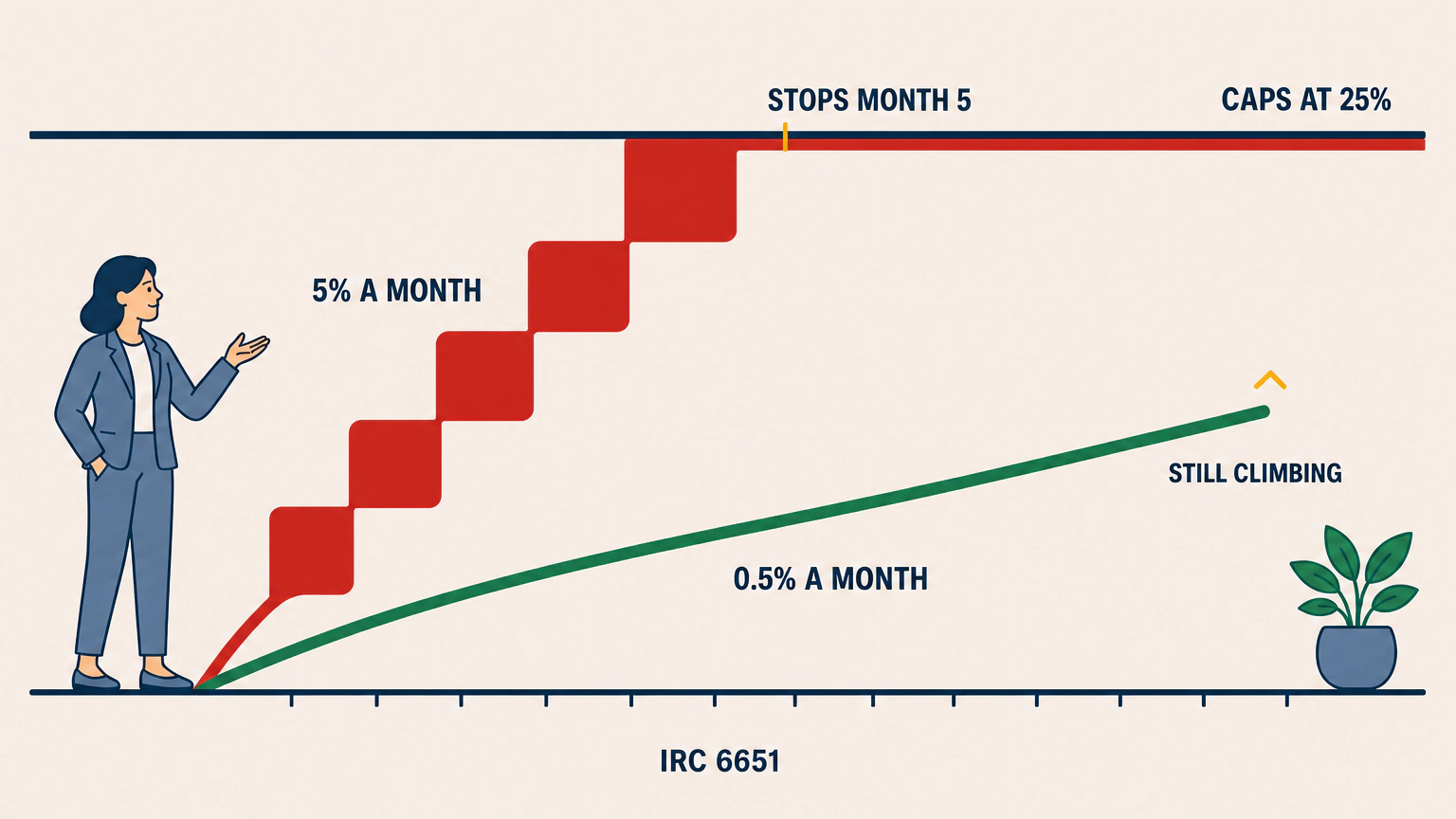
Five percent against half a percent. That ratio decides the order of operations: file first, pay second, worry third. Each penalty has its own shape, and they end in different places.
The filing penalty, and why it stops after five months
5 percent of the unpaid tax for each month or part of a month the return is late, up to 25 percent.
Read "part of a month" literally. One day late is a full month's penalty. Filing on April 16 costs the same 5 percent as filing on May 14, which makes the day after the deadline the best day left to file.
The ceiling arrives fast. Five months at 5 percent hits 25 percent, and the filing penalty stops for good.
In any month where both penalties apply, the filing penalty gets reduced by the paying penalty. So instead of 5.5 percent you pay 4.5 plus 0.5, which still adds to 5. There's a fraud version too, at 15 percent a month with a 75 percent ceiling. For almost everyone in this situation it plainly doesn't apply, which is worth knowing rather than worrying about.
The paying penalty, and why it does not
0.5 percent for each month or part of a month the tax stays unpaid, to the same 25 percent ceiling. At that rate the ceiling takes fifty months to reach. This is the penalty that outlives the other one, and the IRS says so directly: after five months the failure to file penalty maxes out, but the failure to pay penalty continues.
Two things move the rate. It drops to 0.25 percent a month while an approved payment plan runs, but only for someone who filed the return by its due date, extensions included. And it doubles to 1 percent a month if the tax is still unpaid ten days after a notice of intent to levy.
Keep that first one in mind. Filing late is what takes that lower rate away.
The floor that catches small balances
More than 60 days late, the filing penalty gets a minimum. The minimum is the listed amount or all the tax that was unpaid on the payment due date, whichever is smaller.
| Return due date, without extension | Minimum failure to file penalty |
|---|---|
| After 12/31/2025 | $525 |
| 01/01/2025 to 12/31/2025 | $510 |
| 01/01/2024 to 12/31/2024 | $485 |
| 01/01/2023 to 12/31/2023 | $450 |
| 01/01/2020 to 12/31/2022 | $435 |
The IRS publishes three older bands as well, running back to 2009. Read your own return's due date off the left column, not the year you happen to be filing in. Statutory basis: 26 U.S.C. 6651(a) and (j).
Somebody catching up on a calendar-year 2022 return is looking at $450, not $525. Its due date was in 2023, and the due date picks the band.
One more rule surprises people. That 4.5 percent reduction can't push the penalty below this floor.
Pro tip: Interest is a third charge and it behaves differently from the two penalties. Interest on unpaid tax runs from the original payment due date even with a filing extension, and it compounds daily. The IRS also charges interest on penalties from each penalty's own due date. The IRS won't waive tax interest for reasonable cause or a clean record. The underpayment rate is 7 percent for the fourth quarter of 2026, and the IRS resets it every quarter. At that rate, a $4,000 balance left unpaid for six months picks up about $140.
One tax bill, four choices, six months later
| What you did | Filing penalty | Paying penalty | Penalty total at six months |
|---|---|---|---|
| Filed on time, paid nothing | $0 | 3% of $4,000, or $120 | $120 |
| Filed six months late, paid nothing | 22.5% of $4,000, or $900 | 3% of $4,000, or $120 | $1,020 |
| Filed six months late, paid $3,700 by the due date | the floor applies, so $300 | 3% of $300, or $9 | $309, and the filing penalty equals the tax |
| Filed six months late, AEP applies | $0 | $0 | $0, though the tax and the interest still stand |
Every row starts with a return due April 15 and a $4,000 tax bill, measured six full months later. In the third row, $3,700 was paid by the due date and the last $300 stayed unpaid for all six months. Interest sits outside the table.
Read the first row against the second. Both owed $4,000 and paid nothing. One filed, one didn't. The difference is $900.
The third row is the one to sit with. This is the reader whose withholding covered almost everything and who figures a $300 shortfall can't matter much. The ordinary calculation would have produced about $68. The 60 day floor overrides it and the penalty becomes the whole $300.
The fourth row assumes Automatic Exemption from Penalty applies. The same return type was filed and its tax was paid on time for the prior three years, and the return meets the program's other eligibility rules.
So the gap between the best row and the worst isn't the money you had. It's whether you filed.
The relief that now arrives without you asking
Something is changing at the IRS this year. The old relief made you ask for it. The new one doesn't.
What Automatic Exemption from Penalty does
First Time Abate has been the IRS's most common penalty waiver for people with a clean three year record. The IRS says it's transitioning to a replacement called Automatic Exemption from Penalty, beginning in summer 2026. The mechanics change, not just the name.
| What changes | First Time Abate, the old way | Automatic Exemption from Penalty, from summer 2026 |
|---|---|---|
| How the relief arrives | Not automatic | Automatic |
| What you have to do | Call the IRS or send Form 843 to ask for it | Nothing at all |
| When the penalty is charged | Charged first, removed later | Never charged in the first place |
| The late paying penalty | Can keep running until the tax is paid in full | Does not accrue and is not charged on the unpaid tax |
| Which returns it covers | 2025 tax year, 2026 quarterly returns, and every earlier year | 2025 tax year, 2026 quarterly returns, and every year after |
Two of those changes carry the weight. Under the old program the penalty got charged and then removed once you asked. Under the new one it's never charged. And the paying penalty, which used to keep running on the unpaid tax, doesn't accrue at all.
You find out by getting a letter. The IRS applies the relief when your return finishes processing, then sends a notice saying the penalties weren't assessed. You don't need to contact them or respond. The tax and the interest are still yours.
Whether you qualify, in three questions
All three questions are about your own history rather than about the rules.
Did you file the same type of return and pay its tax on time for the three years before this one? Quarterly filers get tested on twelve consecutive quarters instead.
Were those three years clean of penalties, apart from an estimated tax penalty? One that was charged and later removed for reasonable cause or IRS error still counts as clean.
Is this a return you file regularly, rather than a one off? Event based filings are out.
Now the honest part. The IRS reads its own ledger, not your memory, and people forget a penalty that was charged and dropped years ago. Treat your answers as a hint. The notice settles it.
If you do not qualify, there is still reasonable cause
Reasonable cause is the older route, decided case by case, and the IRS publishes both halves of the list.
Reasons the IRS may accept
- Fires, natural disasters or civil disturbances
- You couldn't get your records
- Death, serious illness or unavoidable absence, yours or an immediate family member's
- System problems that delayed a timely electronic filing or payment
Reasons it generally doesn't
- Relying on a tax professional to handle it
- Not knowing the rule applied to you
- Mistakes and oversights
- Lack of funds, on its own
The second list is useful because it shows where not to start.
Both ways to ask are free. Call the number in the top right corner of your notice, or send Form 843, Claim for Refund and Request for Abatement, in writing.
Red flag: If somebody calls offering to get your penalties removed for a fee, hang up. Automatic Exemption from Penalty costs nothing and needs no request. Reasonable cause costs nothing to ask for. A Low Income Taxpayer Clinic may represent you for free or a small fee if you qualify. The longer version is here: how to tell a legitimate tax practitioner from a sales pitch.
What else filing late costs you
Penalties aren't the whole bill. Three other costs ride along with a late return, and the last is why "I'll deal with it later" has an expiry date.
The half rate on a payment plan, gone for that year
The paying penalty drops from 0.5 percent a month to 0.25 percent while an approved payment plan runs. A condition rides along that almost nobody reads. The taxpayer has to have filed that return by its due date, extensions included.
File late and the 0.25 percent plan rate is off the table for that return. Unless penalty relief applies, the paying penalty keeps running at its regular rate while the balance remains.
The return the IRS writes for you if you never do
If you never file, the IRS can file for you. It builds a substitute return from the income already reported to it, and it's blunt about what that leaves out: the return might not give you credit for deductions and exemptions you're entitled to.
Then comes a Notice of Deficiency, form CP3219N, the 90 day letter. You get 90 days to file a real return or petition the Tax Court. Do neither and the proposed assessment goes through, and a bill built without your deductions becomes yours. Once that notice arrives you can no longer request an extension to file.
Filing your own return afterward still helps, and the IRS will generally adjust the account to the correct figures.
The audit clock that never starts
The IRS generally has three years to assess more tax, and that clock starts when the return is filed. A return filed early counts as filed on the due date.
An unfiled year has no clock at all. The tax can be assessed at any time, with no end date.
That inverts the instinct that keeps people from filing. Not filing feels like staying out of sight. What it does is hold the year open forever, so the thing you want most, for this to be over, is the one thing not filing makes impossible.
Filing starts the clock.
What to do today, in order
The first two are free and take an afternoon. They come first because the instinct is to wait for a notice and react, and that's backwards.
One note. These are the federal rules. If your state requires its own return, its late filing rules are separate, so check your state tax agency before you file.
- Pull your wage and income transcript from your IRS online account so you are not filing from memory.
- File the return today, even if you cannot pay a cent of it. Filing is the ten times penalty.
- Pay whatever you can with the return. Every dollar paid stops the paying penalty and future interest on that dollar.
- If a balance is left, set up a payment plan the same day rather than waiting for a notice.
- Read the penalty lines on the notice when it comes, before you pay anything you might not owe.
- If the notice says AEP applies, check that no filing or paying penalty was charged.
- If a penalty was charged and you think it should not have been, call the number in the notice's top right corner.
When this stops being a job you should do alone
For most people, it's a free, same day, do it yourself problem. One return, a number you already know, a payment plan you can set up online. Nobody needs to be paid to ask for penalty relief, because asking is free.
Five situations make hiring proportionate: more than one unfiled year, self-employment income with no records behind it, a balance big enough that a levy notice is realistic, a substitute return already assessed, and a 90 day Tax Court window running.
Match the problem to the work involved. A tax preparer can handle a single late return you don't want to do yourself. A CPA firm can rebuild books for several unfiled years, self-employment income, or a business return behind the personal one. A tax resolution lawyer fits a levy notice, an assessed substitute return, or a 90 day Tax Court deadline.
We're not your accountant, and a several year backlog with a business in it deserves one. For a single late return with a number you already know, this is a job you can finish this afternoon.
Questions people ask about filing late
What happens if you file taxes late but do not owe anything?
Nothing, in penalty terms. Both late penalties are a share of tax you still owe, so when that figure is zero, the penalty is zero. There's a catch. The ordinary refund deadline is three years from the return's due date. A filing extension or qualifying financial disability can move it.
Can I still file a return from three years ago?
Yes. Nothing stops you filing a late return, and the IRS wants it filed. The deadline sits on the money instead. The ordinary refund deadline is three years from that return's due date, with a later date for a filing extension or qualifying financial disability. If you owe instead, filing now stops the filing charge.
Does the IRS charge interest on penalties?
Yes. Interest runs on tax and penalties, and it compounds daily. Tax interest starts on the original payment due date even if you had a filing extension. Penalty interest starts when that penalty is due. The underpayment rate is 7 percent for the fourth quarter of 2026. Reasonable cause won't remove tax interest, but removing a penalty also removes the interest tied to it.
How much is the penalty when both the filing and the paying penalty apply?
5 percent of the unpaid tax for that month, not 5.5. In any month both apply, the filing penalty drops to 4.5 percent while the paying penalty adds its 0.5. Over the full run the pair caps at 47.5 percent, made of 22.5 for filing late and 25 for paying late.
How long can you go without filing before it becomes a real problem?
Two things move fast. After 60 days the filing penalty gets a dollar floor, up to $525 for returns due after 2025, though it cannot exceed the unpaid tax. An unfiled year never closes because the IRS can assess that tax at any time, while a filed return generally starts a three year clock. The IRS can also file for you.
Can you get IRS penalties waived?
Often, and it costs nothing to ask. If you filed the same return type and paid its tax on time for the prior three years, relief can arrive on its own, with no call and no form. If not, reasonable cause may cover a fire, a serious illness, or records you couldn't get. Ask by phone using the number on your notice, or on Form 843.
What if I filed before the deadline but the IRS rejected my return?
A rejection doesn't always make a return late. Fix it and get the return accepted by the fifth calendar day after the due date. If you must file on paper, postmark it within 10 calendar days after the rejection notice. Include the notice, an explanation and your correction history, mark the first page REJECTED ELECTRONIC RETURN, and sign it.