


Here's the short version. Most states no longer let a new common law marriage begin. Years together don't marry you on their own. The test depends on the state, and both partners must be legally free to marry. Texas, for one, requires an agreement that you're married now, living together in Texas after that agreement, and telling others there that you're married. Both of you must also be at least 18. Meet the requirements and you're married, even without a wedding.
On this page
What a common law marriage actually is
A common law marriage isn't a lesser kind of marriage. It's the real thing, formed without a license and without a ceremony, in a state whose law allows that. There's no halfway tier, no probationary status, and no line you drift across without noticing. Either a court would find you married or it wouldn't, and that turns on the state's requirements and your own facts.
The three things Texas looks for
The agreement comes first. After that, it's about how you lived and how you described yourselves in Texas. One, an agreement that you're married right now, not a plan to marry someday. Two, that you lived together. Three, that you held yourselves out to other people as a married couple: the neighbors, the landlord, the tax return, the form at the hospital desk.
Texas writes the test in the plainest statutory language in the country. A marriage can be proved by evidence that "the man and woman agreed to be married and after the agreement they lived together in this state as husband and wife and there represented to others that they were married."
After the agreement, you must live together in Texas and represent yourselves as married there. Two out of three isn't enough. A private agreement you never told anybody about isn't enough, and neither is a decade of shared rent with no agreement behind it.
Why the number of years is the wrong question
Seven years. Five years. Ten. You've heard a number, and it isn't written down anywhere. Years together don't create a marriage on their own. No federal rule sets a number either.
New Hampshire does set a three year rule. You must live together, acknowledge each other as spouses and be generally known as married for three years, until one partner dies. Only then are you deemed to have been legally married. It isn't a way to be married while you're both alive.
In Texas, twenty years together with no agreement won't make you married. Six months can be enough if you meet the state's requirements. Time is evidence of the relationship. It never replaces the test.
Where one can still begin, and where the door has closed
Start with your state's rule and any cutoff date. The rule tells you whether a new common law marriage can still begin there. The date matters because most of the states that closed the door left everything behind it standing.
Find your state and read both. If your relationship met the test before your state's cutoff, that cutoff doesn't reach you.
| Jurisdiction | Can a new one begin? | The date or time rule | What the law actually says | Where the rule lives |
|---|---|---|---|---|
| Colorado | Yes | Sept 1, 2006, for the age rule | Recognition comes from the courts, not a statute. Since that date both partners must be 18 and free to marry. | Colo. Rev. Stat. 14-2-109.5 |
| Iowa | Yes | No cutoff | The statute validates marriages solemnized in any manner other than the one it prescribes. The three part test comes from the courts. | Iowa Code 595.11 |
| Kansas | Yes | No cutoff | Recognition comes from the courts. The statute bars it if either partner is under 18. | Kan. Stat. Ann. 23-2502 |
| Montana | Yes | No cutoff | "Common-law marriages are not invalidated by this chapter." | Mont. Code Ann. 40-1-403 |
| Texas | Yes | No cutoff | Both partners must be at least 18 and free to marry. Record a declaration with the county clerk, or prove you agreed to be married, then lived together in Texas and told others there you were married. | Tex. Fam. Code 2.401 |
| Utah | By court petition filed before May 5, 2027 | May 5, 2027 | Utah has no common law marriage. A court can recognize a relationship as a marriage. Filing closes on that date, but timely petitions can be decided later. | Utah Code 81-2-408 |
| New Hampshire | Only after one partner dies | Three years | Partners must live together, acknowledge each other as spouses and be generally known as married for three years, until one partner dies. They are then deemed to have been legally married. | N.H. Rev. Stat. Ann. 457:39 |
| South Carolina | No | July 24, 2019 | The Supreme Court abolished it purely prospectively. Ones formed earlier stay valid. | Stone v. Thompson, Op. No. 27908 |
| Alabama | No | Jan 1, 2017 | "No common-law marriage may be entered into in this state on or after January 1, 2017." Ones entered into before that date stay valid. | Ala. Code 30-1-20 |
| Pennsylvania | No | Jan 1, 2005 | "No common-law marriage contracted after January 1, 2005, shall be valid." Ones lawful on or before that date stay valid. | 23 Pa. Cons. Stat. 1103 |
| Georgia | No | Jan 1, 1997 | "No common-law marriage shall be entered into in this state on or after January 1, 1997." Earlier ones are still recognized. | Ga. Code Ann. 19-3-1.1 |
| Idaho | No | Jan 1, 1996 | A license and a solemnization are required. Marriage contracts in effect before that date are not invalidated. | Idaho Code 32-201 |
| Ohio | No | Oct 10, 1991 | "Common law marriages are prohibited in this state" from that date. Earlier ones and valid out of state ones remain valid if they still exist and meet Ohio's recognition rules. | Ohio Rev. Code 3105.12(B) |
| Florida | No | Jan 1, 1968 | "No common-law marriage entered into after January 1, 1968, shall be valid." The statute protects some otherwise defective marriages entered in good faith by either partner that substantially follow the marriage rules. | Fla. Stat. 741.211 |
| Indiana | No | Jan 1, 1958 | "A marriage is void if the marriage is a common law marriage that was entered into after January 1, 1958." | Ind. Code 31-11-8-5 |
Oklahoma, Rhode Island and the District of Columbia also recognize common law marriage through their courts. The requirements differ, so use the rule for the place where you formed the marriage.
Utah filing closes in May 2027
If you're in Utah, there's a date coming that decides whether this route stays open to you at all.
Utah's own courts are blunt about the starting point: "Utah does not have common law marriage." What Utah has instead is a petition. You ask a court to recognize your relationship as a marriage, and if the court agrees, you're treated as having been married ever since the requirements were met.
The court wants to see partners who are old enough and able to consent, who are legally free to marry each other, who have lived together, who treat each other as though they are married, and who "present themselves to the public so that other people believe they are married."
The timing is tight. Paperwork has to be filed during the relationship, or within one year after it ends, whether it ends in a separation or a death. Either partner can file. So can a third party, such as next of kin.
Utah stops accepting these petitions on May 5, 2027. The deadline is for filing, so a court can decide a timely petition afterward. If you want that recognition, file before then.
South Carolina is where the statute and the court disagree
South Carolina is the state where the books and the bench say different things, which is why so much of the internet still gets it wrong.
The statute reads exactly as it always has. "Nothing contained in this article shall render illegal any marriage contracted without the issuance of a license." Nobody has amended it since 1911.
The court closed the door anyway. In Stone v. Thompson, filed July 24, 2019, the South Carolina Supreme Court held that "parties may no longer enter into a valid marriage in South Carolina without a license." The justices refused to apply that backward. They saw "no benefit to undoing numerous marriages" already formed.
So a South Carolina couple who met the test before that date is still married. Nobody new joins them.
The National Conference of State Legislatures still includes South Carolina in its common law marriage summary dated March 2020, eight months after the ruling.
Your date is measured against when you met the test
For a formation cutoff, what matters is when you met the marriage requirements. Utah's deadline works differently: it decides when you can file a petition.
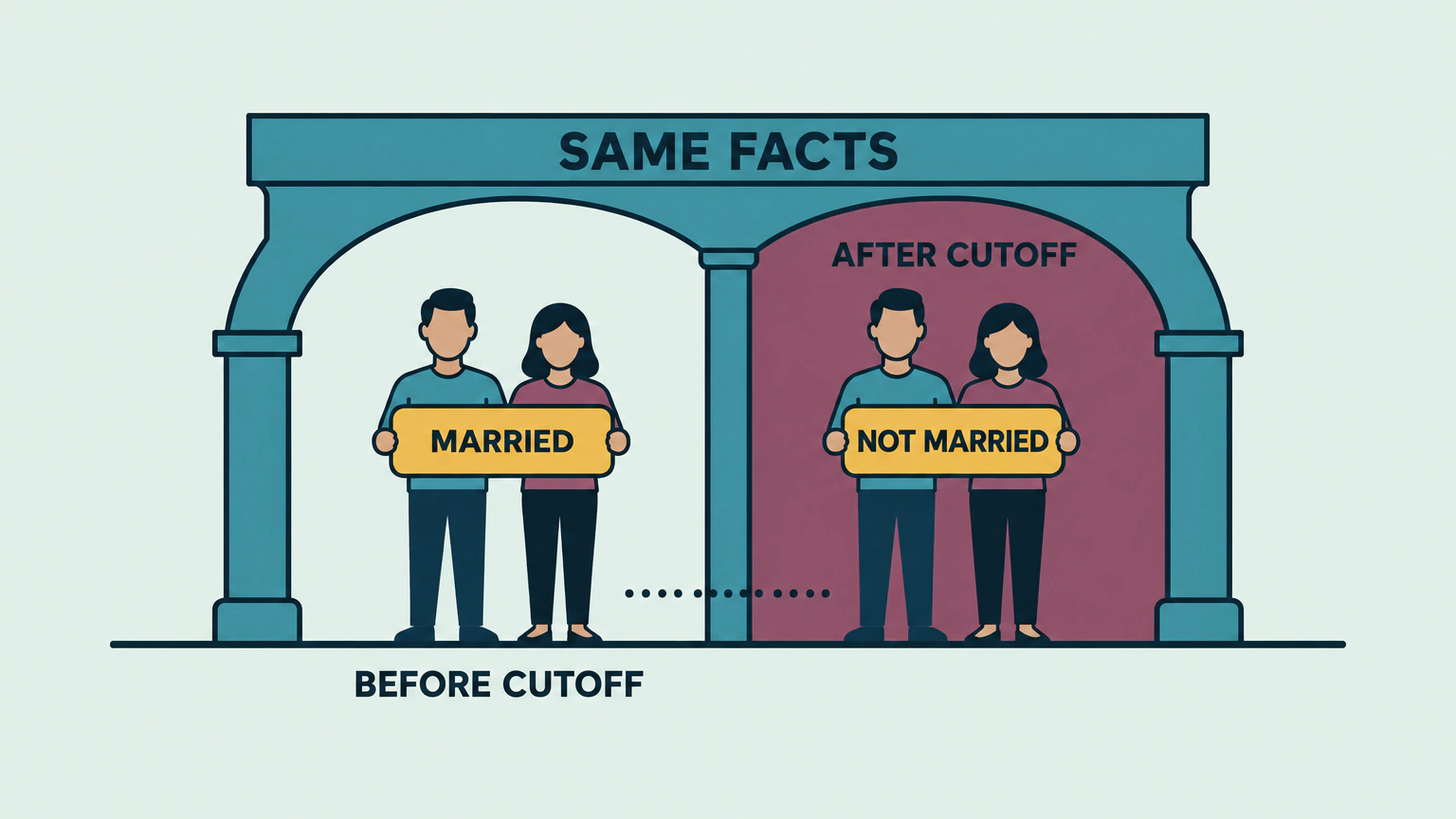
Pennsylvania is the most careful with its dates. New ones are out: "No common-law marriage contracted after January 1, 2005, shall be valid." The saving clause covers marriages that were lawful "on or before January 1, 2005", so January 1, 2005 itself sits inside the window. Writing "before 2005" would lose that protected day.
Georgia, Ohio, Idaho, Florida and Indiana each say the same kind of thing in their own words. A couple who met Georgia's test in 1995 is married. The identical couple who met it in 1999 isn't.
So the work in front of you is dating your own relationship: the date you met every requirement, and the state where you met them. Then hold that against your state's cutoff, not against your state's status today.
What happens when you move
Most of the real confusion starts when somebody moves. People assume a state line either creates a marriage or dissolves one. It does neither. And the IRS has its own rule for deciding your filing status.
A valid one travels with you, and moving does not create one
A valid common law marriage usually travels with you, including into states that wouldn't let you form one. Your new state's restrictions can still matter. Colorado, for example, won't recognize one formed on or after September 1, 2006, if either partner was under 18 or the marriage was prohibited under Colorado law.
Moving to Texas next spring doesn't marry you retroactively. A move or a vacation alone doesn't marry you either. You must meet the law's requirements in the state that allows the marriage. Some states can recognize a marriage formed during a visit, so living there permanently isn't always required.
Ohio recognizes valid common law marriages formed there before October 10, 1991, and ones validly formed elsewhere that meet its recognition rules. Either way, the marriage must still exist and must satisfy Ohio's restrictions on marriage.
For filing purposes, the IRS usually goes by your marital status on the last day of the tax year. Publication 501 says you're considered married if "you are living together in a common law marriage recognized in the state where you now live or in the state where the common law marriage began." That's a cross-check you can run yourself, on a form you already file. If a marriage is ending rather than starting, filing taxes after a divorce works off the same rules.
How you actually prove one
Without a recorded declaration or court order, you may have no marriage certificate to reach for. Proof then comes from ordinary paper, assembled after the fact, and the bar can be higher than you expect.
What a court accepts as proof, and how high the bar is
Courts look at your conduct and what you agreed at the time. Your testimony can help establish that agreement. The usual evidence: joint tax returns filed as married, a deed or a lease with both names on it, insurance and retirement beneficiary forms naming a spouse, joint bank accounts, how you introduced each other, and mail addressed to both of you as a married couple. A funeral notice. A hospital form. The words you used when nobody was building a case.
The burden sits on the person claiming the marriage. After a death, South Carolina requires clear and convincing evidence in a probate claim. That's a heavier load than the usual civil standard. There's a deadline too: you must bring the claim within eight months after the death or six months after the first appointment of a personal representative, whichever is later.
Think about who is on the other side of that argument. After a death it may be the partner's children or siblings, holding a will that names them and arguing the two of you were never married at all. Joint documents can help show what you intended at the time, but a court weighs them alongside the other evidence.
Texas gives you a form, and a two year clock
Texas lets you document the marriage in advance. You can sign and record a Declaration of Informal Marriage at the county clerk's office. That's written evidence of the marriage, but it can still be challenged.
Texas also sets a clock that catches people. If you're proving the marriage without a declaration and nobody starts a proceeding before the second anniversary of the day you separated and stopped living together, Texas presumes that "the parties did not enter into an agreement to be married." You can rebut that presumption. You're just arguing uphill from there, with the paperwork colder every year.
If that's your situation, lawyers in Texas can help you work out what evidence you need.
What follows from the answer
By now you have an answer, or at least the shape of one. Yes and no both carry consequences, and they run in opposite directions.
If you are married, there is no common law divorce
There's no such thing as a common law divorce. A valid common law marriage has the same legal status as a licensed one. That matters for property, inheritance, support, benefits and taxes, though each benefit has its own eligibility rules. To end the marriage while you're both alive, you need a divorce or an annulment.
This is the branch that gets worse with time rather than better. A couple who separated years ago and never went near a court are still married to each other. If one of them has since remarried, that second marriage may be void, and the wreckage reaches property, benefits and estates on both sides. Divorce and separation attorneys can help you sort out the marriage before you divide property or remarry.
If you are not married, make your wishes clear
This is the part that's unfair, and you're right to be angry about it.
When there's no will, state law decides who inherits. Living together alone often leaves a partner without a spouse's share. Some states do protect registered partners or people in civil unions. Property in one name can pass to family instead of the surviving partner unless a will, beneficiary designation or state law gives that partner a claim.
Medical and financial decision-making also depend on state law. Florida, for example, allows a close friend to make medical decisions when nobody in a higher priority group is available. Hospital visits are different: federal rules protect a patient's choice of visitors, including an unmarried partner, subject to the patient's consent and clinical restrictions. Raising a child together doesn't, on its own, make you a legal parent. If only one of you is, the other needs to address that separately.
These documents can protect your choices. A will. Beneficiary designations. A healthcare power of attorney and a durable financial one. Joint title where you want it. A guardianship nomination for a child, though it still needs a court's approval. Estate planning lawyers can help you put those choices in writing. If you're already on the wrong side of a death, check small estate affidavit limits in your state to see whether that route is open to you.
What to do next
Most of this you can do yourself, this week, before you spend a dollar on anybody.
- Write down the state where you met its marriage requirements and the date you met them.
- Check that state's row for a cutoff date, and compare it against your date rather than against today.
- Pull together the paper that shows you told the world: joint tax returns, a lease or deed in both names, insurance and beneficiary forms, and anything addressed to Mr. and Mrs.
- If you are in Texas and both meet its requirements, sign and record a Declaration of Informal Marriage at the county clerk.
- If you are in Utah and you want the court to recognize your relationship, file the petition before May 5, 2027.
- If you have separated and you think you were married, talk to a family lawyer before you divide anything or remarry.
So when is this worth a lawyer's hour? Any time real money, a house or a will is at stake. Any time somebody else is arguing the opposite of what you believe. A one hour consultation is a different purchase from a full case, and it's usually the right first one.
For scale: across 689 family law cost profiles, our typical price range for family law work is $3,060 to $20,400. Those are our own figures for the family law attorneys we list. Our category pages price to a location rather than to one fixed national line, so read the range as a snapshot, not a quote.
We're not your lawyer, and whether a common law marriage exists gets decided on your own facts by a judge who may see them differently than you do. If money or a house or a will turns on the answer, take it to a family lawyer before you act on it.
Common questions about common law marriage
How many years do you have to live together to be common law married?
Years together don't automatically marry you. You have to meet your state's requirements. New Hampshire's three year rule takes effect only after a death. You must have lived together, acknowledged each other as spouses and been generally known as married throughout that period.
Which states still allow a new common law marriage?
Colorado, Iowa, Kansas, Montana and Texas. Utah belongs on the list with an asterisk. You don't form a marriage there. You petition a court to recognize your relationship, and filing closes on May 5, 2027. New Hampshire counts one only after a death. Oklahoma, Rhode Island and the District of Columbia get listed as well, through their courts rather than by statute. Check your own state's date before you lean on any list.
Do you need a divorce to end a common law marriage?
Yes. There's no such thing as a common law divorce. A valid common law marriage is a marriage, so it ends the way a licensed one does: a court, a decree, a division of property. Moving out, separating, or simply calling it over doesn't end it, and it doesn't leave either of you free to remarry.
If we became common law married in Texas and then moved, are we still married?
Yes, if you met Texas's requirements, including living together there after you agreed to be married. Ohio recognizes an ongoing Texas marriage that satisfies its recognition rules. For your tax return, the IRS counts a common law marriage that's valid where you now live or where it began.
How do you prove a common law marriage after your partner dies?
With the same documents a living claimant uses: joint returns, deeds and leases, beneficiary forms, joint accounts, mail addressed to both of you. Expect close scrutiny and a possible dispute. South Carolina, for one, demands clear and convincing evidence in probate. In New Hampshire, you must show three years of living together, acknowledging each other as spouses and being generally known as married, until one partner dies.
Can you file taxes as married if you are common law married?
Yes. The IRS says so directly in Publication 501: you're considered married if "you are living together in a common law marriage recognized in the state where you now live or in the state where the common law marriage began." So a valid Texas marriage still counts on your return after you move to Ohio.