

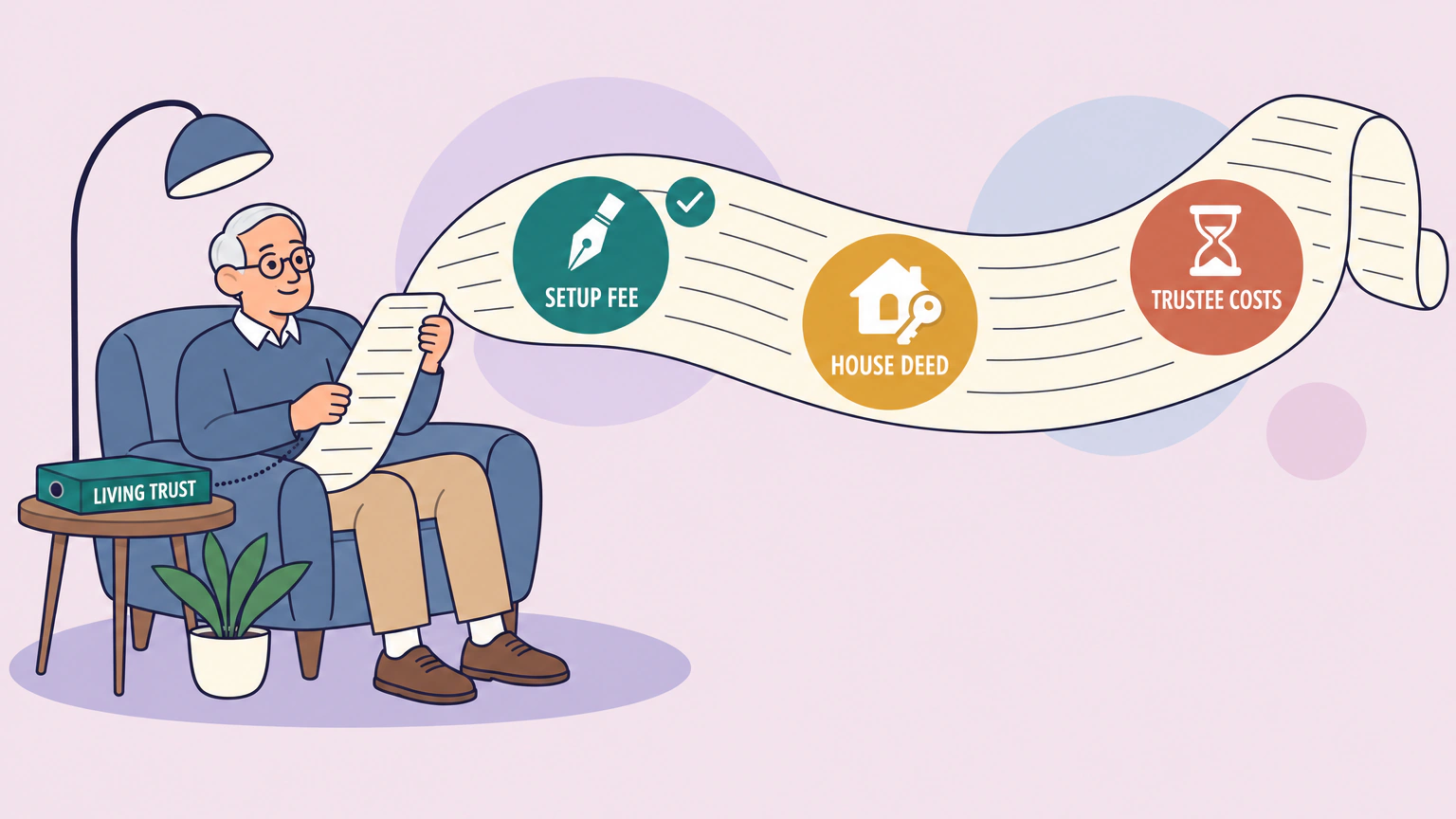
A lawyer-drafted living trust package usually costs about $2,700 for one person and $3,000 for a couple. Those are the medians in a 2026 survey of 909 law firms by LegalTemplates. Online services list trust packages from $399. That price buys the paperwork, not the whole bill. Online plans price the house deed separately, while many law-firm packages include one deed. Your successor trustee's work after you die is another cost.
On this page
- What the trust itself costs, from a lawyer or online
- Putting your house and accounts into the trust
- What a living trust costs while you're alive
- What your family pays after you die
- Is a living trust worth the extra cost?
- Seven questions to ask before you sign a trust quote
- Questions people ask about living trust costs
What the trust itself costs, from a lawyer or online
Three routes, three prices. Fill in an online package yourself. Buy an online package with attorney help attached. Or hire a law firm and pay a flat fee for the whole plan.
LegalTemplates, a company that sells do-it-yourself legal documents, asked 2,469 law firms what they charge and got prices back from 909 of them. Its median for a trust package is $2,700 for one person and $3,000 for a couple. A revocable living trust bought on its own, with no other documents attached, runs $2,475. Set that against the same survey's will package, $1,000 for one person and $1,500 for a couple, and the trust costs $1,700 more if you're single and $1,500 more as a couple.
Online, the list prices are a different world. LegalZoom's Basic Trust is $399 for one person, Trust & Will's Trust Plan $499. Neither one includes the deed for your house, and the trust controls the home only after title is transferred to it. California's court self-help guide puts the counterweight plainly: "Living trusts are complicated and you usually need to have a lawyer help you."
Our own cost profiles for estate planning attorneys average $416, with a typical range of $312 to $1,040 across 665 profiles. That's a yardstick for estate planning work as a whole, not a price for a trust package, and our category pages price to a location rather than to a fixed national line. For trust work itself, the firms that publish their own fees tell you more.
| Route | One person | Couple | What the price leaves out |
|---|---|---|---|
| LegalZoom Basic Trust, online | $399 | $499 | The deed for your home; LegalZoom sells deed transfers separately from $249 plus state filing fees |
| Trust & Will Trust Plan, online | $499 | $599 | The deed for your home; its deed partner charges $140 per deed plus local recording fees |
| Law firm trust package, survey median | $2,700 (middle half: $2,500 to $3,500) | $3,000 (middle half: $2,200 to $4,000) | Usually one property's deed is included; more properties and county fees vary by firm |
| Law firm will package instead, survey median | $1,000 (middle half: $750 to $1,500) | $1,500 (middle half: $1,075 to $2,225) | No trust, so anything titled in your name alone can still need probate |
What six law firms' flat fees actually include
Six firms in four states publish what they charge, and the spread is enormous: $575 to $3,000 for one person. That gap isn't the useful part, though. What sits inside each fee is.
| Firm | One person | Couple | Deed for your home |
|---|---|---|---|
| The Cawlfield Law Firm, Celina, Texas | From $1,250 | From $1,955 | Included, written and filed |
| Arden Law, Maryland | From $1,400 | From $1,800 | Included for a Maryland principal residence; recording fees extra |
| San Diego Trust Lawyer, San Diego, California | $1,800 | $2,995 | $250 extra |
| Clark Allison, El Dorado Hills, California | $3,000 base fee | $4,000 base fee | Included, with recording |
| DeLoach, Hofstra & Cavonis, Florida | From $3,000 | From $3,500 | One property included; more deeds may cost extra |
| Law Offices of Rozsa Gyene, Burbank, California | $575 | $675 | Home included; county recording fees extra |
Two quotes in one state can sit thousands of dollars apart, and the survey explains why: prices vary far more between firms than between states. In 47 of the 51 places LegalTemplates priced, the state median for a trust landed between $2,000 and $3,500. So the firm you call matters more than the state you live in.
One more thing the survey settles. Only about 6% of the firms billed hourly for these documents, so a flat quote is the normal shape of this purchase, and an hourly answer is worth a second question. Watch the add-ons too. San Diego Trust Lawyer charges $350 just for the consultation, so ask any firm whether that fee comes off the package price.
Putting your house and accounts into the trust
A trust only controls what you actually move into it. Signing the document doesn't retitle anything. California's court guide says your assets skip probate "as long as you have put your assets into the trust," and that conditional clause is where most of the disappointment lives.
Assets left outside the trust can still pull part of an estate into probate. That includes an account nobody retitled, property bought later in the owner's name, or a check made payable to the estate.
Much of the funding work is paperwork and phone calls, and you may be able to do it yourself. The house is the step most likely to carry a separate price. Deed preparation and recording fees vary, so the next two sections deal with the deed on its own.
Pro tip: Ask your bank how it handles a trust before you retitle a checking account. Changing the owner and adding a payable-on-death beneficiary are different routes, and the bank may require different paperwork for each.
What the deed costs, and who can prepare it
Four routes, four prices. Some include the recording fee, and others add it.
| Who prepares it | Price | Also expect |
|---|---|---|
| Trust & Will's deed partner | $140 per deed | Local recording fees; $100 for notarization |
| LegalZoom property deed transfer | From $249 | State filing fees |
| San Diego Trust Lawyer, on its own | $450 per deed | $250 instead, inside its trust plan |
| Arden Law, Maryland, on its own | $400 to $500 | The clerk's recording fee is inside that price; county or city taxes are not |
Recording fees belong to the county where the house sits, and they aren't uniform. Rozsa Gyene puts Los Angeles County's at $15 per deed. Arden Law folds Maryland's $60 clerk fee into its flat deed price and charges county taxes separately. Those are the two we checked. Your own county sets its own.
An extra property can mean another deed and another fee. DeLoach, Hofstra & Cavonis says one property is included and more deeds may cost extra. If your title is complicated, a second name on the deed, a property in another state, or anything held with a partner, that's worth an hour with a real estate attorney before the trust is drafted rather than after.
House rules in California, Florida and Texas
A deed into your own trust can cost you more than the deed fee in three ways: a property tax bill that resets, a transfer tax that applies, or a homestead exemption you lose on a wording point. California and Florida answer the first two in your favor.
| State | The rule | What it means for you | Source |
|---|---|---|---|
| California | A transfer into a trust isn't a change in ownership while the trust is revocable | Moving the house in doesn't trigger a property tax reassessment | Rev. & Tax. Code § 62(d) |
| Florida | A deed to the trustee of a trust you can revoke isn't a transfer subject to the stamp tax | No documentary stamp tax on the deed into your trust | Fla. Admin. Code R. 12B-4.013(28)(i) |
| Florida | The homestead exemption can rest on a beneficial interest for life granted by an instrument such as a trust | The deed or the trust needs that wording; one county appraiser asks for the trust pages that show it | Fla. Stat. § 196.041(2); St. Lucie County Property Appraiser |
| Texas | A home held through a "qualifying trust" can still qualify for the homestead exemption | The trust or deed must give you the right to live there rent free, and the deed must be recorded | Tex. Tax Code § 11.13(j) |
Florida and Texas put the risk in the drafting rather than the price. Both hang your homestead exemption on what the paperwork says about your right to live in the home, and Texas adds that the instrument has to be recorded in the county where the property sits. It isn't theoretical. The St. Lucie County Property Appraiser asks homeowners to hand over the trust pages carrying that language before it will keep the exemption in place.
We checked three states, and there are fifty. If yours isn't one of them, we didn't look at it, and nobody should tell you it works the same way. Ask your county property appraiser or assessor about the tax half, and ask whoever drafts the deed about the other half before you sign it.
Can you move a mortgaged house into a trust?
Yes, and federal law is on your side. It covers loans secured by residential property with fewer than five dwelling units. On those, a lender can't use a due-on-sale clause against "a transfer into an inter vivos trust in which the borrower is and remains a beneficiary and which does not relate to a transfer of rights of occupancy in the property."
The wording is narrow. You have to stay a beneficiary of the trust, and the transfer can't be the vehicle for handing someone else the right to live there. Inside those lines your lender has no call option, whatever a loan officer tells you on the phone. Tell the servicer anyway, and keep the letter. Title insurance and what a refinance does to a trust-held home are a bigger subject, and how deeds and mortgages interact covers them.
What a living trust costs while you're alive
Start with the good news, which comes from the IRS. A revocable living trust is a grantor type trust, and the instructions for Form 1041 say that "generally, most people that have revocable living trusts will be able to use Optional Method 1." That method reports the trust's income on your own return. There's no separate trust return, and a trust reporting that way doesn't need its own tax ID number either.
So the recurring costs are the ones you choose. Trust & Will charges $49 a year for a membership. LegalZoom's Premium Trust includes attorney consultations that renew at $199 a year. Amendments cost whatever your firm charges: the San Diego firm bills them hourly and charges $250 to revoke a trust outright. And every time you buy property you want inside the trust, that's another deed to pay for.
Budget for one amendment in the first few years. People move, marry, divorce, and change their minds about a successor trustee, and a trust that no longer says what you mean is worse than no trust at all.
What your family pays after you die
Avoiding probate isn't the same as avoiding administration. A trust swaps probate administration for trust administration, and someone still has to find the beneficiaries, collect the assets, pay what's owed, handle the tax year and distribute what's left. That work takes time, and time is what gets billed.
Some of it is fixed by state law. A California successor trustee has to serve a formal notification on beneficiaries and heirs within 60 days of the trust becoming irrevocable. A Florida trustee files a notice of trust with the court in the county where the settlor lived. The trustee has 60 days after learning that the trust became irrevocable to tell qualified beneficiaries it exists and that they can ask for a copy.
Then there's the federal piece, which is the same everywhere. Once the trust outlives you it files Form 1041 if it has any taxable income, at least $600 of gross income, a nonresident alien beneficiary, or a qualified opportunity fund investment during the year. A trust that has to file needs an EIN of its own. There's also a section 645 election that lets a qualified revocable trust be taxed as part of the estate for a while, which can simplify the first couple of returns. That's work for a CPA, not for the lawyer, and it's a separate invoice.
Which leaves the open item: what the trustee and the trustee's lawyer get paid. Two states answer that with real numbers.
Florida sets a presumed fee for the trust's lawyer
Florida is a sharp example of a state pricing this in advance. Its trust code presumes that a lawyer's ordinary fee for settling a trust is reasonable at 75% of the schedule Florida uses for probate lawyers. Same arithmetic, three-quarters of the bill.
| Value at death, before income earned during administration | Probate lawyer's presumed fee (§ 733.6171) | Trust lawyer's presumed fee (§ 736.1007) |
|---|---|---|
| $300,000 | $9,000 | $6,750 |
| $500,000 | $15,000 | $11,250 |
| $1,000,000 | $30,000 | $22,500 |
The two numbers don't measure quite the same pot. The probate figure runs off the inventory of the probate estate, the trust figure off the trust assets right after death, and both grow with income earned during administration. Both are presumptions, not price tags.
Florida also makes the lawyer say so in writing before charging on that schedule. Two of the required disclosures are worth memorizing: "There is not a mandatory statutory attorney fee for trust administration," and "The fee is subject to negotiation between the trustee and the attorney." Your trustee doesn't have to hire the lawyer who drafted the trust, either. And extraordinary work, a trust contest, tax returns, selling real estate, is billed on top of the schedule.
So a Florida trust trims the presumed lawyer's fee by a quarter against probate. It doesn't make it vanish. For the other side of that comparison, see what a probate lawyer costs in your state.
What four states say about paying the trustee
Your successor trustee can be paid. California, Florida and Texas call for reasonable compensation when the trust doesn't set it.
| State | The law on the trustee's pay | Source |
|---|---|---|
| California | Reasonable compensation, if the trust doesn't set it | Prob. Code § 15681 |
| Florida | Reasonable compensation, if the trust doesn't set it; the trustee's lawyer has the presumed fee described above | Fla. Stat. §§ 736.0708, 736.1007 |
| Texas | Reasonable compensation, unless the trust says otherwise | Tex. Prop. Code § 114.061 |
| New York | Set by statute: 1% of principal paid out, plus yearly commissions of $10.50 per $1,000 on the first $400,000, $4.50 per $1,000 on the next $600,000 and $3.00 per $1,000 above that. A full year on a $500,000 trust comes to $4,650 | N.Y. Surr. Ct. Proc. Act § 2309 |
New York is the outlier that makes the point. There the arithmetic is published, so a family can work out in advance that a $500,000 trust carries $4,650 of annual commissions plus 1% of whatever principal goes out the door. Four states, two approaches, and forty-six we didn't check.
One piece of this belongs to you today, not to your family later. The trust document can set the trustee's pay itself, in a figure or a formula, and that sentence gets written at the lawyer's desk while you're sitting there. It's a cheaper conversation now than an argument then.
Is a living trust worth the extra cost?
At the survey medians, the trust costs about $1,700 more than a will for one person. That's the whole premium, and it's worth judging on what it actually buys.
What it buys depends on what would go through probate, not on what you're worth. Retirement accounts, a transfer-on-death brokerage account and a payable-on-death bank account can pass to the people named on them. An estate made up of nothing else can skip probate, whatever its total value. Meanwhile a modest estate with two low-value lots in two different states can face a court case in each.
The honest test is what would actually go through probate. Go through your own assets, line by line, and mark which ones would land in front of a judge.
Three situations where the premium can make sense:
- You own real estate in more than one state. A home in another state can mean a second court case there; Florida, for one, runs a separate ancillary administration when a nonresident dies owning property there.
- Your house is most of what you own and your state's probate is slow. California's own court guide says the fastest a home passes through probate there is typically nine months.
- You'd rather a trustee hold money for young or inexperienced beneficiaries than hand it to them outright.
If none of the three describes you and your accounts already name beneficiaries, a will-based plan may do the job for roughly a third of the price, $1,000 against $2,700 at the survey medians. California's court guide walks through the cheap alternatives, payable-on-death accounts and transfer-on-death deeds, and Texas authorizes the transfer-on-death deed by statute as well. Before you decide, check whether a small estate affidavit would clear whatever is left, and if a chunk of the estate is headed for court anyway, price that out with probate attorneys rather than guessing. We're not your lawyer, and a trust is a document your family will live with for decades. Have one read yours before you sign.
Seven questions to ask before you sign a trust quote
- Does the fee include the deed for my home, and what does each additional property cost?
- Who records the deed, and is the county's recording fee in the price?
- Will you retitle my accounts, or give me instructions to do it myself?
- Is the consultation fee credited toward the package?
- What do you charge for an amendment later, flat or hourly?
- Is there any annual fee, and what does it pay for?
- If my successor trustee needs help after I die, how would you bill: hourly, flat, or on a schedule?
Take that list to two or three estate planning attorneys and write the answers down side by side. Once the deed, the recording fee and the retitling help are priced in the same places, the comparison is clearer. Then, before you hand anyone a retainer, check they're licensed in your state.
Questions people ask about living trust costs
Is a living trust worth it if my estate is small?
Size matters less than how your assets are titled. An estate held entirely in retirement accounts and bank accounts with named beneficiaries can skip probate, whatever its total value. A small estate with land in two states can face a court case in each. Go down your own list and mark what would need a judge, then decide.
How much does a living trust cost to maintain each year?
While you're alive, usually nothing you're required to pay. A revocable trust files no tax return of its own under the IRS's Optional Method 1. The recurring costs are the ones you choose: Trust & Will's $49 a year membership, LegalZoom's attorney consultations renewing at $199 a year, amendments at your firm's rate, and a fresh deed for each property you add.
Does a revocable living trust have to file its own tax return?
Not while you're alive. The IRS treats it as a grantor type trust, and most people with one use Optional Method 1, which reports the trust's income on your personal return. After you die it's different. The trust files Form 1041 if it has any taxable income, at least $600 of gross income, a nonresident alien beneficiary, or a qualified opportunity fund investment during the year. A trust that files needs its own EIN.
How much does a successor trustee get paid?
In California, Florida and Texas, reasonable compensation, unless the trust itself sets the figure. New York publishes the arithmetic instead: 1% of principal paid out, plus annual commissions that come to $4,650 on a $500,000 trust. The one lever you control today is the trust document, which can fix the trustee's pay before anyone has to argue about it.
Can I put my house in a trust if I still have a mortgage?
Yes. Federal law covers loans on residential property with fewer than five dwelling units. On those, a lender can't call the loan over a transfer into a living trust in which you remain a beneficiary, as long as the transfer doesn't hand someone else the right to live there. Tell your servicer anyway, and keep a copy of the recorded deed.
Does a living trust save you taxes?
No. A revocable living trust doesn't change your income tax, because the IRS treats it as a grantor type trust and the income stays on your return. It doesn't shrink your taxable estate either, since property you can take back at any time still counts in it. A living trust buys probate avoidance, not a tax break.
Can I set up a living trust without a lawyer?
Yes, and online services list trust packages from $399. California's court self-help guide is blunt about the trade-off: "Living trusts are complicated and you usually need to have a lawyer help you." If you go the cheap route, budget for moving each intended asset into the trust. A signed trust controls only the assets you fund into it.