

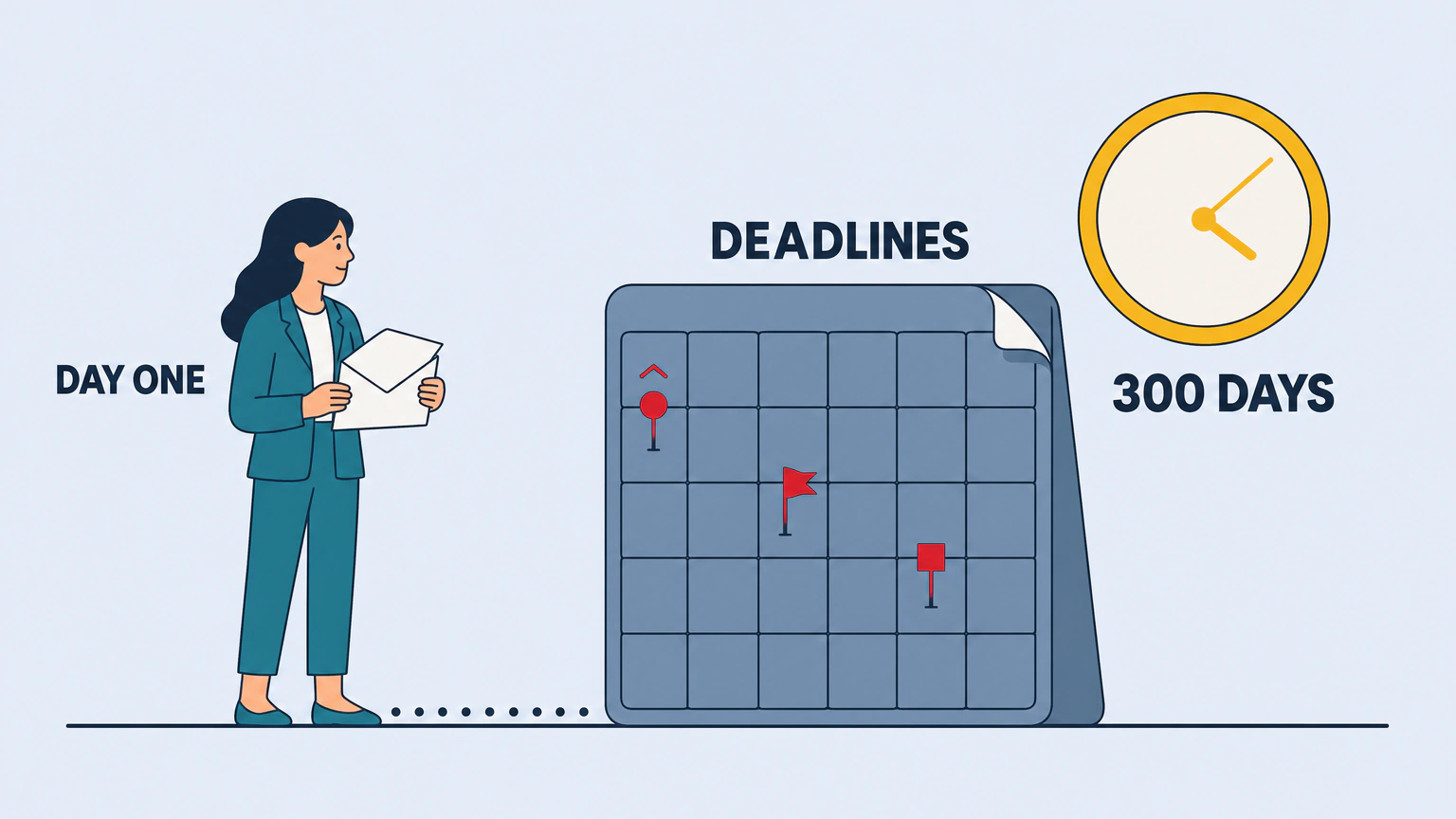
So find the shortest clock that applies to you and work from that one. Don't assume the others can wait.
And if you think you're already too late, stay with us. Many race claims against private employers under Section 1981, the ones the 1991 amendment made possible, run four years, with no charge and no agency in the way.
On this page
- The short answer: find your shortest clock, not your longest
- Clock 1: the paper in your hand
- Clock 2: 30 days, if this was about safety
- Clock 3: the EEOC charge, 180 days or 300
- Clock 4: 90 days from the right-to-sue notice
- Clock 5: the claims that never touch the EEOC
- Your state's own deadline, verified state by state
- When the clock starts, and the narrow ways it moves
- What to do in the next seven days
- Frequently asked questions
- About this guide
The short answer: find your shortest clock, not your longest
One firing, five different clocks
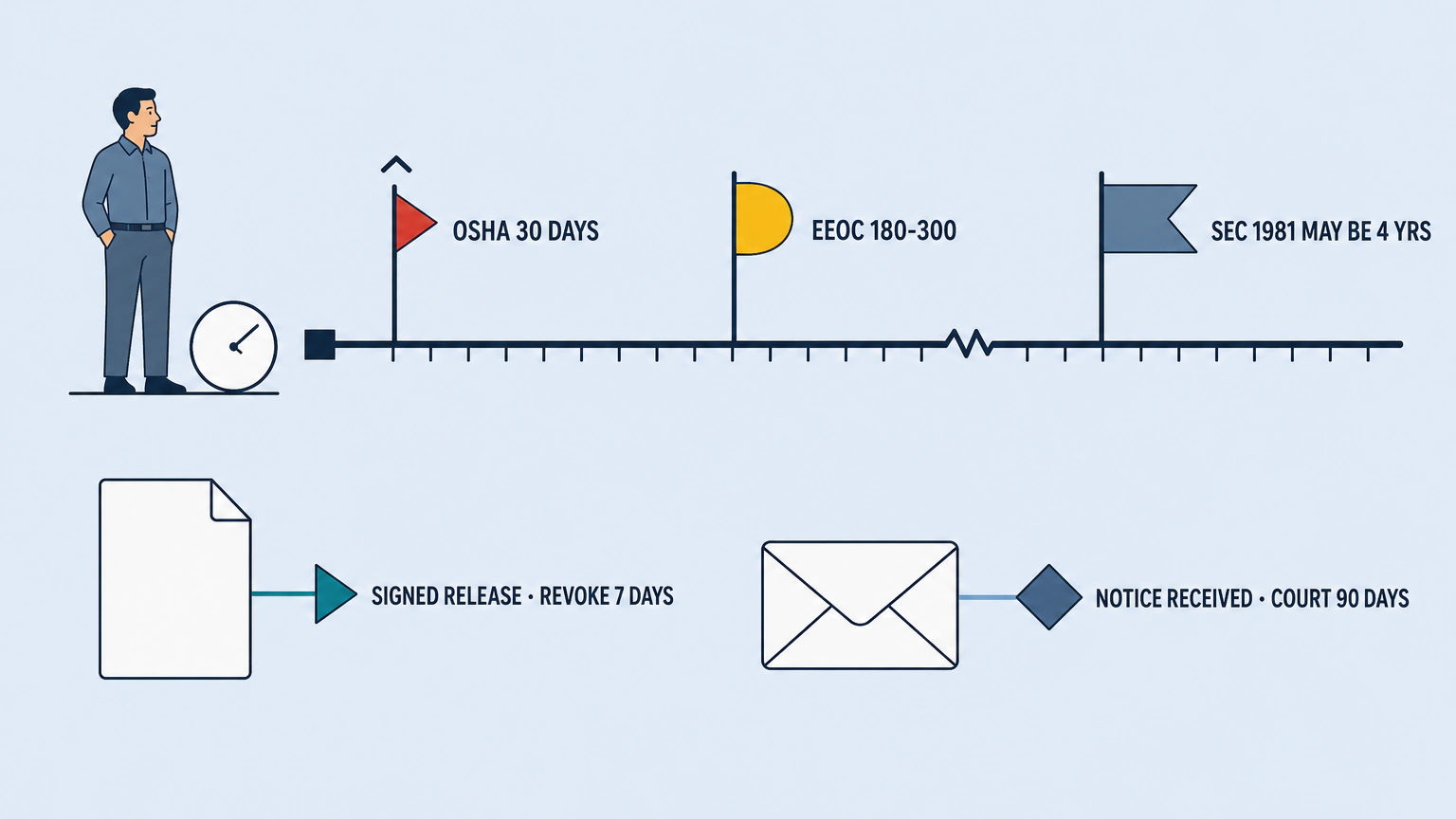
One job loss can set off five separate families of deadline. The paper in your hand. Safety retaliation. The EEOC charge. The lawsuit that follows the notice. And the claims that skip the EEOC altogether. They don't all start on the same day, and they don't help each other out: overlapping clocks run independently, so missing one never buys you time on another.
| Clock | How long | Where you file | EEOC charge first? |
|---|---|---|---|
| Revoke a signed severance release (age 40+) | 7 days after signing | With the employer, in writing | No |
| Consider a severance release (age 40+) | 21 days, or 45 in a group program | n/a | No |
| Safety-related retaliation, OSH Act § 11(c) | 30 days | OSHA | No |
| Discrimination charge (Title VII, ADA, ADEA) | 180 days, or 300 days | EEOC or state agency | This is the charge |
| Federal employee, EEO counselor contact | 45 days | Your agency's EEO office | Different process |
| Lawsuit after right-to-sue notice | 90 days | Federal or state court | Yes, already filed |
| Race claim against a private employer, Section 1981 | 4 years for claims made possible by the 1991 amendment | Court, directly | No |
| Unpaid minimum wages or overtime, FLSA | 2 years, 3 if willful | Court or DOL | No |
| Equal Pay Act | 2 years, 3 if willful | Court, directly | No |
Why "one to three years" is the most dangerous sentence you will read
Somebody will tell you that your state gives you a year, or two, or three, to bring a wrongful termination claim. That number can be perfectly real and still have nothing to do with your federal charge deadline.
Title VII, ADA and ADEA claims generally require an administrative charge before you can sue, and that charge deadline can land months earlier. File on day 200 where the 180-day limit applies and the federal claim may already be untimely, comfortably inside the state-law number somebody quoted you. Wrongful termination attorneys work with both clocks.
Clock 1: the paper in your hand
21 days to consider, 7 days to change your mind
If you're 40 or older and the company wants you to release age claims, federal law sets floors it cannot lower. You have to be advised in writing to talk to an attorney. You get at least 21 days to consider the agreement. And you get at least 7 days after signing to revoke it, a week during which the release isn't enforceable.
That revocation week is the shortest clock of the lot, and the only one that undoes a signature you already regret.
45 days if you were part of a group
If the offer arrives with an exit incentive or a group termination program, the consideration period is at least 45 days rather than 21.
A group offer also carries a disclosure almost nobody reads. The employer has to set out in writing the covered class, the eligibility factors and the time limits, the job titles and ages of everyone eligible or selected, and the ages of everyone in the same job classification or organizational unit who was not eligible or selected. Read it anyway.
What signing does and does not close
A release can close your right to money. It cannot close the door to the agency. Under 29 U.S.C. § 626(f)(4), no waiver can be used to justify interfering with your right to file a charge or take part in an EEOC investigation.
What a particular release does close is a question for a lawyer who has read it.
Clock 2: 30 days, if this was about safety
Section 11(c) and why 30 days is real
If you believe you were fired, demoted or disciplined because you exercised a right protected by the OSH Act, your complaint goes to OSHA, and 29 U.S.C. § 660(c)(2) gives you thirty days after the violation occurs to file it.
Thirty days.
Not thirty business days, and not thirty days from the afternoon you finally found a lawyer.
The other whistleblower laws run 30 to 180 days
OSHA administers more than twenty whistleblower statutes, covering trucking, aviation, rail, nuclear, food safety and financial reporting. By its own guidance those deadlines run anywhere from 30 days to 180 days depending on the law, and each one starts when the retaliation occurs.
Your deadline follows the statute that fits what happened, not your job title. OSHA publishes the deadline for each of them.
Clock 3: the EEOC charge, 180 days or 300
What actually decides which number is yours
The baseline is 180 days from the day the discrimination took place. You get 300 days only where a state or local agency enforces a law against employment discrimination on the same basis as your claim.
A state civil rights agency is not enough on its own. Its law has to cover what happened to you. So a state that bars race discrimination but says nothing about sexual orientation gives you 300 days on one claim and 180 on the other, out of the same firing. Discrimination lawyers or an EEOC field office can settle which one is yours.
The "whichever is earlier" trap
The charge-deadline sentence has a tail that hardly anyone quotes. A charge must be filed within three hundred days after the practice occurred, "or within thirty days after receiving notice that the State or local agency has terminated the proceedings under the State or local law, whichever is earlier."
Read that twice. If the state or local agency ends its proceedings before your charge has actually been filed with the EEOC, that thirty-day cutoff can land long before day 300.
Which is why you should never assume a state or local filing was automatically dual-filed. Confirm that the federal charge was really filed, rather than trusting the 300-day outer limit.
Age claims follow a narrower rule
Age discrimination gets the stingier version of the extension. The EEOC's position is that you reach 300 days only if a state law prohibits age discrimination in employment and a state agency enforces it. A city ordinance on its own does not do it, and the ADEA carries the same 30-day cutoff when a state or local agency ends its proceedings first.
City ordinance, no state statute? Assume 180 days.
Federal employees: 45 days, and it is already running
Federal employees and applicants run a different process, and it starts fast. Instead of a charge, you generally have to contact an EEO counselor at your own agency within 45 days of the discriminatory action.
Clock 4: 90 days from the right-to-sue notice
The deadline that quietly ends the most cases
Your Notice of Right to Sue arrives when the EEOC closes its investigation, or when it grants your request for one. After 180 days the agency must issue the notice if you ask for it. Before that, it issues one only when it expects not to finish within 180 days.
Once you receive it, 42 U.S.C. § 2000e-5(f)(1) gives you ninety days to file a civil action, and the EEOC's own wording is blunt: this deadline is set by law.
Ninety days is short, hard and independent of every other clock. Three months to find a lawyer, get the case evaluated and file a complaint in court.
Spend the first weeks deciding whether to go through with it at all and the window is already closing.
When you do not need a notice at all
Two exceptions matter here. An age discrimination suit needs a charge on file but no right-to-sue notice at all: you can sue any time after 60 days from filing the charge, and no later than 90 days after notice that the investigation concluded. An Equal Pay Act claim needs neither.
Clock 5: the claims that never touch the EEOC
Section 1981: four years for many private-employer race claims
Read this one if you think you're out of time and your employer is a private company. Section 1981 protects the equal right to "make and enforce contracts" without respect to race, and individuals enforce it themselves. No charge. No notice. No agency.
The window is longer, too. Claims made possible by the 1991 amendment, which extended the section to conduct after a contract was formed (a discriminatory firing, a demotion, racial harassment on the job), fall under 28 U.S.C. § 1658(a): an action arising under a statute enacted after December 1, 1990 "may not be commenced later than 4 years after the cause of action accrues."
What it reaches is intentional race discrimination, including discrimination based on ancestry or ethnic characteristics. Not sex, not age, not disability, not religion. For some private-sector readers who missed an EEOC deadline on a race claim, it can still preserve a route to court.
Unpaid wages: two years, three if it was willful
Unpaid minimum wages and unpaid overtime run on a clock of their own under the FLSA. Other final-paycheck or deduction disputes may instead be state-law claims, which is a different question entirely.
The FLSA action may be commenced within two years after the cause of action accrued, or three years if the violation was willful. Nothing about that clock is touched by the EEOC charge deadlines.
Equal pay: two or three years, and the clock resets with each paycheck
An Equal Pay Act claim goes straight to court. Nothing has to be filed with the EEOC first.
The EEOC puts the deadline at two years from the day you received the last discriminatory paycheck, three if the discrimination was willful. And each underpaid check is a fresh violation, which is why a pay gap that has been running for years can still be actionable today.
Your state may let you go straight to court
Some states make you file with their own civil rights agency before you can sue. Others let you walk into court. Either way, the state clock and the federal clock can start on different events, and satisfying one of them does nothing for the other.
Your state's own deadline, verified state by state
We read all eleven of these at the state's own code, or at an archived capture of it, rather than off somebody else's article. Each of these deadlines is the time you have to bring a complaint to the state agency under state law. It does not replace the federal deadline, and it does not extend it.
| State | State agency | Deadline to file with the state agency | Statute |
|---|---|---|---|
| California | Civil Rights Department | 3 years | Cal. Gov. Code § 12960(e)(5) |
| Florida | Commission on Human Relations | 365 days | Fla. Stat. § 760.11(1) |
| Maryland | Commission on Civil Rights | 300 days for employment discrimination other than harassment; 2 years for harassment | Md. Code, State Gov't § 20-1004(c)(2), (c)(3) |
| Massachusetts | MCAD | 300 days | M.G.L. c. 151B, § 5 |
| Minnesota | Department of Human Rights | 1 year | Minn. Stat. § 363A.28, subd. 3 |
| Missouri | Commission on Human Rights | 180 days | Mo. Rev. Stat. § 213.075 |
| New York | Division of Human Rights | 3 years | N.Y. Exec. Law § 297(5) |
| Ohio | Civil Rights Commission | 2 years | Ohio Rev. Code § 4112.051(C)(2) |
| Oregon | Bureau of Labor and Industries | 5 years for complaints under the employment statutes listed in subsection (3) | ORS 659A.820(3) |
| Texas | TWC Civil Rights Division | 180 days, but 300 days for sexual harassment | Tex. Lab. Code § 21.202(a), (a-1) |
| Washington | State Human Rights Commission | 6 months | RCW 49.60.230 |
Four states need a word more. Ohio runs two two-year clocks rather than one: the charge with the commission, and a separate civil action under § 4112.052(C)(1) that is tolled while your charge is pending. Minnesota's year stops running while you and the employer are voluntarily in dispute resolution. Maryland's widely quoted six months is only the statute's default, not the employment rule. Oregon's widely quoted one year is a default too, and complaints alleging the employment practices the statute enumerates get five years instead.
If your state is not in this table
We read eleven states at the source. The other thirty-nine we did not, and a guessed limitations period would be worse than an admitted gap. Illinois, Pennsylvania and New Jersey are missing for a specific reason: we could not open their statutes at a primary source, and a date this consequential is not worth copying off somebody's secondary page.
So do it yourself. Search your state's name plus "civil rights commission" or "human rights commission", open the .gov result, and find the page headed "file a complaint".
Until somebody confirms your number, assume the 180-day federal window is yours. That is the safe direction to be wrong in.
When the clock starts, and the narrow ways it moves
The trigger is the decision, not the last paycheck
The EEOC counts from the day the discrimination took place. For a firing, that is normally the day you were told.
Not the day a notice period ended. Not your last day in the building. Not the date on your final check. And separate events count separately, so a demotion a year before the firing had its own 180 or 300 days, long expired by the time you cleared your desk.
Harassment is measured from the last incident
Harassment is the recognized exception. The EEOC's guidance is that you file within 180 or 300 days of the last incident of harassment, and that it will consider the earlier incidents too, even ones that fall outside the window.
That is why workplace harassment lawyers ask for a timeline rather than a termination date. Write yours out while you still remember the order things happened in.
Tolling exists, and you must never plan around it
Tolling doctrines are real, and the rules differ by state and by statute. California, for one, allows a 90-day extension where the person first learned the facts in the 90 days after the deadline expired.
None of it is a plan. Tolling gets argued after the fact, against an employer whose entire defense is that you were late.
Do not spend a deadline hoping for it.
Red flag: the four mistakes that end good cases.
Waiting for HR's internal investigation to finish. The company's process generally does not pause the EEOC charge deadline. File your charge while it runs.
Waiting for the EEOC to "get back to you" after the right-to-sue notice arrives. That notice is the EEOC's goodbye, not a status update. Your 90 days started the day you received it.
Assuming your state's multi-year limitations period is your deadline. The federal charge requirement usually bites months earlier. Work from the shorter number.
Assuming a court will make an exception because the firing was obviously unfair. Courts enforce these periods strictly. Being right is not the same thing as being on time.
What to do in the next seven days
- Write down the date you were told, not the date your pay ended. That is usually day one for a discriminatory-termination charge, but the severance-revocation and right-to-sue clocks have later triggers.
- If you were handed a severance agreement, find the signature deadline on it and put that date in your calendar today, with the revocation window if you have signed.
- If you suspect retaliation for activity protected by the OSH Act, treat 30 days as the deadline and act this week; other OSHA-administered whistleblower laws run from 30 to 180 days.
- Assume the 180-day federal window applies until you confirm your state has an agency covering your claim on the same basis.
- Save every document you have: offer letter, handbook, reviews, the termination letter and any messages about the decision. Store them somewhere that is not a work account.
- Do not sign a release, cash a severance check or agree to a "mutual separation" before you know what it closes.
- If any clock here is under 60 days for you, talk to an employment lawyer now, not after more research.
On cost, our own panel for employment and labor lawyers puts the national average at $561, with a typical range of $408 to $714 and an average hourly figure of $306. Those are our own cost profiles rather than a survey of the market, and the same profile count turns up on categories that have nothing to do with employment law, so treat the figures as an anchor and ask each firm how it charges. Then spend two minutes to check that the lawyer is licensed, and if an attorney is already sitting on your limitations date, read about switching lawyers mid-case.
Frequently asked questions
What happens if I miss the deadline to sue my employer?
Usually the claim is barred and the employer moves to dismiss on exactly that ground. But one dead clock does not necessarily kill the rest. A blown EEOC deadline can still leave a Section 1981 race claim against a private employer, an FLSA minimum-wage or overtime claim, or a state-law route alive. Find out which of those survives before you decide it's over.
Do I have to go through the EEOC before I can sue?
For Title VII, ADA and ADEA claims, yes. You file a charge first, and for Title VII and ADA you also need the right-to-sue notice before a court will hear you. Three claims skip the EEOC entirely: an Equal Pay Act claim, a Section 1981 race claim against a private employer, and an FLSA minimum-wage or overtime claim.
Is the deadline 180 days or 300 days in my state?
It is 300 days only if a state or local agency enforces a law prohibiting employment discrimination on the same basis as your claim. Otherwise it's 180. That turns on the kind of discrimination, not just on your address, so one state can give you the longer window for one claim and the shorter one for another. Age claims are stricter still: a local ordinance is not enough, and the state itself has to enforce.
How long do I have to file a lawsuit after I get a right-to-sue letter?
Ninety days from the day you receive the notice, under 42 U.S.C. § 2000e-5(f)(1). The EEOC describes that deadline as set by law, and courts enforce it strictly. Treat the day the envelope arrives as day one and start calling firms that week.
Does signing a severance agreement stop me from filing an EEOC charge?
No. A release can waive your right to money, but no waiver can be used to justify interfering with your right to file a charge or take part in an EEOC investigation. That is the statute talking, not us. What a particular agreement does close is a question for a lawyer who has read it.
When exactly does the clock start — the day I was told, or my last day of work?
For a discriminatory termination charge, generally the day the decision was made and communicated to you. The EEOC counts from the day the discrimination took place, not from the end of a notice period. An ongoing hostile-work-environment claim works differently, and is measured from the last incident of harassment.
Do I need a lawyer to file an EEOC charge?
No. You can file a charge yourself, online, in person at a field office or by mail, and it costs nothing. A lawyer is still worth the call if your deadline is close, if somebody handed you a severance agreement, or if more than one of these clocks applies to you.
About this guide
We are not your lawyer, and this is general information about the deadlines that follow a job loss rather than advice about your own situation. Your real deadline can be shorter than it looks, because of a notice from a state agency or a term in your contract that we cannot see from here, and states do amend these periods. Before you rely on any date, have the agency or an attorney confirm the one that belongs to you. Then put it in front of you and work backwards.