

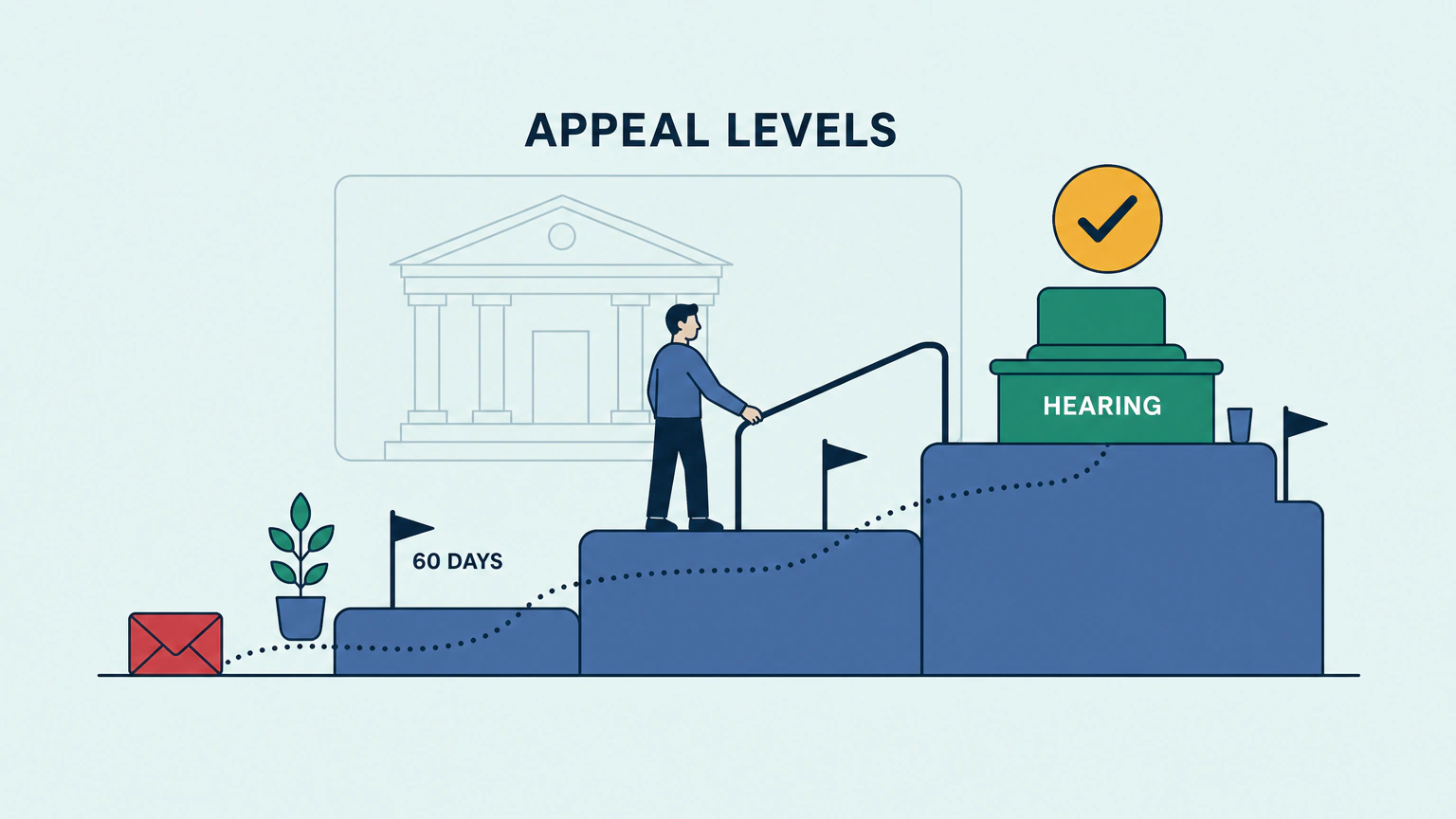
If Social Security denied a new SSDI claim, appeal in writing within 60 days after the letter reached you. Social Security usually assumes that was five days after the notice date. If the letter says current payments will stop after a medical review, ask for reconsideration and continued payments within 10 days after receipt. The first step on a new claim, reconsideration, allows about one claim in eight. Get past it to a judge, and the decision goes the claimant's way more than half the time.
That leaves four things to sort out: how Social Security actually counts the deadline, what each level of appeal is worth in the agency's own numbers, whether to appeal or start over, and what help costs before anybody asks you for money.
We're not your lawyer, and this is general information rather than advice about your own claim. An appeal is worth an hour with someone who does them for a living.
On this page
- Read the letter for one thing first
- The 60 day clock and the five day receipt rule
- What each level of appeal is actually worth
- How long the wait really runs
- Appeal, or start over? The 17 month arithmetic
- What a representative costs, and when you actually pay
- Frequently asked questions
- One thing to do today
Read the letter for one thing first
Before the deadline, before the odds, one question decides what you do next. Did anyone actually look at your medical evidence? The answer is sitting in the reason your letter gives, and it splits every denial into two very different problems.
| What the letter says | What it means | Does appealing help? |
|---|---|---|
| Your condition is not severe | A medical decision was made and went against you | Yes, and new medical evidence is the lever |
| Your condition is not expected to last 12 months | A medical decision about duration | Yes, especially if the condition has since persisted or worsened |
| You can do the work you used to do, or other work | A medical and vocational decision | Yes, and this is where a representative earns their fee |
| You do not have enough recent work credits | A technical denial; nobody assessed your medical condition | Not on the medicine. Check the earnings record on the notice first |
| We did not have enough medical evidence, or you did not respond | The file did not support a favorable decision | Yes, and more complete evidence may help |
A medical denial means someone looked at your condition
Your file went to a state agency called disability determination services, where an examiner read it and reached one of Social Security's own conclusions. Your impairment isn't severe enough. It isn't expected to last twelve months. You can still do the work you used to do, or some other work that exists in the economy.
That is a judgment about your body and your job history, and a judgment is exactly what an appeal is built to challenge. New and relevant evidence can strengthen the appeal. That may include a hospital stay, a specialist's findings or a treatment that failed.
A technical denial means nobody did
The other kind never reaches your medicine at all. Social Security counts technical denials in a separate column from medical decisions, and the usual reason is work credits. You haven't worked recently enough, or long enough, to be insured for disability on the date you say it began.
The numbers are bigger than most people expect. Of the 2,013,669 disability applications filed in 2020, 716,672 were technical denials. If that's your letter, sending in more doctor's notes answers a question nobody asked. Read the earnings record on the notice instead, and check it against the jobs you actually held. Missing wages happen, and they're fixable.
The 60 day clock and the five day receipt rule
Every page you read will tell you that you have 60 days. That is true, but Social Security usually presumes you received the notice five days after its date.
Sixty days from the day it reaches you, not the day it was written
The regulation gives you 60 days to ask for reconsideration, counted "after the date you receive notice." Then Social Security defines that phrase for itself: "Date you receive notice means 5 days after the date on the notice, unless you show us that you did not receive it within the 5-day period" (20 CFR 404.901).
So Social Security usually treats the working deadline as 65 days from the date printed on the letter. The hearing and Appeals Council requests use the same receipt rule.
Don't spend those five days, though. File in the first two weeks if you can, online or on form SSA-561-U2. You want the date stamped well before the last week of the window.
If you are already late, say why
Late isn't automatically over. Social Security can accept a late request for good cause, and the rule spells out what it considers: what kept you from filing on time, whether the agency's own action misled you, and whether you understood what was required. Physical, mental, educational or linguistic limitations count too.
Read it with your own months in mind. Hospitalization, a move, a death in the family, a notice sent to an old address, a condition that makes paperwork genuinely hard: these are the facts the rule asks about.
Don't call to ask permission first. File the appeal and the explanation together, in one envelope or one online submission, and let the agency rule on both at once.
Before you file, put your hands on these five things:
- The appeal request itself, filed online or on form SSA-561-U2, sent before day 60 rather than on it
- The date printed on your denial letter, written down somewhere you can find it again
- Every treatment record created since you applied, including anything from the weeks after the decision
- The name, address and phone number of every doctor, clinic and therapist who has treated you
- A short written note of anything that has become harder since you applied, in your own words
What each level of appeal is actually worth
The four levels share one deadline and almost nothing else, because the odds at each one are wildly different.
| Level | Deadline to ask for it | Who decides | Allowance rate, 2020 claims | What SSA calls the outcome |
|---|---|---|---|---|
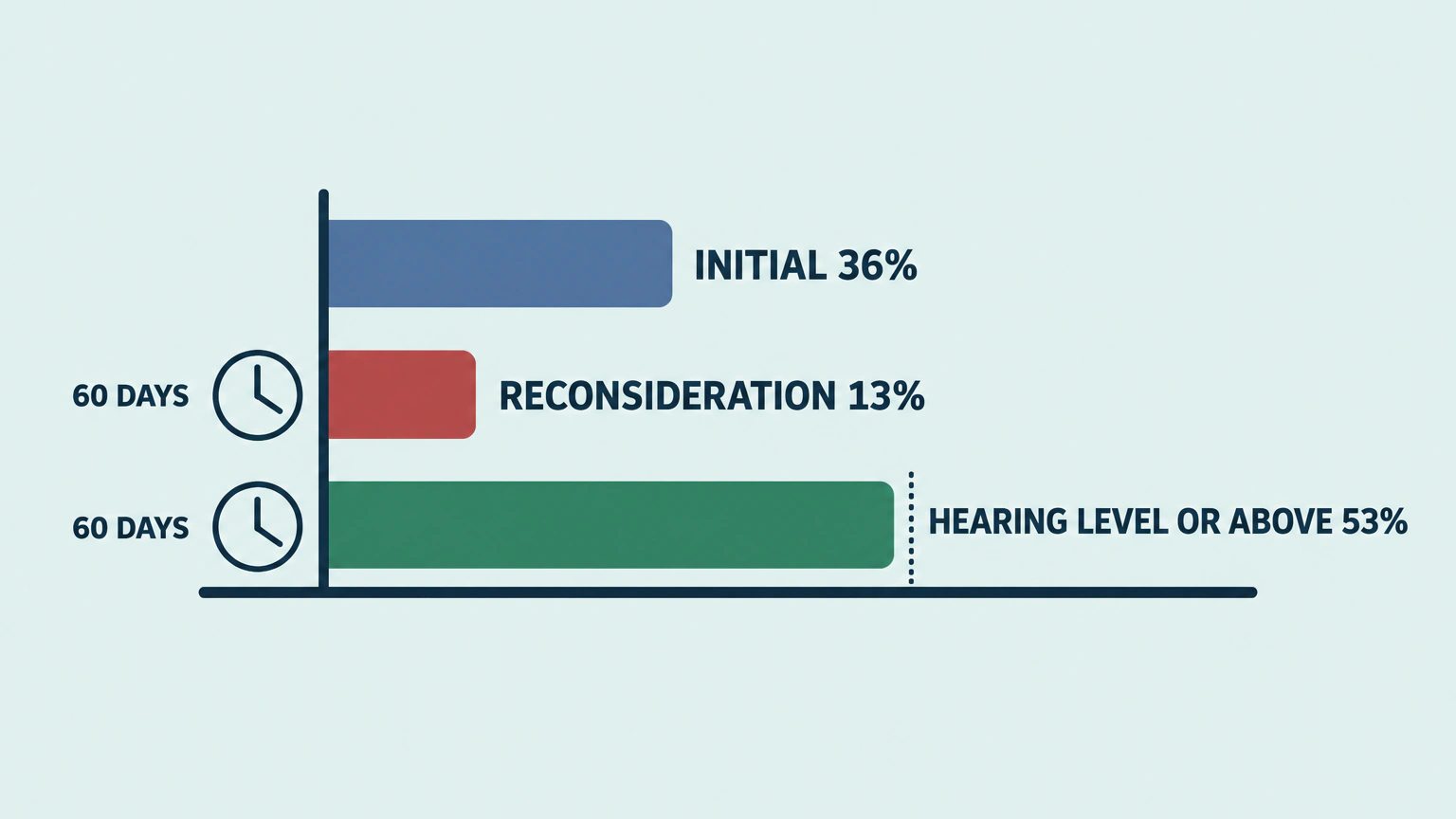
| Initial claim | This is the decision you just got | A disability determination services examiner in your state | 35.9% | Initial determination |
| Reconsideration | 60 days from receipt | A different examiner at the same state agency | 12.9% | Reconsidered determination |
| Hearing | 60 days from receipt | An administrative law judge | 53.1%, for the hearing level and above combined | Decision |
| Appeals Council | 60 days from receipt | The Appeals Council | Counted in the 53.1% above | Review of the hearing decision |
| Federal district court | 60 days from receipt | A United States district judge | Counted in the 53.1% above | Civil action |
Allowance rates are Social Security's own, for claims filed in 2020, and count allowances as a share of the medical decisions made at that level.
Reconsideration allows about one claim in eight
Reconsideration sends your file back to the state agency for another review. For claims filed in 2020, that step produced 54,491 allowances out of 423,344 decisions. That is 12.9 percent, and it is the low point of the published ladder.
Here is the honest part. You normally still have to do it because it is the gate to the judge. And one in eight is not nothing when the alternative is stopping altogether.
Treat it as an early place to strengthen your file. Add relevant records as soon as you can, because later hearing evidence has its own deadline.
A judge says yes more than half the time
This is where the published disability ladder turns. For 2020 claims, the hearing level and above allowed 147,342 of 277,549 medical decisions, or 53.1 percent. Social Security's live fiscal 2026 hearings file gives broader context across all OHO cases. Judges awarded 167,024 of the 289,447 cases they decided, or 57.7 percent. That figure is our arithmetic on the agency's raw file, not a disability-only rate Social Security publishes.
Two things change at this level. A person hears you speak, in your own words, about what a day is like. Vocational and medical experts may also be questioned. Tell the judge about written evidence or submit it no later than five business days before the hearing. Some late evidence qualifies for an exception.
One in six hearing-level dispositions was a dismissal
The same fiscal 2026 file shows 347,357 dispositions and 289,447 decisions. The other 57,910, or 16.7 percent of dispositions, were dismissals. Those cases ended without a decision on the claim's merits.
A judge can dismiss when the request is withdrawn. A judge can also dismiss when neither you nor your representative shows up, and you don't give a good reason within ten days of being asked why.
So the protective advice is duller than it sounds, and it matters more. Open the mail. Answer the notices. Show up, or tell them promptly why you couldn't.
How long the wait really runs
Ask how long a disability appeal takes and you will be told it depends on where you live. Social Security publishes the answer for its reporting hearing sites, and their spread is fairly narrow.
Eight months was the median at reporting sites
For cases closed in July 2026 where a hearing was held, the agency reported an average wait from request to hearing. Leave out the Special Review Cadre, and the remaining 158 reporting sites land between 7.0 and 10.0 months.
The median is 8.0. Of those 158 offices, 149 fall between seven and nine months, which is 94 percent. Six sit at the top of the range at 10.0 months: New York, Queens, Baltimore, both Phoenix offices and Fresno.
That is a three-month spread across the reporting sites. Plan on roughly eight months, a little more at those six offices, and stop refreshing the mailbox in month two.
What the wait costs you, and what it does not
On a successful new application, payable benefits may build during the wait. The amount still depends on the established onset date, application date, waiting period and other entitlement rules.
What the wait costs is cash flow right now, and that's the real reason people quit.
Three things are worth doing with those months. Keep treating when you can, and explain any gap in care. Keep the file current within the evidence deadline above. And keep your address and phone number updated with Social Security, since a missed notice can end a case.
One number will look worse than the wait itself. In the same fiscal 2026 workload file, average processing time at the hearing level was 267 days, weighted by cases closed. That measure runs to the closing of the case, not to the day you walk into the hearing room.
Appeal, or start over? The 17 month arithmetic
The temptation to start fresh is reasonable. A new application may feel cleaner than a reconsideration that allows one claim in eight, but it also creates a new filing date.
The fresh start has a real cost, and it's arithmetic rather than opinion.
Two rules can limit how far back Title II benefits reach. Retroactive benefits usually reach no further than 12 months before the application month. Most disabled workers also face a five-month waiting period. That wait does not apply to applicants with ALS or to some people who became disabled again within five years of earlier entitlement. When both limits apply, the waiting period can start no earlier than the 17th month before the application month.
An appeal continues the same application, so it keeps that date. A new application starts a new one and drags both windows forward by however long you've been waiting.
Work it once. Say you applied in January and are nine months into an appeal. Keeping the appeal preserves the January filing date. Starting over in October moves the 12-month retroactivity boundary forward by nine months. Actual payable benefits still depend on onset and entitlement rules.
Some cases run the other way. A new application may make sense if later work changed your insured status or a new condition began after the first decision. Raise the timing and onset questions before choosing.
Another payment can shrink the check. Social Security may cut SSDI when you also receive workers' compensation. Its formula protects the higher of 80 percent of average current earnings or the prior disability benefits paid to you and your family. If your claim began with a workplace injury, workers' compensation lawyers and your SSDI representative should talk to each other.
Take both options to a representative before you choose either. This decision is hard to undo.
What a representative costs, and when you actually pay
Most people put off this conversation because they assume they can't afford it. The fee rules are more protective than their reputation suggests, and the parts that aren't are worth knowing before somebody sells you on them.
The fee is capped twice over
Under a fee agreement, Social Security approves no more than 25 percent of your past-due benefits or the Commissioner's dollar cap, whichever is less. Past-due benefits are calculated under the program's entitlement rules, not just by counting months the claim was pending. The current cap is $9,200. It took effect November 30, 2024 and a later Federal Register notice kept it there.
Watch one trap in how the number moves. Social Security has said it will publish a notice only when it raises the cap. So there's no annual bump to assume, and a page quoting a different figure may simply be old.
If your representative can be paid directly, Social Security may hold back up to 25 percent of past-due benefits for the approved fee. You may still owe an approved balance that was not withheld.
What free unless you win leaves out
The shorthand is roughly true, and it hides three things.
Expenses aren't the fee. Your representative can charge you for out-of-pocket costs such as medical reports or hospital records without Social Security's approval, and you pay those directly, win or lose.
If the case produces no past-due benefits, or your representative isn't eligible for direct payment, you owe the whole authorized fee yourself. Social Security's own booklet says so plainly.
In most situations, a representative cannot charge or collect a fee without Social Security's written approval. One exception applies when a third party pays from its own funds and you and your family have no liability. Money you provide in advance must stay in a trust or escrow account until approval.
Red flag: four things to watch for when someone offers to take your case. Your money up front with no escrow. If someone asks you to pay before Social Security authorizes a fee, ask where the money will stay. Get written confirmation that your money stays in trust or escrow until approval. A guaranteed approval. Nobody can guarantee one. Treat the promise as a reason to keep looking. A vague answer about who they are. A representative may be an attorney or a qualified nonattorney, and both are allowed. Refusing to say plainly which one they are is the signal. Extra fees stacked on top. A separate filing fee, processing fee or administration fee sitting alongside the approved fee deserves a direct question: what exactly does this buy? Get the answer in writing.
When to bring someone in
If you're going to hire anyone, do it before the hearing request rather than after. That's where the record gets built, and where the odds change most. Waiting for the hearing notice hands your representative a file they had no part in building.
You can appoint an attorney or a qualified nonattorney, on form SSA-1696. Every Social Security office keeps a list of organizations that help people find representation or provide free legal services. When you're ready to compare, start with disability attorneys in your state, and see how we pick the firms we list rather than taking a badge on trust.
Two minutes of homework is worth it before you sign. If you choose a lawyer, check that the lawyer is licensed and in good standing. If you choose a nonattorney, ask about their qualifications. If the relationship goes wrong, you can change representatives.
Frequently asked questions
How long do you have to appeal a denied SSDI application?
For a denied SSDI application, you usually have 60 days from the day the notice reached you. Social Security usually presumes receipt five days after the notice date. The same receipt rule runs through reconsideration, hearing, Appeals Council and federal court. File early anyway.
Do most disability claims get denied the first time?
Yes. For applications filed in 2020, Social Security allowed 35.9 percent of the medical decisions it made at the initial level, so roughly two in three went against the claimant. Separately, 716,672 of those 2,013,669 applications were denied for nonmedical reasons before anyone reviewed the medical evidence at all.
What are the chances of winning a disability hearing?
Better than at any earlier step in Social Security's 2020 disability tables. The hearing level and above allowed 53.1 percent of medical decisions. For broader context, the fiscal 2026 OHO file shows judges awarded 167,024 of 289,447 decisions across all case types, or 57.7 percent.
Should you appeal, or file a new application?
An appeal usually protects the original application date. For Title II claims, retroactive benefits can reach up to 12 months before the application month. Most claimants also face a five-month waiting period, but exceptions apply. A new application usually moves the filing-date boundary forward.
How much does a disability lawyer cost?
Under a fee agreement, the cap is 25 percent of past-due benefits or $9,200, whichever is less. In most situations, Social Security must approve the fee before collection. Expenses are separate. If the case brings no past-due benefits, you may owe the authorized fee directly.
How long does it take to get a disability hearing?
About eight months from the request in the July 2026 reporting-site file. After excluding the Special Review Cadre, 158 sites ranged from 7.0 to 10.0 months and the median was 8.0. Average processing time was 267 days.
One thing to do today
Protect the appeal deadline first. Good cause can excuse some late requests, but it is safer not to need it. Evidence has a separate deadline before a hearing, so do not leave the file until the last minute. Then find disability attorneys in your state. If the problem is different, browse every service category.